Surgery · Signature Lifting

Forehead Reduction

Bringing the hairline down, not the brow up

Apgujeong, Seoul | Board-certified plastic surgeon, Dr. Jonghwan Choi
Hairline advancement with Endotine fixation · Full HD endoscopic dissection · KHIDI-registered for international patients

Forehead Reduction Forehead Reduction Forehead Reduction Forehead Reduction Forehead Reduction 
Define

Forehead reduction surgery

What does forehead reduction surgery move, and in which direction?

The operation in one paragraph

Forehead reduction shortens a forehead by bringing the hairline forward. Rewind describes it as moving a measured portion of the scalp in front of the hairline so that a broad forehead is reduced into proportion, and states that the design is drawn against the balance of the whole face and not against forehead length alone. The hairline is opened on a 45-degree oblique line, the scalp is undermined, the surplus forehead skin is removed, and the advanced tissue is held with Endotine while the closure is made. Dissection is carried out under a Full HD endoscope so that nerve and vessel structures are identified as the plane is opened.

Facts on this page come from Rewind's own Korean surgical page for forehead reduction, which supplies the incision angle, the three operative steps, the fixation material and its absorption window, the endoscopic dissection, the dressing period and the durability the clinic records. Two figures are absent from that page and therefore absent here: the anaesthetic used and the length of the operation. Prices come from the clinic's fee schedule and from nowhere else.

The direction is the whole point, and it is where English search results mislead people daily. This operation lowers the hairline and shortens the distance between hairline and brow. A forehead lift does the opposite thing at the other end of the same region: it raises a descended brow and smooths the forehead, and in doing so tends to make the forehead read as longer. Rewind lists both, and lists them combined as one operation for the patients who need both at once.

A second comparison decides almost as many consultations. Hair transplantation moves follicles to add density where hair is thin or absent. Forehead reduction moves the border of hair-bearing scalp that you already have. One is a question about density, the other a question about position, and the examination is where it is settled which one your forehead is asking.

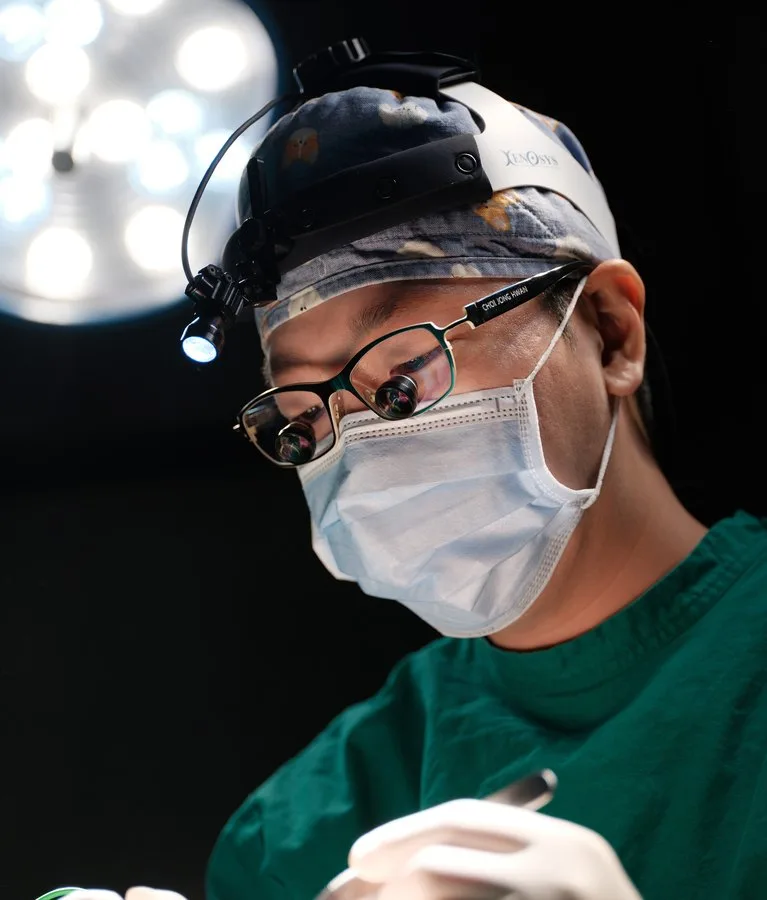
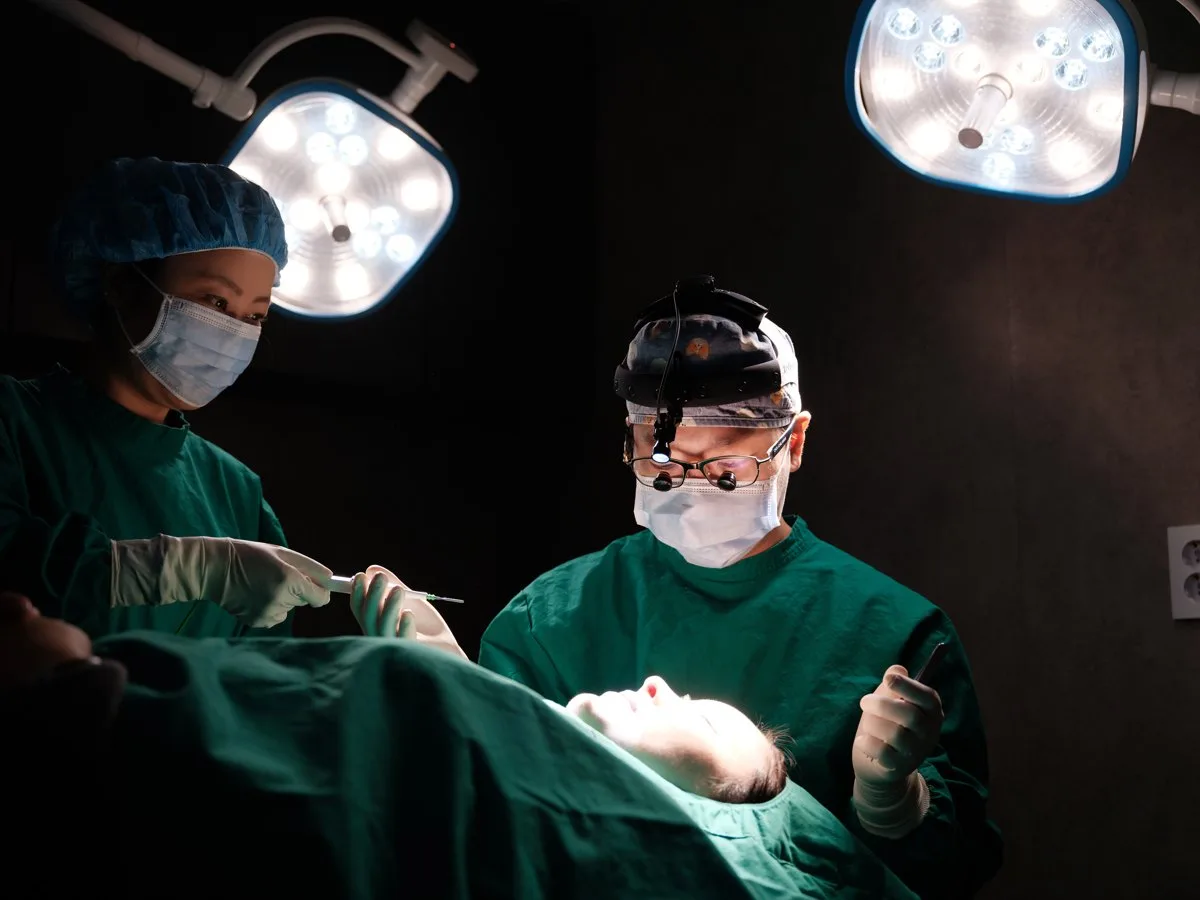
Operating team at work during surgery at Rewind Plastic Surgery
Fig. 01 — One operating surgeon, and the team that stays with the case
Result

Case record

Why the hairline frames here are reserved and still empty

Rewind photographs its own patients inside the clinic and publishes the pairs uncropped, with the caption naming every operation carried out in that session. The upper-face material the clinic holds was shot alongside other procedures done at the same time, so a pair can only appear here once it has been traced back to its source, matched to one patient by eye and cleared for release. Until that is finished these frames stay empty; nothing is borrowed from a neighbouring page.

Forehead reduction — case pairs reserved

BEFORE PHOTO
AFTER PHOTO
BEFOREAFTER
case — front
Forehead reduction, awaiting clinic release
Individual results may vary.
BEFORE PHOTO
AFTER PHOTO
BEFOREAFTER
case — hairline close-up
Forehead reduction, awaiting clinic release
Individual results may vary.
BEFORE PHOTO
AFTER PHOTO
BEFOREAFTER
case — with forehead lift
Forehead reduction, awaiting clinic release
Individual results may vary.
BEFORE PHOTO
AFTER PHOTO
BEFOREAFTER
case — scar at the line
Forehead reduction, awaiting clinic release
Individual results may vary.

When these pairs are released they will be Rewind's own patients, photographed by the clinic under one lighting set-up, shown uncropped and unretouched, published only with the patient's consent and captioned with every operation performed in the same session. Individual results may vary, and no photograph predicts what your own proportions would do. Surgery at the hairline can be followed by bleeding, infection, a scar that widens or stays visible, numbness of the scalp behind the incision, temporary shedding of hair near the line, asymmetry and a result that leads to a revision. An examination with the surgeon comes before any decision.

Measure

What changes, what does not

Which measurements does forehead reduction change, and which stay where they are?

A forehead is read as a fraction of a face, and the number on its own says very little. That is why Rewind writes that the line is designed against overall facial balance, with length only one input into it. Three of the four columns below move during this operation. The fourth is the reason a second listing exists.

measure 01
Hairline to brow
The distance this operation exists to shorten. It moves because the border of hair-bearing scalp is advanced onto forehead skin that is then removed, so the change is visible from the day the dressing comes off, with nothing to wait out over months.
measure 02
The shape of the hairline itself
Advancing the border is also an opportunity to redraw it. Rewind describes designing the line to suit the face, and not simply pulling the existing shape forward, and the direction in which hair grows out of that border is what decides where the resulting scar can hide.
measure 03
The proportion of the whole face
The clinic's stated aim is the ratio between the upper, middle and lower thirds, not the forehead in isolation. A face that reads as long or as large frequently traces back to one third being out of step with the other two, and this is the third that can be altered by moving a border.
boundary 04
Brow position and forehead lines
Neither belongs to this operation. A descended brow, heavy upper lids and deep horizontal lines are what the clinic's separate forehead lift is written for, and the two are listed together as one combined operation when the examination finds both.
Steps

In sequence

How the hairline is advanced, and what holds it in its new position

Rewind publishes three operative steps for forehead reduction, along with the instrument used to open the plane and the device used to hold the result. Read together they answer the two questions that decide whether this operation is worth having: where the scar goes, and what stops the advanced scalp from drifting back.

01Design

The new forehead line is measured before anything is opened

The clinic's first step is reading the proportion and marking where the line will sit. How far the border can travel is limited by how much the scalp behind it will stretch, and that is assessed on you, never assumed from an average, so the number you are quoted is the number your own scalp allows.

02Incise

The hairline is opened on a 45-degree oblique line

Rewind specifies the angle. Cutting obliquely across the hair-bearing border, instead of straight down through it, is the technique the published series on anterior hairline surgery use, because hair can then grow up through the healed line and break its outline. The clinic designs the line with the direction of hair growth in mind for the same reason.

03Advance

The scalp is undermined and the surplus forehead skin removed

The second published step. Freeing the scalp is what allows the border to move forward at all; the strip of forehead skin left over once it has moved is excised. This is why the change is immediate and why the limit on it is anatomical, set by tissue and not by how much was requested.

04Fix

Endotine holds the advanced tissue while the closure is made

The third step. Rewind states that Endotine is approved by the Korean drug authority and by the US Food and Drug Administration as a material for forehead reduction, and that it is absorbed by the body over roughly nine months. Fixation is what carries the tension off the skin edge during the period the scar is deciding how it will look.

05See

Dissection is carried out under a Full HD endoscope

The clinic uses endoscopic vision to identify nerve and vessel structures accurately as the plane is opened. The sensory nerves to the scalp emerge at the brow and run back through exactly the territory being undermined, which is the practical reason for working under vision.

06Unstated

Two figures this page will not estimate

Which anaesthetic is used for this operation, and how long it takes in theatre. Rewind's surgical page records neither, and neither is inferred here from its other procedures. Both are confirmed by the surgeon at the examination, together with when sutures come out.

Surgery under magnification in the operating room at Rewind Plastic Surgery
Fig. 02 — The plane is opened under vision, not by feel
Rewind

Why here

Why the direction of an upper-face operation is settled before the technique

Two operations at this clinic work on the same handspan of tissue and pull it opposite ways. Choosing between them is not a matter of taste, and getting it wrong is not a small error, because a brow raised on a forehead that was already too long produces exactly the proportion the patient came in to escape.

01Direction

Lowering a border and raising a brow are separate findings

A long forehead with a brow sitting where it belongs calls for the hairline to move. A brow that has descended over tired-looking lids calls for a lift. Both can be true at once, and the clinic carries a combined listing for that case. The literature below includes a Korean series on performing hairline lowering during endoscopic forehead lifting, which is the published form of the same decision.

02Scope

Reduction, lift and the combination are quoted as three separate lines

Nothing is bundled into anything else by default at Rewind. The reduction has its own line, the endoscopic forehead lift has its own, and the two performed together have a third. That separation is what makes it possible to decline the half of a plan your examination did not call for and still book the half it did.

03Fixation

An absorbable device, with published work behind it

Endotine fixation is shared between the clinic's upper-face operations, and it is the component patients most often ask about because something is being left inside the head. It dissolves over about nine months. Two of the papers listed at the foot of this page report on the same device in endoscopic brow surgery, including its safety profile.

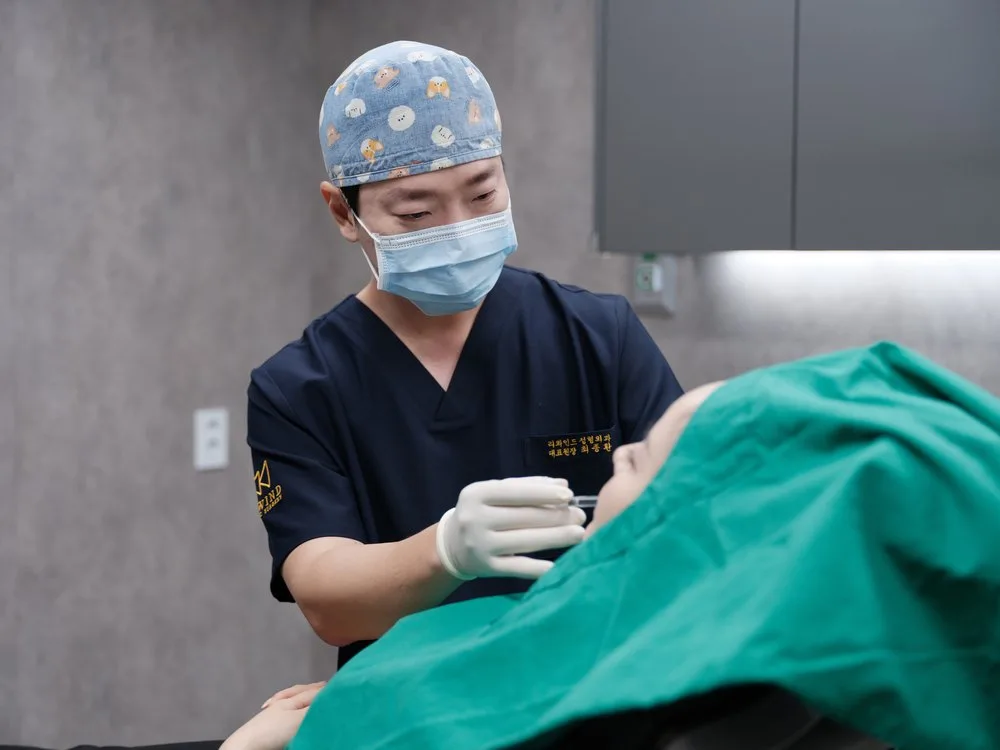
Dr. Jonghwan Choi in consultation with a patient at Rewind Plastic Surgery
Fig. 03 — Which direction the upper face needs is decided at the chair
Theatre

On the day

Where a hairline operation is carried out, and what happens around it

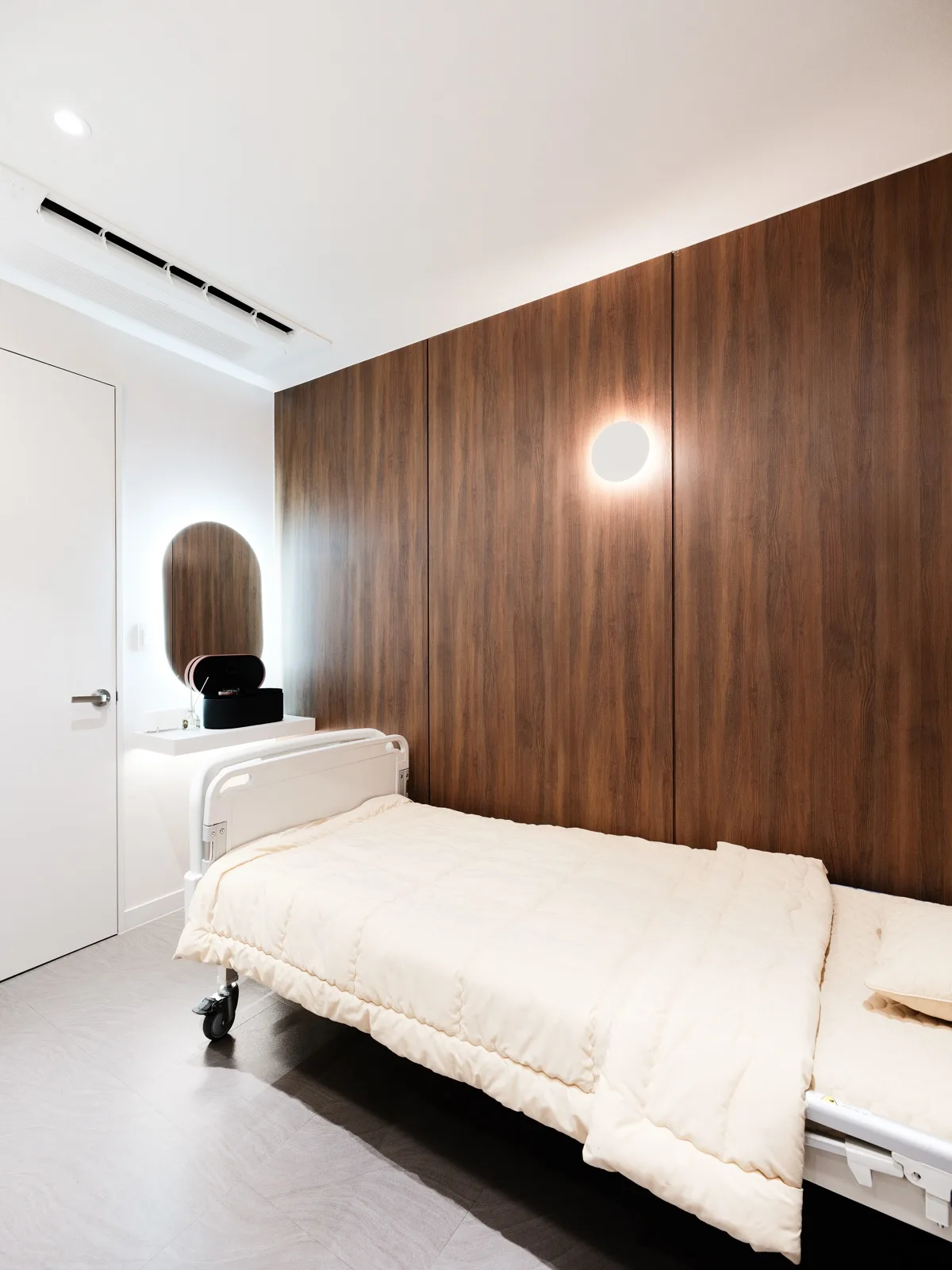
Prepared procedure room at Rewind Plastic Surgery

Fig. 04 — Prepared and checked before the patient comes through

Recovery room at Rewind Plastic Surgery where the compression dressing is applied

Fig. 05 — Recovery, where the dressing is fitted before you leave

The clinic is on the fourth and fifth floors of the Richro Building in Apgujeong, Gangnam. The medical director takes the consultation, marks the line, carries out the operation and sees you at each review that follows. You leave with a compression dressing fitted, and the clinic asks for it to stay on for one to two days, so plan the trip home and the day after around wearing it. Surgical consultations are held Monday, Tuesday, Wednesday and Friday from 10:00 to 19:00 and on Saturday from 10:00 to 16:00, entirely by appointment.

Incision: 45-degree oblique line along the hairline
Scalp undermined; surplus forehead skin excised
Fixation: Endotine, absorbed over about nine months
Dissection under Full HD endoscopic vision
Compression dressing: one to two days
Anaesthetic and theatre time: confirmed at the examination
Dr. Jonghwan Choi, board-certified plastic surgeon

Board-certified plastic surgeon

Korean specialist certification in Plastic Surgery, ten peer-reviewed papers, and a single operating surgeon on every case. KHIDI registration as an institution treating international patients: Reg. M-2025-01-08-09288.

Cost

Pricing

What forehead reduction costs in Seoul, alone and paired with a lift

Three lines on Rewind's schedule cover the upper face. Reading them together is the fastest way to understand what the examination is deciding, because the gap between the first line and the third is precisely the cost of needing both directions at once.

Forehead reduction with Endotine fixationThe hairline advanced and the forehead shortened, as a single listed operation
₩4,500,000
Forehead lift with forehead reductionOne combined listing, where the brow has descended and the forehead is long at the same time
₩8,500,000
Endoscopic forehead liftThe opposite direction, listed on its own: the brow raised and the forehead smoothed
₩4,500,000

Each figure is a list price with VAT charged separately, and anaesthetic fees already included within it. The reduction and the lift are quoted apart from one another so that a plan can be read line by line before it is agreed, and neither is added to the other unless the examination gives a reason for it. What your own forehead needs, and therefore which of these three lines applies, is settled with the surgeon before a date is offered.

Fit

Suitability

Whose forehead this operation suits, and whose question it does not answer

What this operation is written for

  • A forehead broad enough that the face reads as long, with the brow itself sitting where it belongs
  • A hairline and forehead out of proportion with the rest of the face, so the head reads as larger than it is
  • Someone who wants the change in proportion to be visible immediately, with no slow accumulation
  • Someone who wants the border of the hairline redrawn as well as moved, into a line that suits the face
  • Someone prepared for a scar along the hairline, a dressing for the first day or two, and a pause on strenuous exercise

What sends the plan in another direction

  • A receding or thinning front hairline, where the finding is density and not position, so moving a sparse border only moves the problem
  • A brow that has descended over the lids, which is what the separate forehead lift and its combined listing are written for
  • A scalp with little give, since how far the border can travel is limited by what the tissue behind it will stretch to
  • A history of thick, raised or spreading scars, which changes the conversation about a line that sits at the front of the head
  • Smoking that has not stopped, bleeding or clotting disorders, medication affecting either, pregnancy or breastfeeding, or an active scalp condition at the planned line
After

Recovery

What healing at the hairline asks of you after a forehead reduction

Rewind's own instructions for this operation are short and specific: a compression dressing for one to two days, a gradual return to ordinary activity, strenuous exercise paused for a while, and a list of things to keep away from the fixed tissue while it settles. One item on that list is unique to this operation and is the one people forget.

Days one to two
The dressing stays on
The clinic asks for a compression dressing over the first day or two. Expect swelling across the forehead and around the eyes, since gravity carries it downwards from where the work was done, and expect the line itself to feel tight. Keep the head raised and the wound clean and dry as instructed.
The first week
Ordinary days, resumed gradually
Rewind describes everyday life returning progressively while strenuous exercise stays off for the time being. Anything that raises blood pressure in the head works against a fresh closure. When sutures come out is set by the surgeon, since the clinic does not publish an interval for this operation.
The first weeks
Nothing pulling backwards
Sauna, strong massage, alcohol, smoking and hair dye are all ruled out for a period, and the clinic adds one instruction specific to this operation: do not pull the tissue against the direction in which it was fixed. Tight ponytails, hard brushing backwards and sleeping face-down all do exactly that.
Beyond
The scar, and the years after
The line follows the hairline, and Rewind describes it as difficult to notice in most cases once healed; it is still a surgical scar and how it settles varies between people. Protect it from sun while it matures. The clinic records the result as holding for five years or more, with individual tissue elasticity and the extent of surgery changing that.

Surgery at the front of the head carries risk, and the ones worth naming are bleeding, infection, a scar that widens or stays visible along the hairline, numbness or altered sensation in the scalp behind the incision that can take months to settle and occasionally does not, temporary shedding of hair close to the line, asymmetry between the two sides of the new border, itching as the wound matures, and a result that leads to a revision. Wound-healing problems are considerably more likely in smokers. An outcome cannot be promised and results vary by individual. Tell the surgeon about any previous surgery to the scalp or forehead, and about any medication you take, before a date is agreed.

Doctor

Professional

At Rewind, one board-certified plastic surgeon carries every case — from the first consultation to the final follow-up. Because a face is a story, and a story deserves a single author.

Dr. Jonghwan Choi, board-certified plastic surgeonRewind,
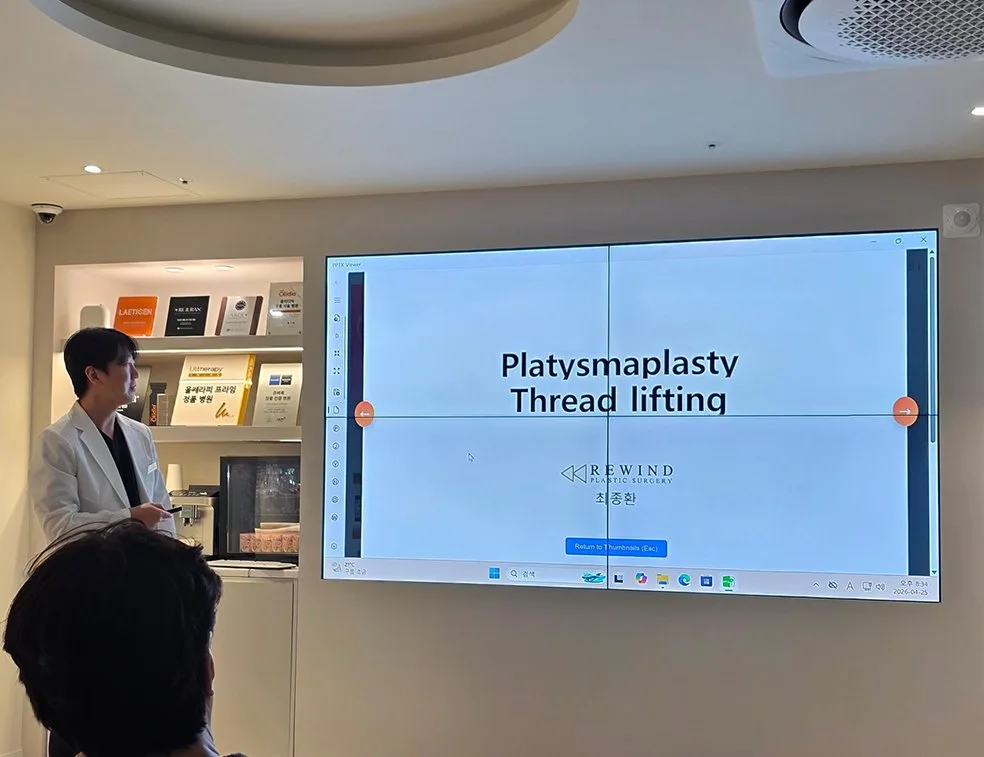
Dr. Jonghwan Choi presenting at an academic session
Fig. 06 — Academic presentation, lifting session

Rewind's Doctor

Dr. Jonghwan Choi Medical Director

One surgeon, from the first
consultation to the last follow-up.

A board-certified plastic surgeon devoted to anti-aging lifting — with the precision and restraint built through years of craniofacial practice.

Board-certified plastic surgeon (Plastic Surgery)
10 peer-reviewed publications
Medical Director, Rewind Plastic Surgery
Korean Society of Plastic & Reconstructive Surgeons
Former chief director, Apgujeong Y&T Plastic Surgery
Korean Society for Aesthetic Plastic Surgery
J Craniofac Surg · JKMS · Arch Craniofac Surg
Korean Cleft Palate-Craniofacial Association
Voices

Google Reviews

What our patients say.

G 5.0 ★★★★★ 12 Google reviews · Rewind Plastic Surgery, Apgujeong — live-synced from Google Business Profile

"Sample review card — at launch this section pulls the clinic's real Google reviews automatically, shown verbatim with the reviewer's initial and posting date."

AReviewer namePOSTED ON GOOGLE

"Sample review card — reviews are never written or edited by the clinic; only what patients posted on Google appears here."

BReviewer namePOSTED ON GOOGLE

"Sample review card — a 'See all reviews on Google' link takes visitors to the clinic's Business Profile."

CReviewer namePOSTED ON GOOGLE
Ask

Questions

Forehead reduction in Seoul — the questions asked before booking

How is forehead reduction different from a forehead lift?
Direction. Reduction brings the hairline forward and shortens the forehead. A forehead lift raises a descended brow and smooths horizontal lines, which if anything makes the forehead read longer. Rewind lists each separately and lists the two performed together as a third, combined operation.
Where does the scar sit, and will it show?
Along the new hairline. Rewind cuts at a 45-degree oblique angle and designs the line with the direction of hair growth in mind, describing the result as difficult to notice once healed in most cases. It remains a surgical scar, how it settles varies between people, and sun protection while it matures is asked for.
What exactly is Endotine and does it stay in my head?
It is the fixation device that holds the advanced tissue while the closure heals. Rewind states that it carries both Korean drug-authority and US FDA approval as a material for forehead reduction, and that the body absorbs it over roughly nine months. Two papers on this device in brow surgery are listed at the foot of this page.
Should I be considering a hair transplant instead?
It depends which problem you have. Transplantation adds density where hair is thin or missing; this operation moves the border of the hair you already have. A front hairline that is receding or sparse is a density question, and moving a sparse border forward simply relocates it. The examination separates the two.
How much shorter can my forehead actually get?
However far the scalp behind the border will stretch, which is measured on you at the first step, and never chosen from a menu. Rewind marks the proportion before opening anything, so the figure you are quoted reflects your own tissue. Requests beyond that limit are declined.
Why is a Full HD endoscope used for an operation on the forehead?
To see the nerves and vessels while the plane is being opened. The sensory nerves supplying the scalp emerge at the brow and run backwards through the territory being undermined, so the clinic identifies the structures under endoscopic vision, and does not work by feel through a long incision.
Will my scalp be numb afterwards, and for how long?
Altered sensation behind the incision is a recognised consequence of undermining the scalp, and it commonly runs to months before it settles. In some cases a patch of reduced feeling remains. This is among the risks the surgeon goes through before a date; it is never a detail discovered afterwards.
Can both forehead operations be done in one session?
Yes, and Rewind prices that as its own listing, and not as two operations added together. The published Korean series in the literature below reports hairline lowering performed during an endoscopic forehead lift, which is the same combination. Whether your case needs it is decided at the examination.
How soon can I wash my hair, dye it or tie it back?
Washing is governed by the written instructions you are given; dye is on the clinic's restricted list for a period along with sauna, alcohol, smoking and strong massage. Tying hair back tightly pulls against the direction the tissue was fixed in, which Rewind specifically asks you to avoid while it settles.
How long does the result hold?
Rewind records five years or more, and says plainly that individual tissue elasticity and the extent of the surgery change it. A hairline that has been moved does not travel back on its own; what continues is ageing in the tissue around it, so the clinic gives a working figure and not an absolute one.
When can I fly home after this operation?
The surgeon sets the date, because Rewind publishes no flying interval for it. The dressing comes off after a day or two, but the timing of suture removal and your first review is what decides the earliest sensible departure. Agree both before a return flight is booked.
When can this consultation be booked?
The clinic consults Monday, Tuesday, Wednesday and Friday between 10:00 and 19:00 and on Saturday between 10:00 and 16:00, entirely on appointment, and an upper-face assessment can be booked into any of those slots. Interpreting is arranged for people travelling in from other countries, and Rewind holds KHIDI registration for the treatment of foreign patients.
Booking

Reservation

REWIND,booking

Tell us what you are considering — we reply within one business day, in your language.

Scientific evidence

Published research on hairline lowering, pretrichial incisions and absorbable forehead fixation

Read in the order the operation is built: a large Asian series on advancing the hairline through a line drawn in front of the hair, a Korean report on doing that at the same sitting as an endoscopic forehead lift, and two papers on the absorbable device used to hold upper-face tissue in its new position, one of them addressing its safety directly. The techniques, materials and anaesthetic choices in these papers are the authors' own and describe neither this clinic's protocol nor your own case; Rewind publishes no anaesthetic detail for this operation, and that is confirmed at the examination. None of this research predicts an individual outcome.