Surgery · Signature Lifting

Midface Lift

Apple-cheek lifting, reached from inside the lower lid

Apgujeong, Seoul | Board-certified plastic surgeon, Dr. Jonghwan Choi
Endotine fixation · KHIDI-registered for international patients

Midface Lift Midface Lift Midface Lift Midface Lift Midface Lift 
Define

Midface lift

What is a midface lift?

In one paragraph

A midface lift raises the block of soft tissue between the lower eyelid and the nasolabial fold. Rewind reaches it through the lower eyelid — through the conjunctiva on the inner surface, or through the lid skin — and draws the midface tissue upward as one unit with its fascial layer included. The fat that has slid down the cheek is repositioned and fixed to the periosteum, and an absorbable Endotine device holds that position while the tissue settles. The clinic's own name for the operation is apple-cheek lifting; its menu name is midface lift.

Source: Rewind's own Korean-language surgical page for the midface lift, which states that the approach is made through the conjunctiva or the skin of the lower eyelid and that the descended fat is fixed to the bone covering.

Two decisions sit behind that paragraph: which route the surgeon uses, and whether the under-eye fat is repositioned in the same session. Both are settled by examination, and both change what the healed lid looks like from a conversational distance.

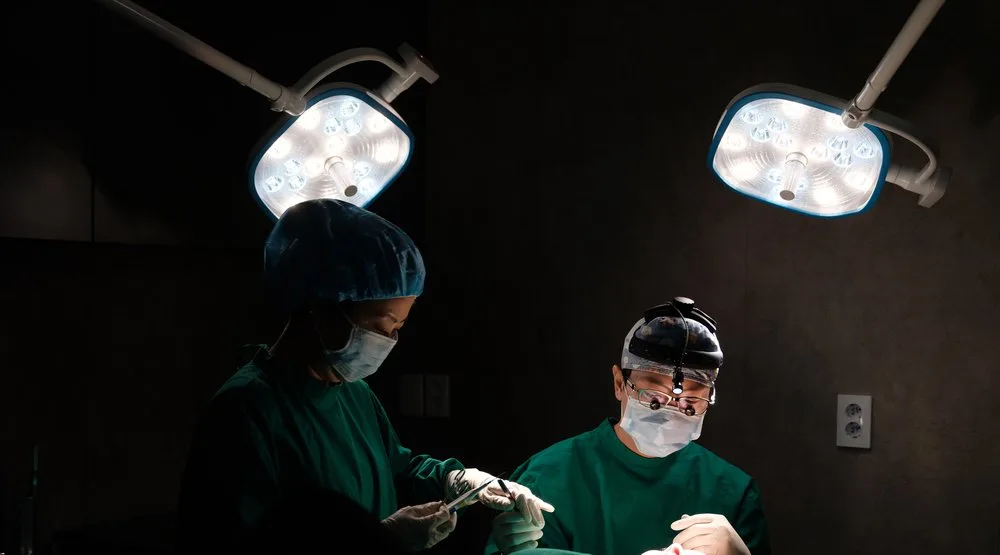
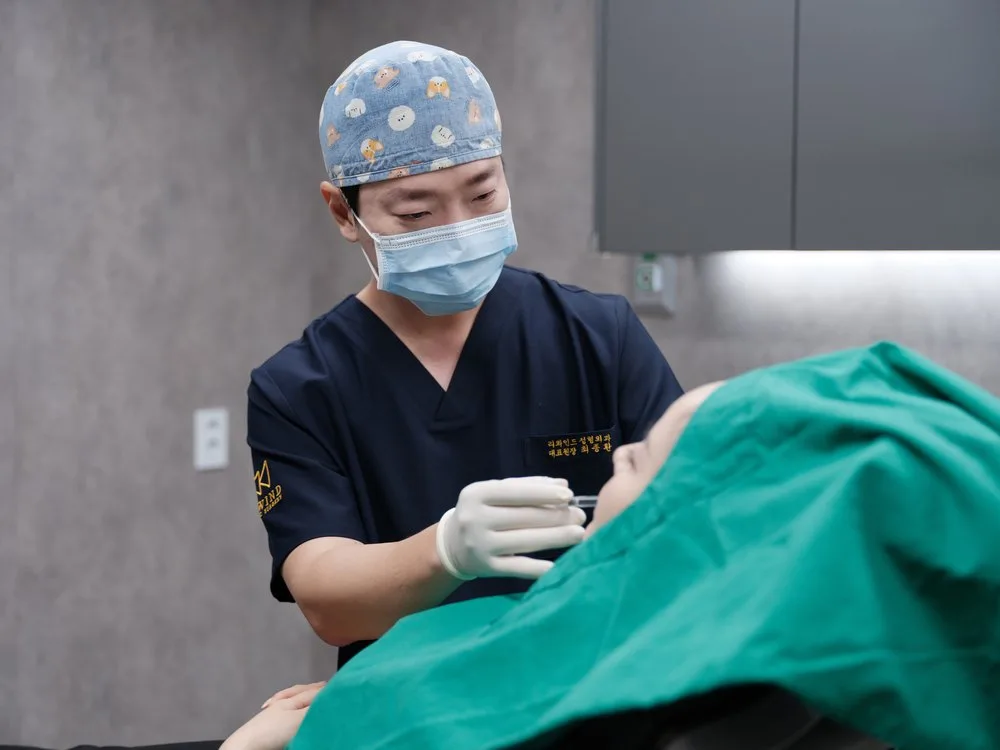
Dr. Jonghwan Choi operating at Rewind Plastic Surgery, Apgujeong
Fig. 01 — Operating field, Rewind Plastic Surgery
Result

Before & After

What do the midface frames show?

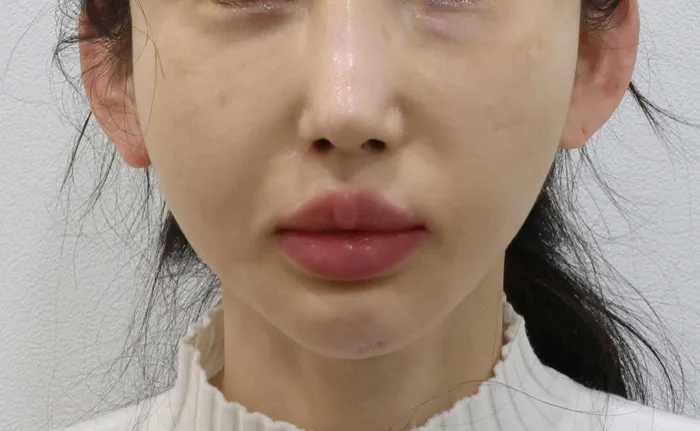
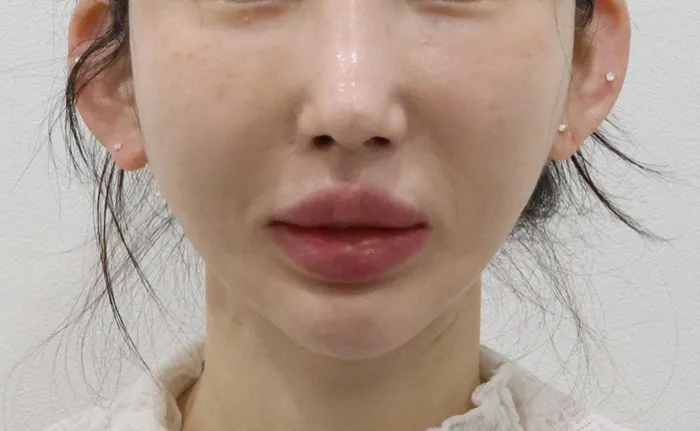
One case is released for this page, and its caption names every procedure that was performed in it. Photography of the transconjunctival operation with Endotine fixation is held at the clinic and has not been released for publication yet, so the remaining frames below are marked as pending instead of being filled with another procedure's photographs.

Rewind patients — midface and lower lid

Before — midface elevation with under-eye fat repositioning After — midface elevation with under-eye fat repositioning BEFOREAFTER
case 01
Midface elevation by thread anchoring + under-eye fat repositioning
Individual results may vary. This case was elevated by thread anchoring, and is shown for the midface vector; the transconjunctival Endotine operation described on this page is photographed separately.
BEFORE PHOTO
AFTER PHOTO
BEFOREAFTER
case — pending release
Transconjunctival midface lift with Endotine fixation
Individual results may vary. Photographs held at the clinic; release for publication is pending.
BEFORE PHOTO
AFTER PHOTO
BEFOREAFTER
case — pending release
Midface lift combined with under-eye fat repositioning
Individual results may vary. Photographs held at the clinic; release for publication is pending.
BEFORE PHOTO
AFTER PHOTO
BEFOREAFTER
case — pending release
Midface lift added to a lower-eyelid plan
Individual results may vary. Photographs held at the clinic; release for publication is pending.

The released frame was photographed by Rewind Plastic Surgery of its own patient under identical lighting and conditions, and is shown uncropped. Individual results may vary. Swelling, bruising, asymmetry, altered sensation and scarring can follow any surgical procedure. A consultation with the surgeon is required before any decision.

Zones

Anatomy map

Which zones does a midface lift reach?

The midface is a short distance with several problems stacked inside it. Rewind describes the operation zone by zone, from the shadow under the eye down to the fold beside the mouth, and the examination decides how much of that range a given face needs.

zone 01
Nasojugal groove
The shadowed line running from the inner corner of the eye down across the cheek — the tear trough. It is the anatomy the medical director's own published paper addresses, and the feature most patients point to first.
zone 02
Under-eye fat
Where the fat pad bulges forward it casts a shadow of its own. Rewind lists a bulging under-eye pad and a deep groove as separate findings, and they are not always present together.
layer 03
Midface soft tissue
Skin, fat and the fascial layer beneath them are lifted together. Taking the fascial layer with the lift is what makes the vector hold across the cheek and not at a single stitch.
layer 04
Periosteum and fixation
The repositioned fat is anchored to the bone covering, and the Endotine device seats against bone to hold the lifted tissue at five separate points before it is absorbed.
Steps

In sequence

How is the apple-cheek midface lift performed?

Rewind publishes the operation as three surgical steps, with the fixation device and its absorption as the story around them. Read in order, they show that the correction is carried by bone anchorage and by the fascial layer, and that skin tension is not doing the work.

01Design

A one-to-one design, then a small opening below the eye

Rewind describes a bespoke design drawn before the operation begins, followed by a small opening made below the eye. On the conjunctival route that opening sits on the inner surface of the lid, which is how the clinic keeps the healed line off the face and keeps the lateral cheek from widening.

02Elevate

The midface is drawn upward with its fascial layer

The fascial layer is taken together with the tissue above it and the whole midface block is pulled up. Lifting as a unit is a different mechanical act from filling the hollow that the descent has left behind, and it is the reason this operation is described as a lift at all.

03Reposition

Descended fat is fixed to the periosteum, then closed

The fat that has slid down is set back and secured to the bone covering, and the opening is closed with care. Because the anchor point is bone and not skin, the position does not depend on how much the lid can be stretched.

04Fix

Endotine holds the lift at five points

Rewind uses Endotine, a fixation device it describes as approved by the Korean Ministry of Food and Drug Safety and by the US FDA for this purpose. Five prongs catch the tissue at several points, a bone-seated base supports it where the surgeon placed it, and the rounded finish is designed to limit pressure on the tissue it holds.

05Absorb

The device is absorbed over about nine months

Endotine is taken up by the body across roughly nine months. Rewind's stated reason for choosing an absorbable device is that it keeps the sensation of something foreign, and the interference with ordinary daily life, to a minimum while the surgical effect is maintained.

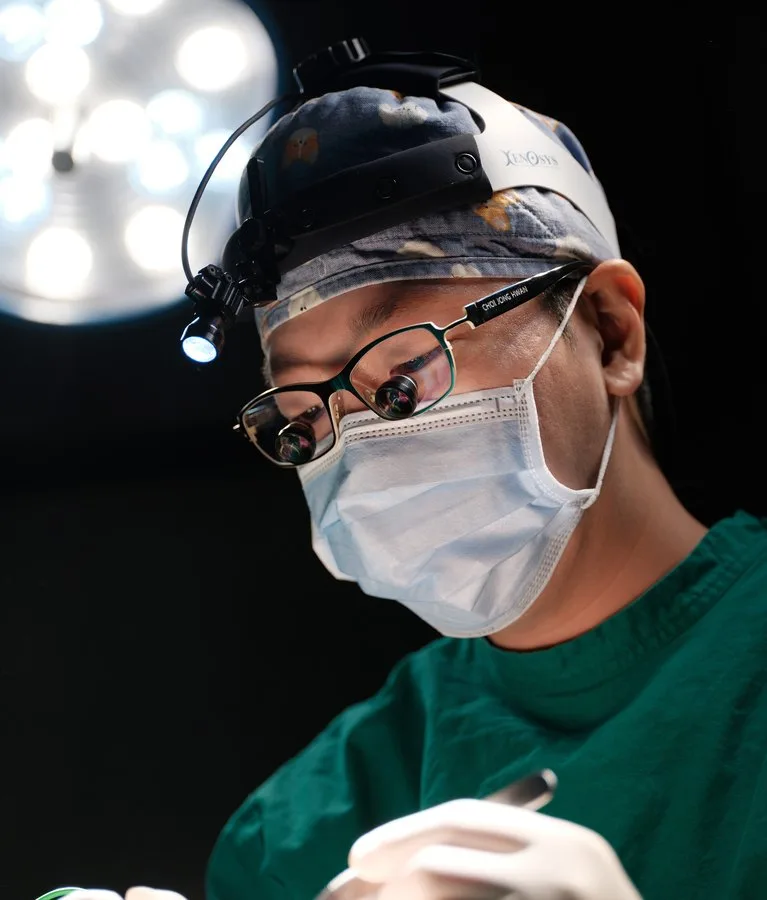
Operating room at Rewind Plastic Surgery, Richro Building
Fig. 02 — Every step above is carried out by the medical director
Rewind

Why here

Why have a midface lift from a surgeon who published on this groove?

A midface lift is a short operation with a long dependency. Route, vector and fixation point are chosen in a single examination by a single pair of hands, and the anatomy it crosses is the anatomy the surgeon has written about in the literature.

01Published

The groove in the paper is the groove in the mirror

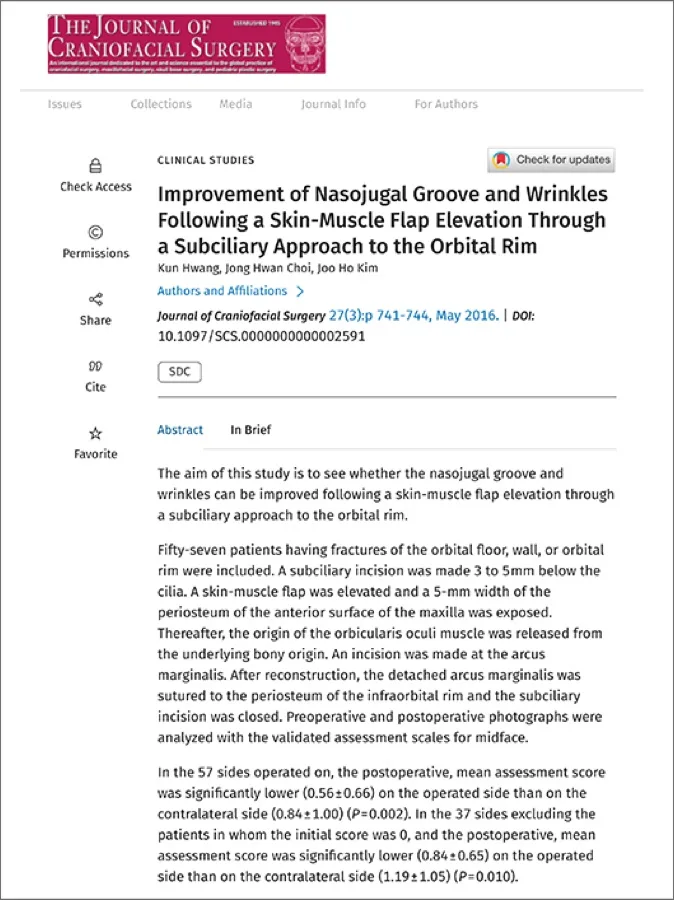
Dr. Choi's paper on improvement of the nasojugal groove and wrinkles following skin-muscle flap elevation appeared in the Journal of Craniofacial Surgery, one of ten peer-reviewed publications to his name. Its subject is the exact line that brings most midface patients to a consultation.

02Route

Conjunctival or through the skin — the finding chooses

Rewind's own page states the approach may be made through the conjunctiva or through the lid skin. It also states that where the skin route is used, a line can stay visible below the lashes depending on skin elasticity. That trade-off is put in front of the patient before a date is booked.

03Continuity

One surgeon across the examination, the operation and the reviews

The person who decides the route is the person who operates and the person you see at follow-up. International patients are supported in their own language from the first enquiry onward, and Rewind holds KHIDI registration as an institution for foreign patients.

Peer-reviewed paper by Dr. Jonghwan Choi in the Journal of Craniofacial Surgery
Fig. 03 — Published in the Journal of Craniofacial Surgery: the nasojugal groove after skin-muscle flap elevation
Theatre

In the operating room

Where is a midface lift done, and who chooses the route?

Procedure room prepared at Rewind Plastic Surgery

Fig. 04 — Preparation, before the lid is opened

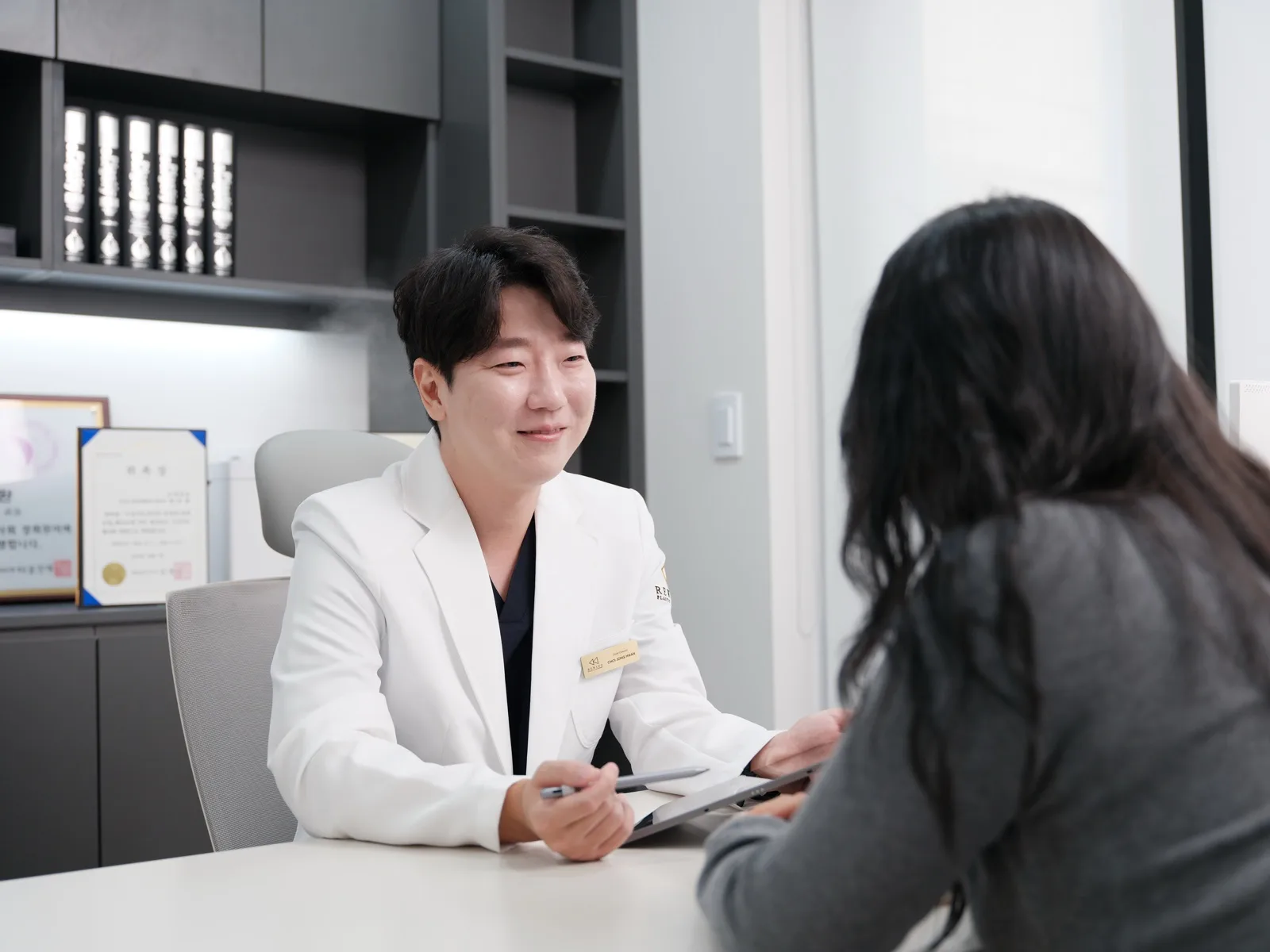
Dr. Jonghwan Choi in consultation with a patient

Fig. 05 — The route is chosen at the chair, with the patient looking on

Rewind occupies the fourth and fifth floors of the Richro Building in Apgujeong. The surgeon who examines you plans the vector, performs the operation and holds the follow-up appointments; consultations for surgical cases are taken Monday, Tuesday, Wednesday and Friday until 19:00 and Saturday until 16:00, by appointment only. No part of the case is handed to a second operator.

Approach through the lower eyelid: conjunctival or through the skin
Conjunctival route leaves no opening on the outer skin
Fascial layer lifted together with the midface block
Descended fat fixed to the periosteum
Endotine fixation, absorbed over about nine months
Operated by Dr. Jonghwan Choi
Dr. Jonghwan Choi, board-certified plastic surgeon

Board-certified plastic surgeon

Dr. Jonghwan Choi holds Korean specialist certification in Plastic Surgery and is the only operating surgeon at the clinic. Rewind is registered with KHIDI as an institution for international patients — Reg. M-2025-01-08-09288.

Cost

Pricing

How is a midface lift priced in Seoul?

Rewind lists the midface lift three ways: on its own, together with under-eye fat repositioning, and as an addition to a lower-eyelid plan already being scheduled. Which line applies follows from the examination, and the figure quoted at consultation is the listed figure for that line.

Midface lift — transconjunctival, on its ownApple-cheek lifting through the inner surface of the lower lid, with Endotine fixation
₩4,000,000
Midface lift with under-eye fat repositioningThe combined operation, where the bulging pad and the descent are both findings
₩6,000,000
Midface lift added to a lower blepharoplasty planWhere lower-eyelid surgery is already scheduled and the midface is lifted in the same session
₩7,000,000

List prices, VAT excluded; anaesthetic fees are included in the figures above. The combined line and the add-on line are different operations with different scopes, and the difference between them is explained at the examination before any date is offered.

Fit

Suitability

Who is the apple-cheek midface lift for?

Usually a good candidate

  • A deep tear trough, or shadowing under the eye that concealer no longer settles into
  • An under-eye fat pad that bulges forward and casts a shadow of its own
  • Descent that runs from the lower lid down into the cheek, so the middle of the face reads heavier in photographs than in the mirror
  • A lower eyelid turned outward after previous lower-lid surgery, where the midface needs to be brought back up to support it
  • A patient who wants the under-eye pad repositioned in the same session as the lift, and understands that this is a larger operation than either alone

Talked through before a date is offered

  • Descent across the whole face and neck: the discussion then moves to a full or a mini lift, and the surgeon says so at the examination instead of booking this operation
  • The skin route requested for convenience: the line that can stay visible below the lashes is the price of it, and that has to be accepted in advance
  • Volume loss with no descent to correct: adding volume and repositioning fallen tissue solve different mechanical problems, and a lift is the wrong instrument for the first of them
  • Bleeding, clotting or wound-healing conditions, and any medication that affects them
  • Pregnancy, breastfeeding, or an active infection anywhere around the eye
After

Recovery

What is recovery after a midface lift like?

Because the operation is reached through the lower eyelid, the instructions that govern it are Rewind's own sheets for under-eye work. They are specific about the first three days and about the first fortnight. For durability the clinic records more than five years, with variation between individuals; ageing carries on afterwards, and the sheet does not pretend otherwise.

First three days
The dressing is left alone
Rewind asks that the dressing under the eye stay in place for three days. It is not lifted early to look at the result, and the area is kept clean and dry.
One to two weeks
Swelling and bruising recede
The clinic records early swelling and bruising decreasing across one to two weeks. The eye area is not rubbed or pressed while that happens, and sunscreen goes on from the start.
One week
No sauna, no hard training
Sauna, steam rooms, swimming pools and strenuous exercise are set aside for at least a week on Rewind's under-eye sheet. Alcohol and smoking belong in the same column.
About a month
Nothing pulls on the midface
For roughly a month Rewind asks that the operated area not be pulled firmly in any direction, and that alcohol, smoking and sauna visits stay off the calendar while healing finishes.

Any surgical procedure carries risk, including bleeding, infection, swelling, asymmetry, altered sensation and scarring. Where the lift is reached through the skin of the lower lid, Rewind states that the line can show below the lashes depending on individual skin elasticity. Tell the surgeon about every previous operation around the eye, and about any medication you take, before a date is set.

Doctor

Professional

At Rewind, one board-certified plastic surgeon carries every case — from the first consultation to the final follow-up. Because a face is a story, and a story deserves a single author.

Dr. Jonghwan Choi, board-certified plastic surgeonRewind,
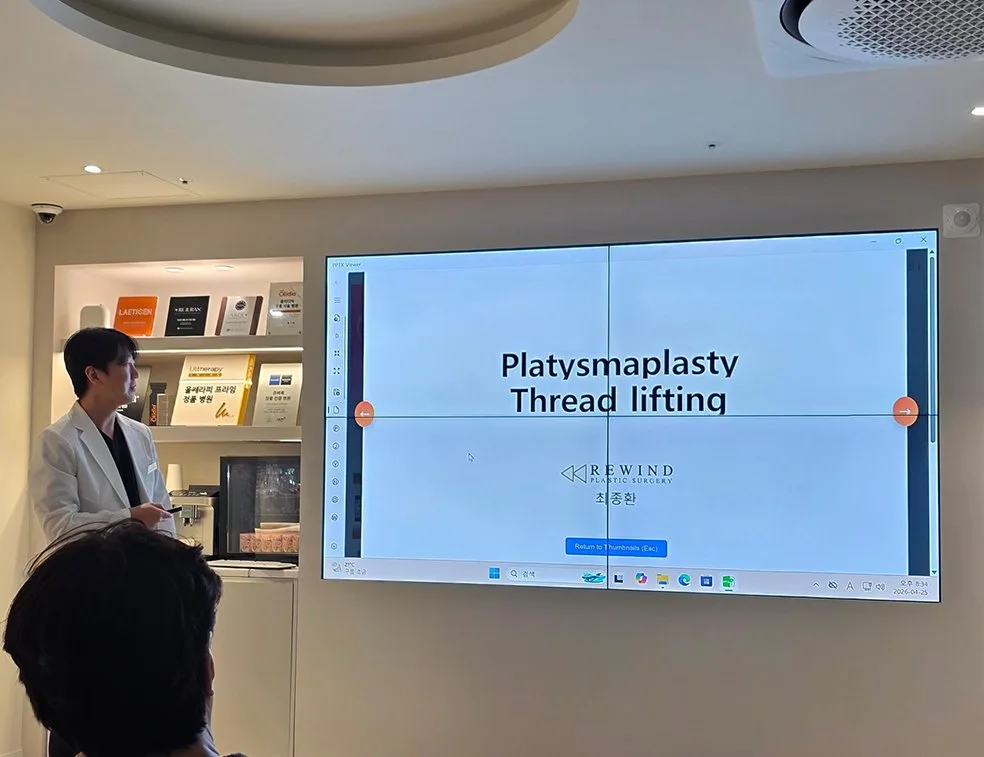
Dr. Jonghwan Choi presenting at an academic session
Fig. 06 — Academic presentation, thread-lifting session

Rewind's Doctor

Dr. Jonghwan Choi Medical Director

One surgeon, from the first
consultation to the last follow-up.

A board-certified plastic surgeon devoted to anti-aging lifting — with the precision and restraint built through years of craniofacial practice.

Board-certified plastic surgeon (Plastic Surgery)
10 peer-reviewed publications
Medical Director, Rewind Plastic Surgery
Korean Society of Plastic & Reconstructive Surgeons
Former chief director, Apgujeong Y&T Plastic Surgery
Korean Society for Aesthetic Plastic Surgery
J Craniofac Surg · JKMS · Arch Craniofac Surg
Korean Cleft Palate-Craniofacial Association
Voices

Google Reviews

What our patients say.

G 5.0 ★★★★★ 12 Google reviews · Rewind Plastic Surgery, Apgujeong — live-synced from Google Business Profile

"Sample review card — at launch this section pulls the clinic's real Google reviews automatically, shown verbatim with the reviewer's initial and posting date."

AReviewer namePOSTED ON GOOGLE

"Sample review card — reviews are never written or edited by the clinic; only what patients posted on Google appears here."

BReviewer namePOSTED ON GOOGLE

"Sample review card — a 'See all reviews on Google' link takes visitors to the clinic's Business Profile."

CReviewer namePOSTED ON GOOGLE
Ask

Questions

Midface lift — questions patients ask before booking

What is a midface lift, in one sentence?
It is an operation that lifts the tissue between the lower eyelid and the nasolabial fold and fixes it higher. Rewind reaches the midface through the lower lid, repositions the fat that has descended, secures it to the periosteum and holds the result with an absorbable Endotine device.
Where does the opening go, and will anyone see a scar?
The opening is made below the eye. On the conjunctival route it sits on the inner surface of the lid, so nothing is cut on the outer skin. Rewind states that where the skin route is used instead, a line can remain visible below the lashes, depending on individual skin elasticity.
How is a midface lift different from a full facelift?
Rewind answers this directly: a full facelift pulls the whole face, while the midface lift covers the range from under the eye to the nasolabial fold. The two are chosen by what the examination finds, not by which sounds larger, and the clinic prices them as separate operations.
What is Endotine, and why does Rewind use it?
Endotine is a fixation device that the clinic describes as approved by the Korean Ministry of Food and Drug Safety and by the US FDA. Five prongs hold the lifted tissue at several points and a bone-seated base keeps it where the surgeon placed it, which supports even tension across the cheek.
Does the Endotine device stay in my face?
No. Rewind records absorption over roughly nine months. The clinic's stated reason for choosing an absorbable fixation is that the sensation of something foreign and the interference with ordinary daily life are kept to a minimum while the surgical effect is maintained.
How long does a midface lift last?
Rewind records more than five years, with variation between individuals. In the clinic's own hierarchy that sits below a full facelift and alongside forehead lifting. Weight change and ordinary ageing continue afterwards, as they do after every lifting operation.
Can the under-eye fat be repositioned in the same operation?
Yes, and Rewind lists that combination as its own item. There is also a separate line for adding the midface lift to a lower blepharoplasty that is already planned. Whether the pad needs repositioning at all is a finding from the examination and never a package option.
Would a filler or a suspension thread achieve the same thing?
They address different mechanics. Filling adds volume inside a hollow; a suspension lifts soft tissue without moving the orbital fat or anchoring to bone. This operation repositions descended fat and fixes it to the periosteum, so it answers descent rather than deficit.
What anaesthesia is used, and how long am I in theatre?
Rewind publishes neither an anaesthesia protocol nor a theatre time for this operation, so neither figure appears on this page. Both are confirmed by the surgeon once the route and the scope of your plan are settled at consultation.
When will I look presentable again?
The dressing under the eye stays on for three days, and the clinic records swelling and bruising receding across one to two weeks. Sauna, swimming and strenuous exercise wait at least a week. Nobody at Rewind promises a specific day for a specific face.
Who should not have this operation?
Where the examination finds descent across the whole face and neck, the surgeon moves the conversation to a full or a mini lift. Where the complaint is lost volume with no descent, a lift is the wrong instrument. Both are said at the examination, before any date is discussed.
Who performs the operation, and can the consultation be in English?
The medical director, Dr. Jonghwan Choi, examines every patient and operates himself; the practice has one operating surgeon. Interpreter-assisted consultations are arranged for international patients, and the clinic is KHIDI-registered as an institution for foreign patients.
Booking

Reservation

REWIND,booking

Tell us what you are considering — we reply within one business day, in your language.

Scientific evidence

Published research on transconjunctival midface lifting and absorbable fixation

These papers describe midface lifting and absorbable fixation as a surgical class, and the last of them concerns nasojugal groove correction performed through a lower-lid blepharoplasty; it is cited for the anatomy of that groove and not for midface suspension outcomes. None is a study of Rewind Plastic Surgery, and none predicts an individual result. The approach, the fixation and the setting reported in each paper are those of the study concerned.