Surgery · Nose

Revision Rhinoplasty

The contracted nose, and the second operation that has to undo the first

Gangnam, Seoul | Board-certified plastic surgeon, Dr. Jonghwan Choi
KHIDI-registered for international patients · Apgujeong Rewind

Revision Rhinoplasty Revision Rhinoplasty Revision Rhinoplasty Revision Rhinoplasty 
Define

Revision rhinoplasty

What is revision rhinoplasty, and what is a contracted nose?

The short answer

Revision rhinoplasty is a second operation on a nose that has already been operated on. Rewind lists the reasons people come for one: a tip that dropped, a nose line the patient never accepted, a nose that stayed crooked, a hump or a bulbous tip that was never resolved, inflammation, an implant showing through the skin, and a contracted nose. The contracted nose is the case the clinic singles out. It describes it as inflammation arising around the implant from the first operation, after which the skin of the nose hardens, so the problem becomes functional as well as cosmetic.

Source: Rewind's Korean page on nose revision surgery. That page publishes no anaesthesia, no operating time and no recovery timetable for revision work, so none appears here.

A second operation is never the first operation repeated. It begins with scar tissue, a foreign body that has been in place for years, and soft tissue whose blood supply has already been interrupted once. That is why the question below is answered in months and why Rewind refuses to time a revision by how impatient a patient feels.

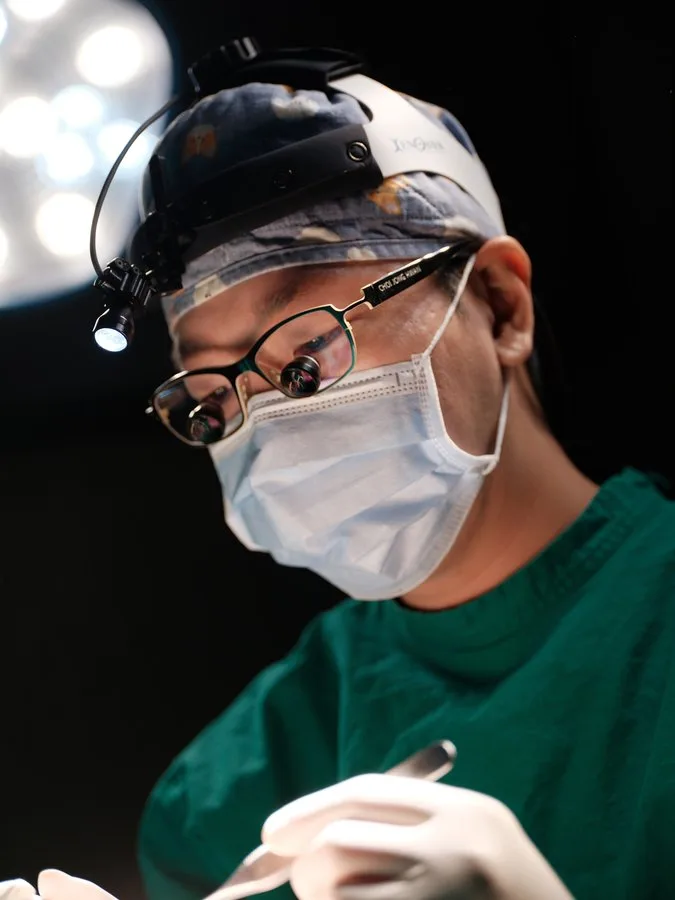
Dr. Jonghwan Choi operating under magnification at Rewind Plastic Surgery
Fig. 01 — Magnification and light: revision work is done through scarred tissue
Result

Before & After

What would a contracted nose before and after case show?

Case photography for revision work has to show the same patient at the same angle under the same light, and Rewind has released none for this page. The frames below stay empty until it does; nothing here is a stock image or a case borrowed from another procedure.

Revision rhinoplasty — case pairs, profile and base view

BEFORE PHOTO
AFTER PHOTO
BEFOREAFTER
case · revision rhinoplasty
Awaiting release by the clinic
Individual results may vary.
BEFORE PHOTO
AFTER PHOTO
BEFOREAFTER
case · revision rhinoplasty
Awaiting release by the clinic
Individual results may vary.
BEFORE PHOTO
AFTER PHOTO
BEFOREAFTER
case · revision rhinoplasty
Awaiting release by the clinic
Individual results may vary.
BEFORE PHOTO
AFTER PHOTO
BEFOREAFTER
case · revision rhinoplasty
Awaiting release by the clinic
Individual results may vary.

Revision results are harder to photograph fairly than first operations, because the starting point is already a surgical nose and the change can be structural before it is visible. When cases are released, every caption will name what was removed, what was released and what was rebuilt. Individual results may vary, and scarring, asymmetry, altered sensation and prolonged swelling remain possible after any second operation.

Reasons

Why noses come back

Which problems bring a nose back for revision surgery?

Rewind's page names eight reasons for a second operation. They fall into four groups, and the group yours belongs to decides how much of the operation is removal and how much is reconstruction.

group 01
A contracted nose
The clinic's stated priority case. Inflammation around the implant leaves the skin of the nose hard, and because the shortening pulls on structure as well as surface, breathing can be affected alongside appearance.
group 02
A tip that moved
A tip that has dropped or lifted since the first operation. Rewind also lists nostrils that became asymmetric, which is read from the base view and often noticed later than the profile change.
group 03
A shape never resolved
A nose that stayed crooked, a hump still sitting on the dorsum, or a bulbous tip unchanged by the first operation. The complaint here is not a complication; it is a correction that did not happen.
group 04
Inflammation or a visible implant
Inflammation, or an implant whose outline shows through the skin. Both are listed by the clinic as revision reasons in their own right, and both are assessed as tissue problems before they are treated as shape problems.
Steps

In sequence

How is a contracted nose rebuilt in revision surgery?

Rewind publishes revision as three steps, and the middle one carries the whole operation. Set out in the order they happen, with the timing decision in front of them, the sequence looks like this.

01Timing

The revision date is set before the revision plan

Swelling and inflammation from a first operation settle over six to twelve months, and the clinic recommends waiting until that window has passed. Operating earlier means operating on a nose whose final shape nobody has seen yet.

02Design

Proportions are measured again from scratch

The first published step is the same as for a first operation: design the ratio of the nose to the face. The difference is that the drawing now has to account for what the previous surgery took away and what the scar tissue will allow.

03Remove

The old implant and the damaged tissue come out

The second step begins with removal of the implant and of tissue damaged around it. Removal is also its own listed item at Rewind, which is how a case that only needs the implant taken out can be quoted without a reconstruction attached.

04Release

Contracted soft tissue is released before anything is rebuilt

The same step then releases the contracted soft tissue. This is the part that separates a revision from a repeat: until the shortened envelope is freed, any new structure placed inside it is fighting the tissue that shortened the nose in the first place.

05Rebuild

The structure is reconstructed, then the profile is completed

With the envelope released, the structure is rebuilt and the bridge and tip are completed to the design. Which graft material does the rebuilding is not published on the clinic's page; its price sheet does carry donated costal cartilage as a separate line, so a cartilage framework is one of the options examination may settle on.

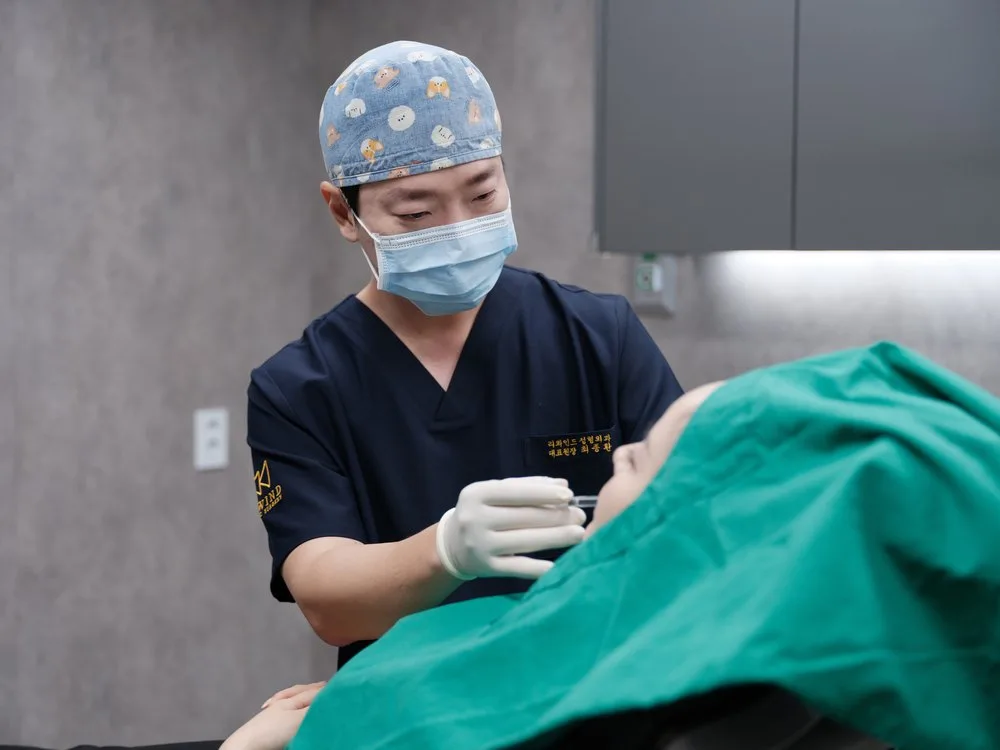
Preparation of a draped patient in the procedure room at Rewind
Fig. 02 — Preparation in the procedure room, before a revision begins
Rewind

Why here

Why does a revision nose need one surgeon from diagnosis onward?

In a revision the diagnosis is most of the operation. What sits inside the nose, how thin the skin has become and how far the envelope has shortened cannot be read from a photograph, and the person who reads them has to be the person who then works through them.

01Diagnosis

What is inside the nose decides what a revision can reach

Dr. Choi examines the nose himself and separates the shape complaint from the tissue problem. Where a contracted nose is the finding, the clinic's position is that this is the case where a second operation becomes necessary and no longer optional.

02Sequence

Removal, release and reconstruction are three separate decisions

Each is priced on its own at Rewind, including removal of an implant placed at a previous operation. Because they are unbundled, a plan can stop at removal, or continue to a full rebuild, and you see which of the three you are paying for.

03Continuity

The surgeon who rebuilt the nose is the one following it

A revised nose is watched for longer than a first one, because the tissue it was rebuilt in has been operated on before. Follow-up stays with the operating surgeon, support runs in your own language throughout, and Rewind holds KHIDI registration for international patients.

Dr. Jonghwan Choi explaining a surgical plan to a patient at consultation
Fig. 03 — The plan is explained at the desk before a date is taken
Theatre

In the operating room

Where does a revision take place, and who sets the plan?

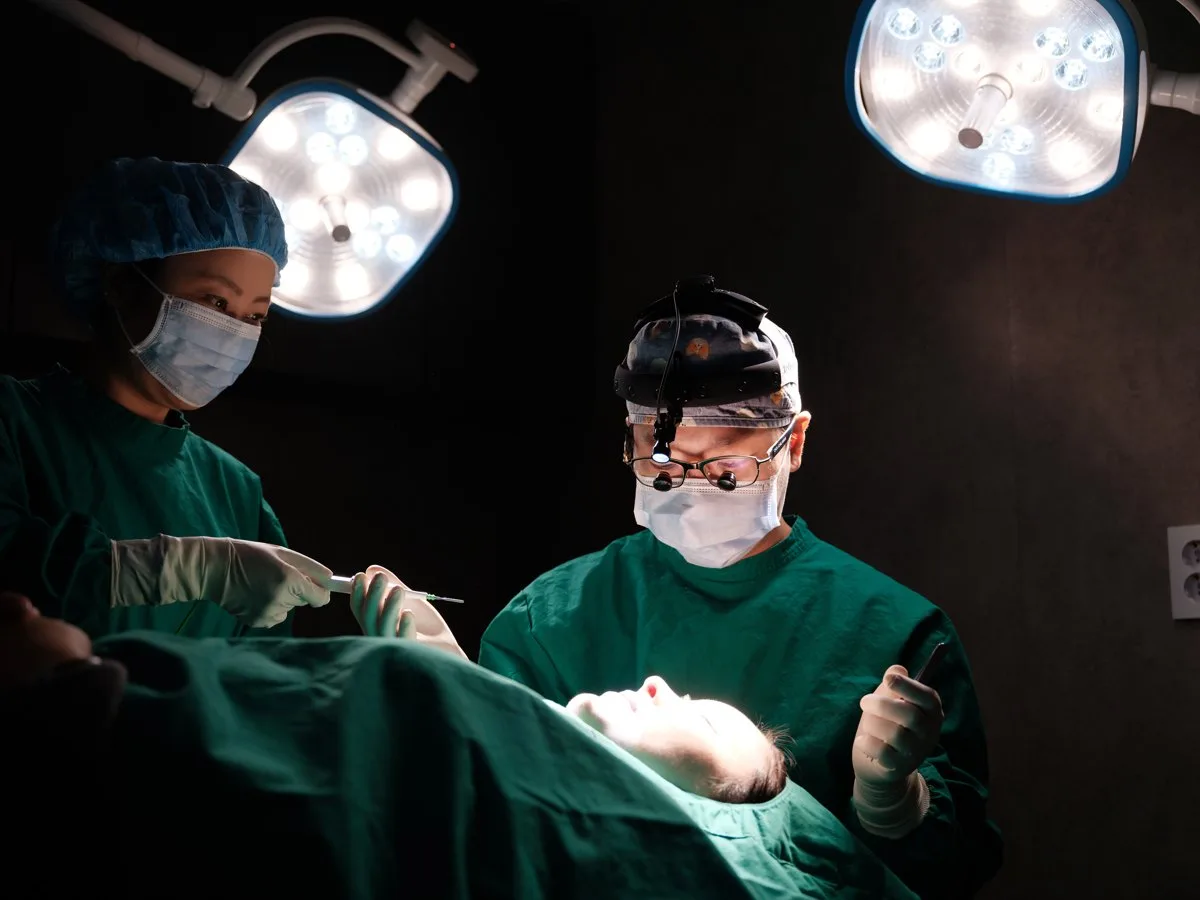
Surgery in progress under the operating light at Rewind Plastic Surgery

Fig. 04 — The operating room during surgery, Richro Building, Apgujeong

Consultation room at Rewind Plastic Surgery, Apgujeong

Fig. 05 — A consultation room, where the revision plan is drawn

Rewind is a single-surgeon practice on two floors of the Richro Building in Apgujeong, working by appointment only, with consultation hours Monday, Tuesday, Wednesday and Friday until 19:00 and Saturday until 16:00. For a revision that structure matters twice: the surgeon who decides whether to operate at all is the one who will be inside the nose.

Timing assessed against the six-to-twelve-month window
Previous implant removed as its own listed step
Contracted soft tissue released before rebuilding
Structure reconstructed, then bridge and tip redesigned
Revision rates listed separately from first-operation rates
Operated by Dr. Jonghwan Choi
Dr. Jonghwan Choi, board-certified plastic surgeon

Board-certified plastic surgeon

Korean board certification in plastic surgery, ten peer-reviewed publications, and sole responsibility for every operation performed in this clinic. Rewind is a KHIDI-registered institution for international patients — Reg. M-2025-01-08-09288.

Cost

Pricing

What does revision rhinoplasty cost in Seoul?

Revision is quoted from a different column of the clinic's price sheet. Against each nose procedure Rewind lists a separate revision rate, set above the first-operation rate for the same work, and the individual steps of a rebuild are listed on their own.

Removal of an implant placed at a previous operationListed on its own, so a case needing only removal is not quoted as a reconstruction
₩1,000,000
Donated costal cartilageAdded where the rebuild needs a cartilage framework instead of an implant
₩2,000,000
Full revision reconstructionRelease and rebuild of a contracted nose, quoted from the revision rates after examination
Consultation required

List prices, VAT excluded, with the anaesthetic fee already inside each figure. A revision quote is built from the steps your examination calls for, which is why it is written out only after the nose has been looked at. Where a plan needs items with no listed rate, the clinic quotes them at consultation instead of publishing a figure it would have to revise.

Fit

Suitability

Who is revision rhinoplasty for?

Often a good fit

  • Six to twelve months past a first operation, with swelling and inflammation settled
  • A contracted nose: hard skin over the bridge, a shortened nose, breathing that has changed
  • A tip that dropped or lifted after the first surgery and has stayed that way
  • Nostrils that became asymmetric, which shows in the base view more than in profile
  • A result you have not accepted at any point since the swelling went down

Discussed at consultation first

  • Less than six months since surgery, where swelling still hides what the nose will become
  • Pain, redness or discharge now, which is examined promptly and separately from any timing question
  • Very thin skin over an old implant, since it limits what a rebuild can safely carry
  • Several previous operations, because the clinic states no fixed maximum and treats the count as individual
  • Bleeding, clotting or healing conditions, regular medication, pregnancy or breastfeeding
Timing

When, and what after

When is the right time for a nose revision?

The timing rule is the one piece of the revision pathway Rewind publishes in numbers, and it is worth more than any recovery promise. A first nose takes six to twelve months to stabilise, and both the shape complaint and the functional complaint are judged only after that.

0–6 months
Still settling
Swelling and inflammation from the first operation are still resolving. A nose judged in this period is being judged on a shape that has not finished arriving.
6–12 months
The window the clinic names
Rewind puts stabilisation at six to twelve months and recommends revision after it. That is the point where what you are looking at is the result and no longer the healing.
Either reason counts
Function or appearance
The clinic states that a revision may follow from difficulty breathing as much as from a result you are unhappy with, and that most of its revision patients come for the second reason.
Afterwards
No published timetable
Rewind publishes no dressing, stitch or swelling schedule for revision surgery. Those dates are set by the surgeon for your case, since they depend on what had to be removed and released.

A second operation carries the risks of the first and adds its own: scar tissue from the previous surgery, skin thinned by an implant that sat under it for years, a blood supply already interrupted once, and the possibility that the rebuilt structure still needs further work. Bleeding, infection, asymmetry, altered sensation, visible scarring and prolonged swelling all remain possible, outcomes cannot be promised, and they vary between individuals. Bring your operative record from the first surgery if you have one.

Doctor

Professional

Every operation at Rewind is carried out by one board-certified plastic surgeon, and revision cases are where that matters most: the diagnosis, the decision to operate and the reconstruction all belong to the same pair of hands.

Dr. Jonghwan Choi, board-certified plastic surgeonRewind,
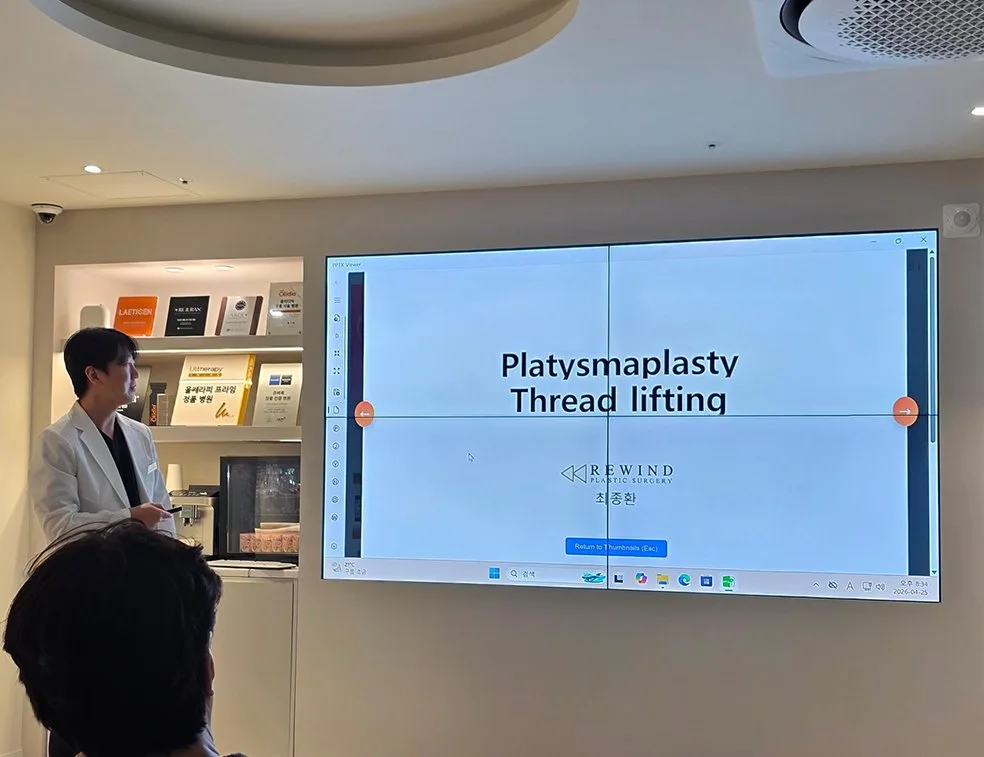
Dr. Jonghwan Choi presenting at an academic session
Fig. 06 — Academic session — surgical technique presented to peers

Rewind's Doctor

Dr. Jonghwan Choi Medical Director

A second operation is judged by
what it can safely undo.

A board-certified plastic surgeon with ten peer-reviewed papers indexed under his name, published across craniofacial and aesthetic surgery journals.

Board-certified plastic surgeon (Plastic Surgery)
10 peer-reviewed publications
Medical Director, Rewind Plastic Surgery
Korean Society of Plastic & Reconstructive Surgeons
Former chief director, Apgujeong Y&T Plastic Surgery
Korean Society for Aesthetic Plastic Surgery
J Craniofac Surg · JKMS · Arch Craniofac Surg
Korean Cleft Palate-Craniofacial Association
Voices

Google Reviews

What our patients say.

G 5.0 ★★★★★ 12 Google reviews · Rewind Plastic Surgery, Apgujeong — live-synced from Google Business Profile

"Sample review card — at launch this section pulls the clinic's real Google reviews automatically, shown verbatim with the reviewer's initial and posting date."

AReviewer namePOSTED ON GOOGLE

"Sample review card — reviews are never written or edited by the clinic; only what patients posted on Google appears here."

BReviewer namePOSTED ON GOOGLE

"Sample review card — a 'See all reviews on Google' link takes visitors to the clinic's Business Profile."

CReviewer namePOSTED ON GOOGLE
Ask

Questions

Revision rhinoplasty — frequently asked questions

What is a contracted nose?
Rewind describes it as the consequence of inflammation around the implant placed at a first operation, after which the skin of the nose hardens. Because the hardening shortens and stiffens the nose, the clinic notes that the problem can be functional as well as aesthetic.
When is the right time for revision rhinoplasty?
After six to twelve months. The clinic states that swelling and inflammation from the first operation need that long to stabilise, and it recommends a second operation only once the period has passed and the true result is visible.
Is a contracted nose a medical problem or only a cosmetic one?
Both, by the clinic's own description. It names the contracted nose as the case where revision becomes necessary, because the inflammation-driven hardening of the skin can produce functional trouble, including difficulty breathing, alongside the change in shape.
How many revision operations are possible on one nose?
Rewind does not give a maximum. Its stated position is that no exact number is fixed and that it differs between individuals, which is why the number of previous operations is something the surgeon weighs at examination before agreeing to another.
Can a revision be done for purely aesthetic reasons?
Yes. The clinic states that most revision patients come because they were dissatisfied with how the first result looked. A functional complaint such as obstructed breathing is an equally valid reason, and the two often appear together in a contracted nose.
What happens to the implant from my first operation?
It is removed, together with tissue damaged around it, as the opening part of the reconstruction. Removal is also a separate line on the clinic price sheet, so a nose that only needs the implant taken out can be planned and quoted without a rebuild attached.
What is used to rebuild the nose after removal?
The clinic publishes the sequence, which is removal, release of the contracted soft tissue and structural reconstruction, without naming the graft material. Its price sheet lists donated costal cartilage separately, so a cartilage framework is one option, decided after examination.
Does a revision cost more than a first nose operation?
Yes. Rewind lists a distinct revision rate against each nose procedure, set above the corresponding first-operation rate, and the steps of a rebuild are priced individually. The total is written out after examination, once the steps your nose needs are known.
I had my first operation somewhere else. Does that change anything?
It changes the information available. Bring your operative record if you can get hold of one, since what was placed and how it was placed shapes the plan. Where no record exists, the examination and imaging have to answer those questions.
Can breathing problems be corrected at the same time?
The clinic names functional trouble such as difficulty breathing as one of the reasons for revision, alongside dissatisfaction with the result. Whether both can be addressed in one operation depends on the finding at examination and on how far the envelope has contracted.
What additional risks does a second operation carry?
Scar tissue from the first surgery, thinned skin, and a blood supply already interrupted once. Bleeding, infection, asymmetry, altered sensation, visible scarring and prolonged swelling stay possible, and a rebuilt structure can still need further work.
Does Rewind publish a recovery timetable for revision surgery?
No. Unlike its first-operation pages, the revision page carries no figures for dressings, stitches or swelling, so none is quoted here. Those dates come from the surgeon afterwards and depend on how much had to be removed and released.
Booking

Reservation

REWIND,booking

Send us what was done at your first operation and when, and we reply within one business day, in your language.

Scientific evidence

Published research on contracted nose correction and secondary rhinoplasty

These papers cover the contracted nose and secondary surgery as a class: the capsule that forms around a nasal silicone implant, correction using conchal cartilage and dermofat, rib-cartilage frameworks with an auricular composite graft, costal cartilage after a complicated silicone rhinoplasty, and a regional review of revision for contracted noses in Asia. They report the techniques and settings of each study, they are not studies of Rewind Plastic Surgery, and they do not predict what a particular nose will do.