Surgery · Nasal dorsum
The dorsal line, settled in profile
Gangnam, Seoul | Board-certified plastic surgeon, Dr. Jonghwan Choi
KHIDI-registered for international patients · Apgujeong Rewind
Hump reduction rhinoplasty
The short answer
It is surgery on a nose whose bone stands proud of the line the rest of the dorsum makes. Rewind describes the shape as curved like a hawk's beak: the middle of the dorsum bulging into an arch, or a dorsum reading high because the area between the brows sits low while the tip has dropped. The published sequence has three parts. The nose is designed to the harmony of that particular face, the raised portion is shaved or trimmed down, and a silicone implant is placed so the corrected dorsum finishes smooth and even.
Source: Rewind's Korean surgical page for hump correction. Anaesthesia, operating time, the day stitches are removed and the number of days swelling lasts are absent from it, so this page states none of them. Prices come only from the clinic's price sheet.
A hump is a problem of one segment of the nose, and it is judged against the two segments on either side of it. That is why the same arch can call for different plans: on a high dorsum the correction is mostly subtraction, while on a nose that reads high only because the radix is shallow, lowering the arch alone would leave the profile flat in the middle. Rewind groups the presentations into three, and which group a nose belongs to is decided in profile at the examination.
Before & After
This operation lives or dies in the side view, so a useful case is photographed from the same angle, at the same distance, under the same light on both days. Rewind has released no dorsal case for this page. The four frames below therefore stay blank, with no stranger's profile borrowed to fill them.
These frames hold no photographs at present. Once the clinic releases dorsal cases, each caption will spell out every operation that patient underwent in the same session, because a smooth profile is usually the sum of several listed items. Individual results may vary. Swelling, bruising, irregularity of the dorsal line, altered sensation and scarring can follow surgery of this kind, and nothing is decided without the doctor's examination.
Three named patterns, one common finding
Rewind sorts hump noses into three groups and lists a fourth finding that often travels with them. The group decides how much of the plan is subtraction and how much is rebuilding.
Lower it, then rebuild the line
The clinic publishes three steps for this operation. Two further items live on its price sheet and are pulled in only where the examination asks for them, so they appear below as rungs of their own.
Step one on Rewind's page is a design made to the balance of the individual face. In profile that means fixing how much of the arch comes down and where the finished line should run between the brow and the tip, before an instrument is picked up.
The clinic's own wording for step two begins with taking the protruding part down by shaving or trimming it. This is the subtraction half of the operation, and it is the part that determines how much of the original dorsum is still there to build on.
The same published step ends with a silicone implant being inserted. Lowering an arch leaves a line that has to be re-established along its full length, and the implant is what Rewind states it uses for that. Whether anything else is needed alongside it is not written on the clinic page, so it belongs to the consultation.
The clinic's price sheet carries inner and outer osteotomy as its own item, and donated rib cartilage as another. Neither is claimed here as part of your operation. Both exist as lines that the examination may or may not add, and the quote shows which ones it did.
Step three describes a bridge completed smooth and natural. In practice the side view is compared against the drawing while the nose is still open, since that is the last moment at which an arch left a millimetre high can be brought down.

Why here
Plenty of hump patients arrive asking for the tip to be raised until it matches the arch. Rewind's published answer is direct: because the hump stands higher than everything around it, lifting the tip to meet it over-corrects, and the better route is to smooth the hump and correct the shape as a whole. That answer is a surgical philosophy, and it is worth knowing before you choose a clinic.
The clinic states that matching tip projection to an existing hump risks over-correction. Taking the arch down first keeps the tip working at the height your face already supports, and it keeps the profile from being pushed forward to hide a problem that could have been removed.
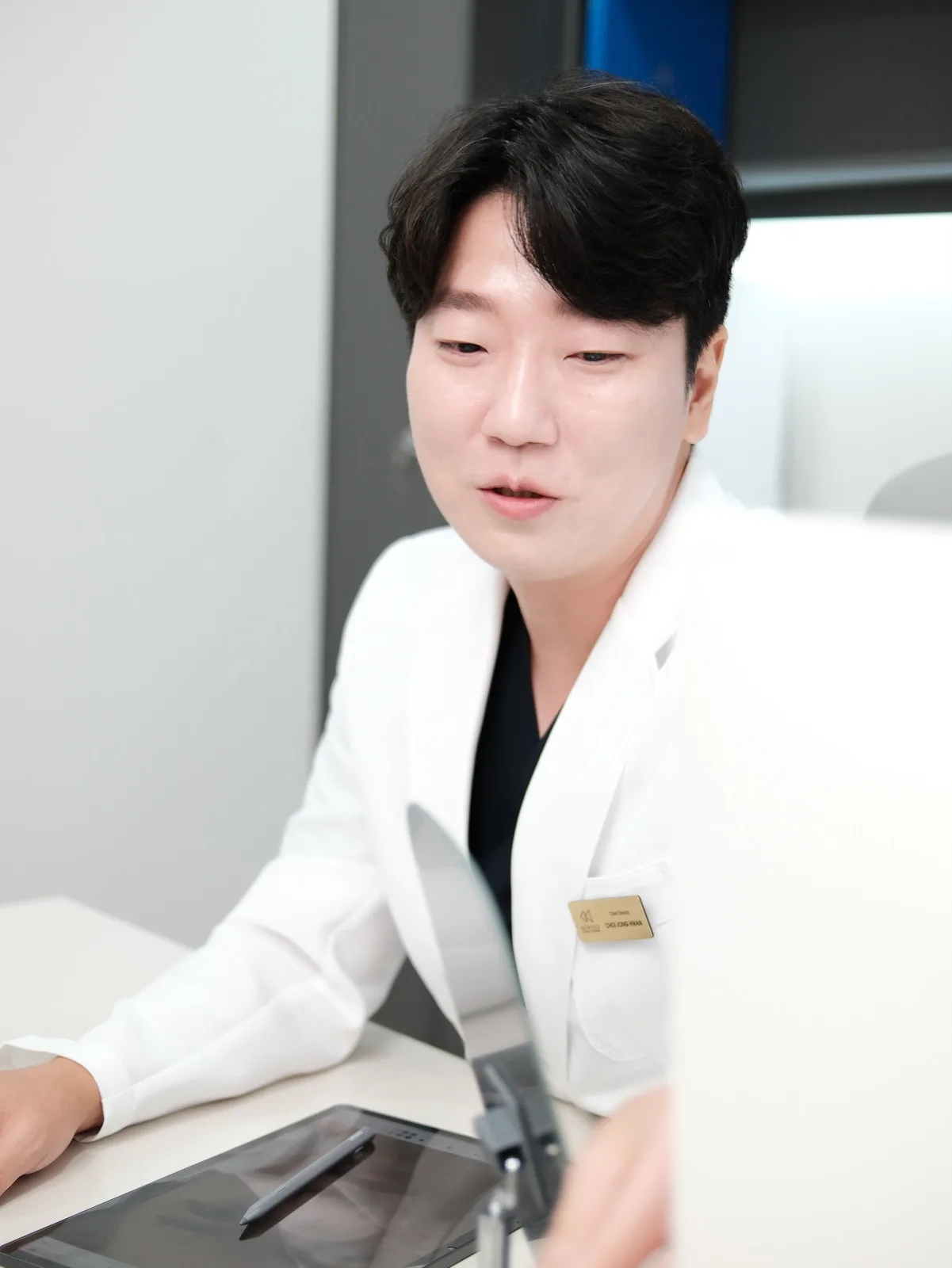
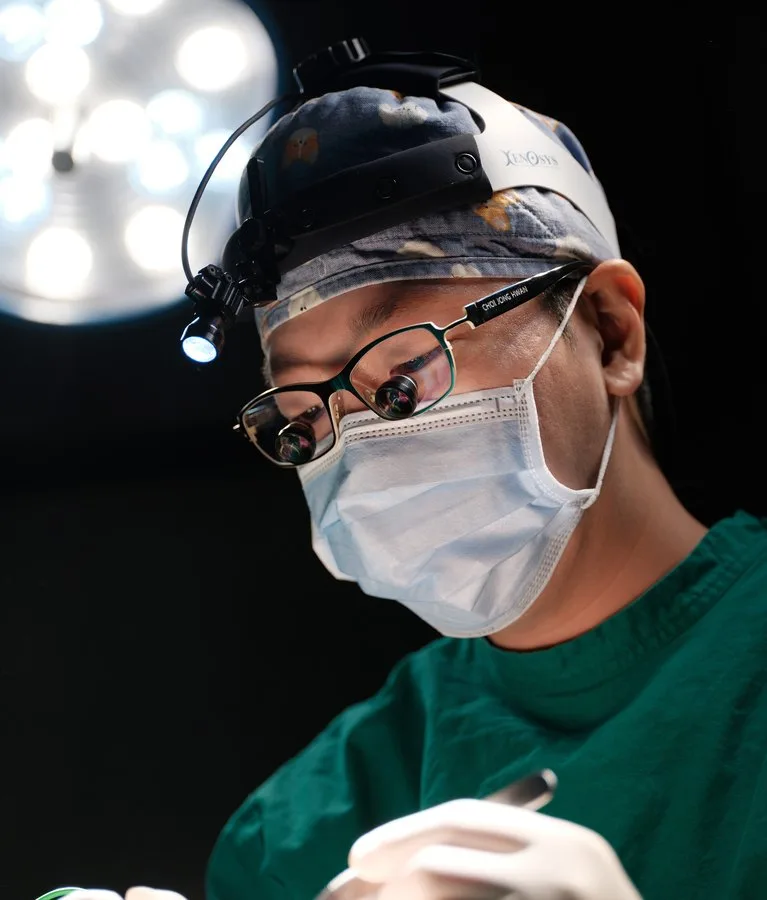
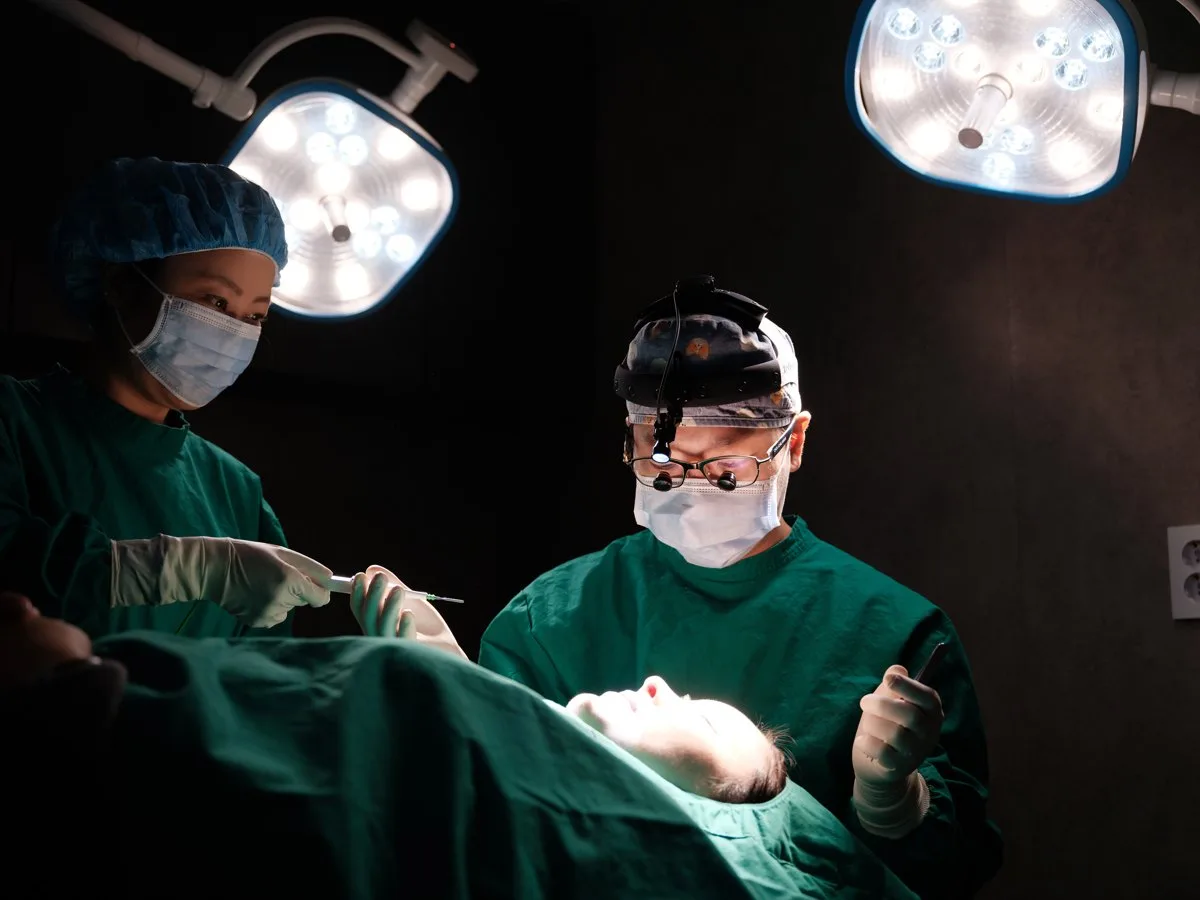
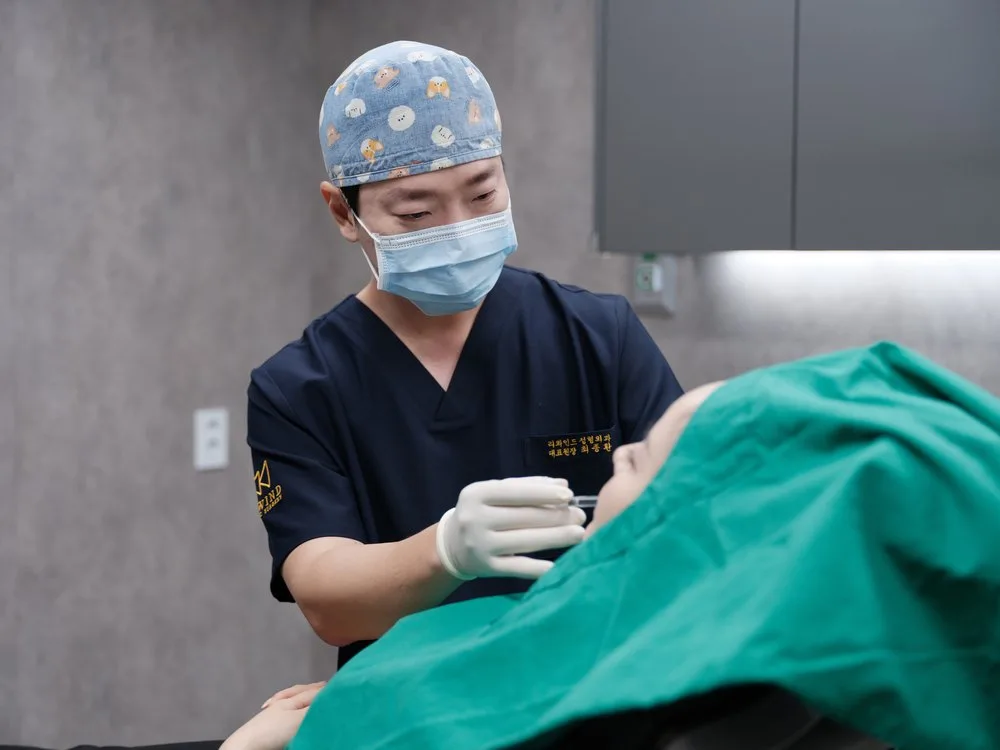
Rewind operates as a single-surgeon clinic. Dr. Choi reads the profile at the examination, sets how far the dorsum comes down, and is the person who later decides that it has come down far enough. No part of that judgement passes to anyone else.
The clinic describes accurate removal of the raised bone and stable repositioning of the cartilage structure as what keeps the result settled. No surgeon can promise that, and individual healing differs. What can be arranged is continuity: review visits with the operating surgeon, support in your own language, and KHIDI registration for foreign patients under Reg. M-2025-01-08-09288.
In the operating room

Fig. 04 — The room prepared, instruments laid out, before the patient comes through

Fig. 05 — A private room on the treatment floor, for the hours after surgery
Two floors of the Richro Building in Apgujeong hold the consulting rooms, the operating room and the private rooms patients rest in afterwards. Rewind runs on one surgeon and on appointments only, with consultation slots Monday, Tuesday, Wednesday and Friday until 19:00 and Saturday until 16:00.
Board-certified plastic surgeon
Dr. Jonghwan Choi is certified by the Korean board in plastic surgery and is the sole operating surgeon at Rewind, a clinic registered with KHIDI for the care of international patients under Reg. M-2025-01-08-09288.
Pricing
Rewind quotes the nose line by line. A hump plan usually starts from one listing and picks up others only where the profile requires them, so a quote reads as a short list.
Figures above are list prices; VAT sits outside them and the anaesthetic fee sits inside. Which lines belong to your nose is decided once the profile has been examined, and the finished list goes to you before any date is held. For a nose that has been operated on already, the clinic works from its revision rates, and those run higher than what you see here.
Suitability
Recovery
Rewind's post-operative notes for this operation are short and physical: keep pressure and chemistry away from a dorsum that is still setting. The four below are the ones with enough detail to plan around.
Surgery on the dorsum carries its own risks alongside the general ones. Every operation can bring bleeding, infection, swelling that lingers, uneven sides, changed sensation and a scar. Specific to this one are irregularity or a palpable step where bone was reduced, a line that settles differently from the drawing, and, because an implant is used, the chance of movement, visibility through thin skin or inflammation around it. Any of these can lead to further surgery. Individual healing differs and no outcome can be promised. Bring the full history of your nose, and your regular medication, to the consultation.
A dorsum can be lowered once. How much comes off is a judgement made in profile, at the examination and again in the operating room, and at Rewind both moments belong to the same board-certified plastic surgeon.
Rewind,
Rewind's Doctor
Dr. Jonghwan Choi Medical Director
A profile is not a line drawing.
It is bone, cartilage and skin,
each settling at its own speed.
A plastic surgeon certified by the Korean board in plastic surgery, with ten peer-reviewed papers to his name and a publication record centred on the craniofacial skeleton and the nose.
Google Reviews
"Sample review card — at launch this section pulls the clinic's real Google reviews automatically, shown verbatim with the reviewer's initial and posting date."
"Sample review card — reviews are never written or edited by the clinic; only what patients posted on Google appears here."
"Sample review card — a 'See all reviews on Google' link takes visitors to the clinic's Business Profile."
Questions
Reservation
Send us a side-view photograph and a sentence about the dorsal line, and we reply within one business day, in your language.
Scientific evidence
The first two compare the two families of dorsal technique under trial and review conditions, one as a randomised prospective study and one as a meta-analysis of what patients themselves reported. The third follows donated costal cartilage as graft material over two years in Asian noses. The last two describe what can happen around a nasal silicone implant: the tissue capsule that forms about it, and what is done when one extrudes or becomes infected. None of these studies was conducted at Rewind Plastic Surgery, none forecasts an individual result, and each describes its own technique and setting.