Surgery · Mouth-corner incision

Corner Lip Lift Scar

Where the line sits, and what it does afterwards

Gangnam, Seoul | Board-certified plastic surgeon, Dr. Jonghwan Choi
KHIDI-registered for international patients · Apgujeong Rewind

Corner Lip Lift Scar Smile Lip Incision Corner Lip Lift Scar Smile Lip Incision 
Line

Corner lip lift scar

Does a corner lip lift leave a mark, and where does it sit?

The short answer

Yes. This is surgery, and surgery leaves a line. In a Smile Lip at Rewind that line is a minimal incision placed along the crease running beside the corner of the mouth, and the clinic's stated reason for choosing that position is that a cut following the natural lip border is difficult to pick out afterwards. Difficult to pick out is the claim; invisible is not, and nobody can promise it. How the line matures differs between individuals, and it goes on changing long after the sutures come out at six to seven days. Rewind publishes no timetable for that maturation, so none is invented on this page.

The incision position, the tissue excised beneath it, the suture window and the eating and mouth-opening limits described here come from Rewind's own Korean page for Smile Lip. That page states no anaesthesia, no operating time and no date at which a line is considered settled, so this page states none of them either.

One detail matters more than most patients expect. The operation does not remove skin alone: slackened muscle is excised together with the redundant skin, and the corner is re-fixed above the mouth-corner muscle. That means the line you can see is closed over tissue that was rearranged beneath it, and the instructions about eating and opening the mouth exist to protect the deep work. A line placed perfectly can still be pulled during the weeks a mouth is being used carelessly.
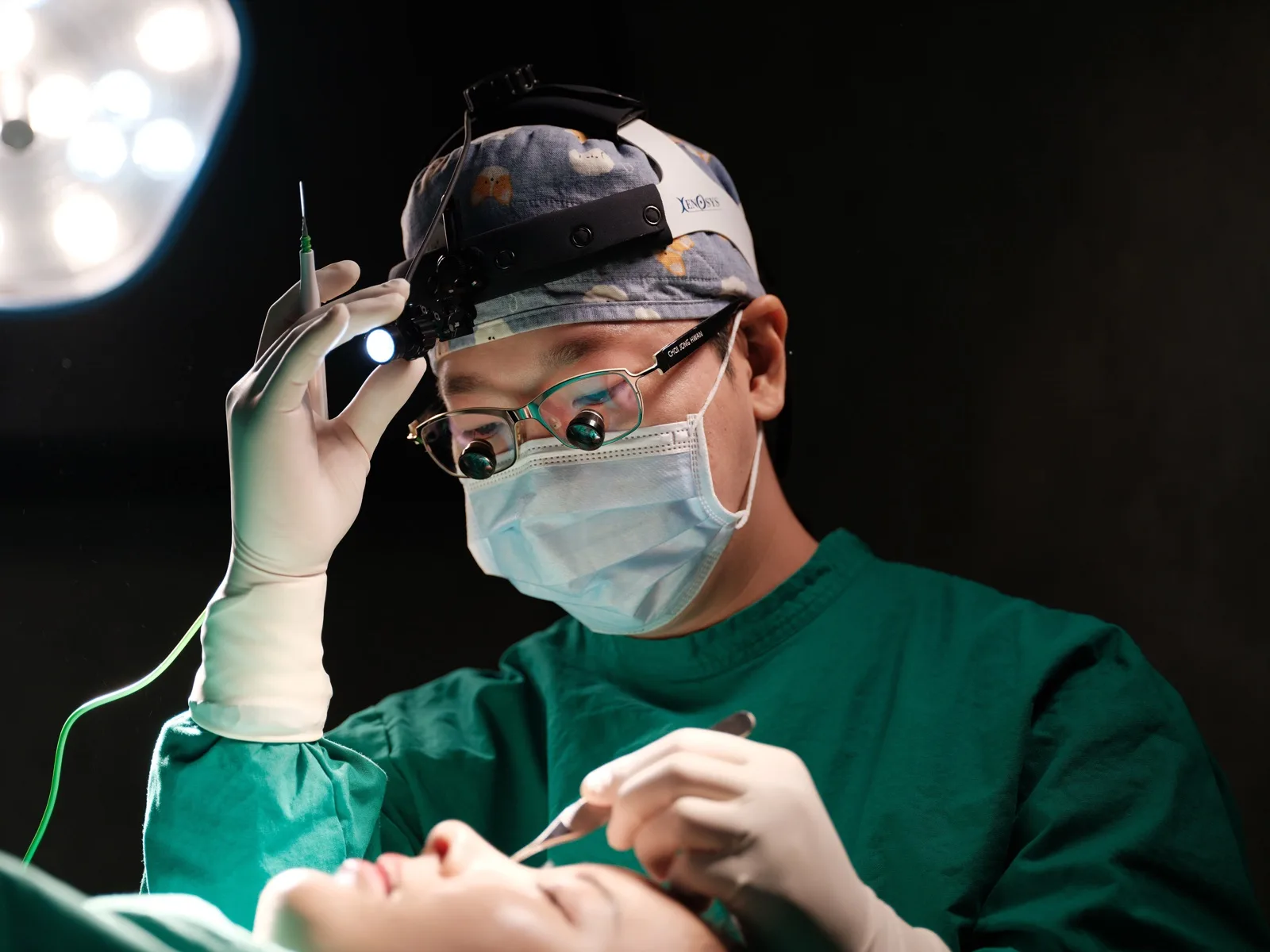

Dr. Jonghwan Choi operating under loupe magnification at Rewind Plastic Surgery
Fig. 01 — At the mouth corner, magnification is what keeps an incision on its intended line
Factors

What decides the line

Four things that decide how a Smile Lip line behaves

Scarring at the mouth corner is not one variable. Four of them act together, and only the first is fully in the surgeon's hands on the day.

factor 01
Where the incision is placed
Along the crease line beside the corner of the mouth. A cut that follows an existing border sits in a shadow that already belongs to the face, which is the clinic's reason for that placement. A line drawn somewhere convenient instead would be read as a line.
factor 02
What was removed underneath it
Loosened muscle is excised with the redundant skin, and the corner is re-fixed above the mouth-corner muscle. A closure over rearranged tissue behaves differently from a closure over nothing, and the restrictions afterwards are therefore about the mouth and hardly at all about dressings.
factor 03
How much the mouth is used while it heals
Chewing, wide bites and wide yawns all pull directly across the corner. Rewind's soft-food and mouth-opening limits protect the fixation first, and the line second, because tension across a healing closure is what tends to leave it wider.
factor 04
The way your own skin scars
Keloid or hypertrophic scarring in your history changes the calculation entirely, and it is asked about at consultation. Where that history exists, this operation trades a direction at the corner for a line that may stay obvious, and the surgeon says so before a date is offered.

Only the first two of those belong to the operation itself. The third is yours to manage for a period measured in weeks, and the fourth was decided long before you walked in. A consultation that does not ask about the fourth has skipped the part of the conversation that matters most on this page.

Course

From incision to settled line

What happens to the corner lip lift line, stage by stage

Five stages separate the cut from a line nobody comments on, and the clinic publishes markers for the middle three. The first and the last belong to judgement; no calendar covers them.

01Placement

The corner lift incision is drawn before anything is opened

Both corners are designed against your facial proportion and the shape of your own mouth, with the published lip proportion of 1:1.615 as the reference the drawing is checked against. The two marks are rarely identical, because the amount of loosened tissue differs between the sides, and the line follows the crease on each side separately.

02Closure

The line is closed over excised muscle and re-fixed tissue

The minimal incision is what the excision and the fixation are performed through. Skin is not simply trimmed and stitched; the corner is secured at a level above the muscle beneath it, and the closure then sits over that. A surface line and the work under it heal on the same schedule.

03Sutures

Stitches out at six to seven days, with swelling still present

Rewind removes the sutures at about six to seven days and states that swelling then subsides gradually. A line assessed on the day the stitches leave is a line surrounded by swelling, and patients who judge it that afternoon are judging something that will not be there in a month.

04Protection

Weeks of restrictions that keep tension off the corner

Mainly soft food for the first one to two weeks, and no wide opening of the mouth for one to two months counted from the day the stitches come out. Both instructions keep the corner from being stretched in the direction the surgery worked against, and both have more to do with the line than they appear to.

05Maturing

The months in which the line stops announcing itself

A closure beside the mouth goes on changing after the restrictions end, and the pace differs between individuals. Rewind publishes no month at which the line is called finished, so it is reviewed visit by visit with the operating surgeon, who has the original drawing to compare it against.

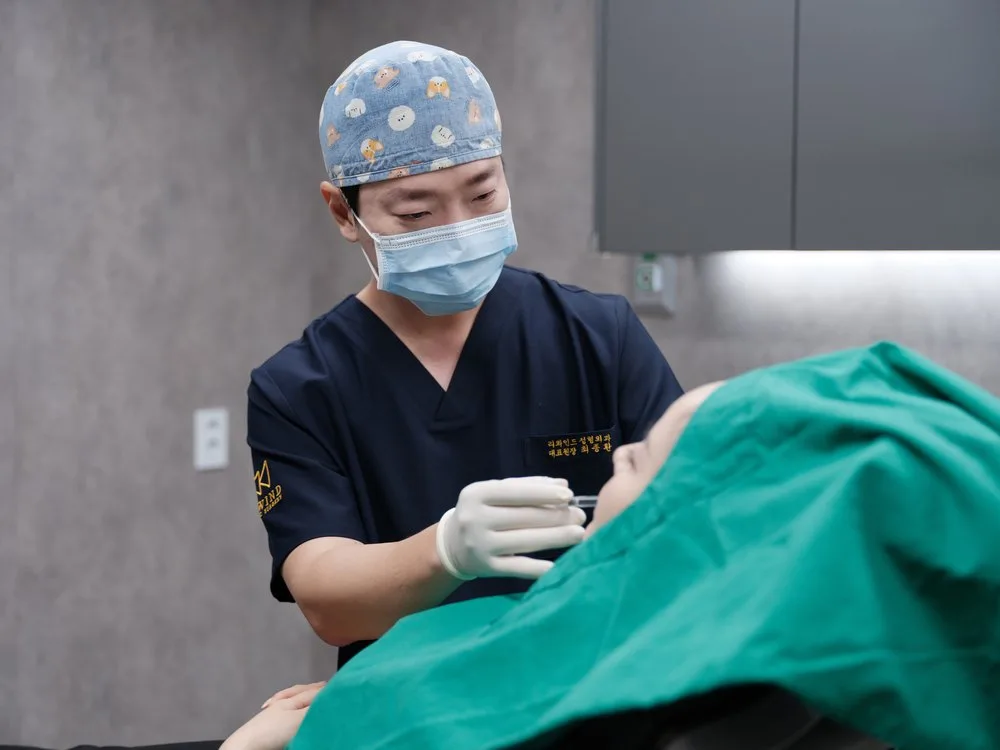
Consultation with Dr. Jonghwan Choi at Rewind Plastic Surgery
Fig. 02 — The line is reviewed by the surgeon who placed it, at intervals set in advance
Rewind

Why placement first

Why the corner lift incision is sited before the amount is decided

A mouth corner offers a small number of places where a cut can hide, and one of them is the crease that already runs beside it. Deciding where the line will live comes before deciding how much tissue leaves, because the second choice has to fit inside the first.

01Borders

A corner lip lift line follows a border the face already has

The clinic places the incision along the wrinkle line beside the corner, where an existing shadow does part of the work of concealment. The position is a stated surgical choice, and it is the reason the operation is described as leaving a line that is difficult to notice.

02Layers

Skin, muscle and fixation are handled as one decision at the corner

Removing skin alone would leave the soft tissue underneath doing the same downward work as before, so muscle is included in what comes out and the corner is re-fixed above the muscle. Reading a lower face as a stack of layers is surgical work, and it is what a plastic surgery practice is for.

03Months

The surgeon who closed the line is the one watching it mature

Follow-up sits with the operating surgeon through the weeks of restrictions and the months after them. Patients travelling from abroad correspond in their own language from the first message, at a clinic registered with KHIDI for foreign patients under Reg. M-2025-01-08-09288.

Private recovery room at Rewind Plastic Surgery
Fig. 03 — The quiet hours after the closure, before the weeks of restrictions begin
Theatre

Around the incision

What surrounds a corner lip lift incision on the day

Draped preparation of a patient in the procedure room at Rewind Plastic Surgery

Fig. 04 — Preparation, before the first cut beside the corner

Clinic interior at Rewind Plastic Surgery, Apgujeong

Fig. 05 — The clinic floor in Apgujeong

Rewind occupies the fourth and fifth floors of the Richro Building in Apgujeong and operates in its own theatre, with one surgeon carrying the case from the drawing to the last review of the line. Consultations run Monday, Tuesday, Wednesday and Friday from 10:00 to 19:00 and on Saturday from 10:00 to 16:00, by appointment. The points below are what the clinic publishes about the incision and what it asks of you afterwards.

Minimal incision along the crease beside each corner
Design checked against a lip proportion of 1:1.615
Each side marked separately before anything is opened
Loosened muscle excised together with redundant skin
Corner re-fixed above the mouth-corner muscle
Sutures removed at about six to seven days
Soft food for the first one to two weeks
No wide mouth opening for one to two months after that
Dr. Jonghwan Choi, board-certified plastic surgeon at Rewind

Board-certified plastic surgeon

Each incision described here is placed by Dr. Jonghwan Choi, certified by the Korean board in plastic surgery, with membership of the Korean Society of Plastic and Reconstructive Surgeons and published work in craniofacial surgery. Patients from abroad are treated under KHIDI registration M-2025-01-08-09288.

Rates

Published rates

What the operation that leaves this corner lift line is listed at

The figures below are the clinic's standard published rates for a first operation. They are worth reading on a page about scarring, because a second operation on the same corner is quoted differently and starts from a line that already exists.

Corner lip lift (Smile Lip)Both corners: design, minimal incision at the crease, excision of muscle with skin, re-fixation above the muscle
₩1,700,000
Lip reduction, where the lip body is also treatedA separate operation with its own incision inside the lip and its own recovery, quoted on its own line
₩1,700,000
Sedation, where the surgeon calls for itA separate item on the clinic's sheet; the anaesthesia used for a given Smile Lip is not published in advance
₩200,000

Each figure is a standard listed rate that already counts the anaesthetic fee and has VAT added on top. Revision of a corner operated on before is quoted from the clinic's revision rates, which sit above these figures, and the surgeon has to see how the first line healed before any number is attached to it. Nothing here is a promotional rate, and no figure is issued by message before the mouth has been examined.

Risk

Who should think longer

Whose corner lip lift line is likely to settle quietly, and whose may not

Circumstances that favour a discreet line

  • An existing crease beside the corner for the incision to follow, which is checked at examination
  • No history of raised or thickened scarring anywhere on the face or body
  • Skin around the mouth free of active inflammation, and dental work already settled
  • A schedule that genuinely allows soft food and a quiet mouth for the weeks the clinic asks for
  • Willingness to attend the suture visit at days six to seven with the operating surgeon
  • An understanding that a discreet line is a line, and that it will be visible for a period first

Circumstances in which the operation may be declined or delayed

  • Keloid or hypertrophic scarring in your history, where a line at the corner can stay obvious and the trade is a poor one
  • A demand for a mark that cannot be seen at any distance, which no surgeon can undertake to deliver
  • Wounds that healed slowly before, a clotting disorder or daily blood-thinning medication
  • Active cold sores, inflammation or infection of the lip or the skin around the mouth
  • Pregnancy or breastfeeding, where the operation waits
  • Travel plans that put a wedding or a filming date inside the first fortnight after surgery
  • A complaint that is really about lip volume, where the corner needs no incision at all and lip reduction is the relevant operation
Care

Protecting the closure

How the corner lip lift line is looked after, week by week

Aftercare for this operation is unusual in that almost none of it involves touching the line. It is about how the mouth is used, because the mouth is what pulls on the closure.

Days one to seven
The sutures stay, and the corner is left alone
Stitches are removed at about six to seven days, and swelling subsides gradually from then on. Until that visit the corner is not pressed, rubbed or tested with a fingertip, and any change in the shape of the corner is a reason to come in early.
Week one to two
Soft food while the closure takes hold
Mainly soft food through the first one to two weeks. Chewing loads the tissue that was excised and re-fixed, and every hard bite in that window is tension delivered straight across the healing corner.
One to two months
No wide opening, counted from suture removal
Large bites, wide yawns and dental appointments that hold the jaw open are all off the list for one to two months after the stitches come out. This is the longest of the clinic's published restrictions and the one patients underestimate most.
The months after
Review, at intervals agreed in advance
Once the restrictions lift, the line is assessed at each review with the operating surgeon. Patients who have flown home send photographs at the intervals set before they left, so a line behaving unusually is seen early and discussed while options remain open.

Named risks for this operation include bleeding, infection, prolonged swelling, a line at the corner that stays visible, asymmetry between the two sides once the swelling settles, altered sensation around the corner, tightness or discomfort on wide opening, and a corner raised further or less far than intended. Any of those can lead to a further procedure quoted at revision rates. How a surgical line matures differs between individuals and no specific appearance can be promised. Tell the surgeon about every operation performed around your mouth or jaw and every medicine you take daily before a surgical date is agreed.

Doctor

Professional

The incision, the excision beneath it, the fixation and every review of the line afterwards belong to one board-certified plastic surgeon. A closure at the mouth corner is measured in millimetres, and millimetres do not survive being handed between people.

Dr. Jonghwan Choi, board-certified plastic surgeonRewind,
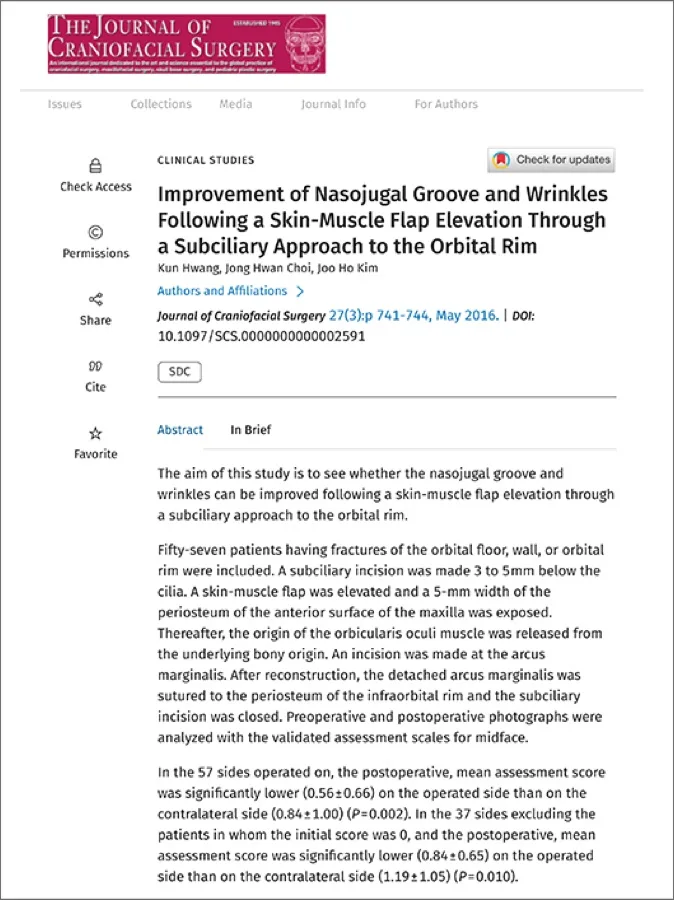
Peer-reviewed paper by Dr. Jonghwan Choi in the Journal of Craniofacial Surgery
Fig. 06 — Indexed work under his name in the Journal of Craniofacial Surgery

Rewind's Doctor

Dr. Jonghwan Choi Medical Director

A line is chosen once.
Everything after it is patience.

A board-certified plastic surgeon in plastic surgery, with ten peer-reviewed papers indexed under his name and published work in craniofacial and facial reconstruction.

Board-certified plastic surgeon (Plastic Surgery)
10 peer-reviewed publications
Medical Director, Rewind Plastic Surgery
Korean Society of Plastic & Reconstructive Surgeons
Former chief director, Apgujeong Y&T Plastic Surgery
Korean Society for Aesthetic Plastic Surgery
J Craniofac Surg · JKMS · Arch Craniofac Surg
Korean Cleft Palate-Craniofacial Association
Voices

Google Reviews

What our patients say.

G 5.0 ★★★★★ 40 Google reviews · Rewind Plastic Surgery, Apgujeong — live-synced from Google Business Profile

"There are just way too many cosmetic clinics in Korea and I'm so happy I found Rewind Clinic in Gangnam. Dr. Choi was so kind and patient while explaining the different face-lifting options, from threads to mini-lifts to deep-plane lifts. I've had procedures in Taiwan and the US and now m…"

JJ. S.3 MONTHS AGO · POSTED ON GOOGLE

"Really nice environment. Doctor is easy to communicate and understands my visions. Waited two weeks to make a review and I confirm the results exceeded my expectations and I am super happy with it. Can't wait to come back!! :))"

KKristie Chu3 MONTHS AGO · POSTED ON GOOGLE

"I found Rewind clinic through a Korean chat forum and many local clients highly recommended it. The clinic is brand new, featuring large, clean rooms and many private waiting areas so it doesn't give off that "factory" clinic vibe. All the staff, including the receptionists, nurses, a…"

JJ. Siou3 MONTHS AGO · POSTED ON GOOGLE

"You know how you get self-conscious about your facial contours before going on vacation? I was wondering what I could do to see quick results, and a friend recommended Apgujeong Rewind Plastic Surgery. All the staff were friendly, and the facilities were incredibly pleasant—it felt like a hotel! Val…"

똑띠언니A MONTH AGO · POSTED ON GOOGLE · Translated by Google

"I went for a consultation for lip fillers and am leaving this review because I am so satisfied with the results. I told them about the lip line I had always wanted, and they carefully examined my face shape and features to naturally recreate a shape that suited me well. The director definitely has …"

WWang, Ziyuan(경영대학 경영학과) ­2 MONTHS AGO · POSTED ON GOOGLE · Translated by Google
Ask

Questions

Corner lip lift scarring — what patients ask at consultation

Will the mark from a corner lip lift ever disappear completely?
No surgeon can undertake that. The clinic's position is that a cut following the natural lip border is difficult to pick out afterwards, which is a claim about how noticeable a line is and not a claim that it goes away. How a line matures differs between individuals, and Rewind publishes no timetable for it.
Exactly where is the incision placed?
Along the wrinkle line running beside the corner of the mouth, on each side separately. The position is chosen so the cut sits in a border the face already has. Both corners are marked before anything is opened, and the two marks are rarely identical because the sides differ.
How long before the line stops being obvious?
Rewind publishes no figure for that. What it does publish is the sequence: sutures out at about six to seven days, swelling subsiding gradually from there, soft food for one to two weeks and no wide opening for one to two months afterwards. The line keeps changing past the end of those restrictions.
Why do the eating rules matter to a scar?
Because chewing pulls across the corner. The operation excises loosened muscle with redundant skin and re-fixes the corner above the muscle, so the closure sits over rearranged tissue. Tension delivered through a hard bite in the first fortnight reaches the deep repair before it reaches anything on the surface.
I scar badly. Should I have this operation at all?
Raise it at the consultation before anything else. A history of keloid or hypertrophic scarring changes the trade this operation offers, since it exchanges a direction at the corner for a line beside the mouth. Where that history exists the surgeon says so, and the operation is declined or delayed instead of attempted.
Can makeup cover the line while it is healing?
Ask at the suture visit, since it depends on how your own closure looks at that point and nothing published by the clinic sets a date. Until the stitches are out at six to seven days the corner is left alone entirely, with no pressing, rubbing or testing of the area.
Will both sides look the same?
Different amounts of tissue are excised from each corner, because the sides rarely start level. Asymmetry once the swelling settles remains a recognised complication of this operation and is discussed before surgery; complete symmetry is beyond what any surgeon can promise.
What can be done if the line stays raised?
Raise it with the operating surgeon at a review visit rather than waiting. A corner that has been operated on is assessed on what was excised the first time and how the tissue healed, and further work is quoted from the clinic's revision rates, which sit above the first-operation figure.
Booking

Reservation

REWIND,booking

Tell us about any raised or thickened scarring in your history before anything else, and we reply within one business day, in your language.

Scientific evidence

Published work on incisions and healing around the mouth

Each of these papers sets out where an incision is placed around the lip and what the authors report about the closure afterwards: a description of the surgical corner-of-mouth lift, a reference on commissure elevation and the grooves running down from it, a single-technique series in which the scar line is the central design question, and a reduction cheiloplasty paper covering markings and the recovery that follows. The series described belong to those surgeons and their patients. Nothing in them predicts how one particular corner will heal.