Non-Surgical · Contour Injection
A contour decision measured in centimetres of jaw line, never in kilograms
Gangnam, Seoul | Board-certified plastic surgeon, Dr. Jonghwan Choi
KHIDI-registered for international patients · Apgujeong Rewind
Fat dissolving injection
The short answer
A fat dissolving injection places a lipolytic preparation into a defined pocket of subcutaneous fat so that fat cells in that pocket break down and their contents are carried out of the body. Rewind's Korean page calls the treatment a contour injection and describes it as reducing unwanted fat and fluid retention to make the line of the face lighter and better defined, working on the heaviness around the cheeks, the under-chin and the jaw line. The clinic's own material states that no anaesthesia is used and that there are no stitches to remove.
Source: Rewind's own treatment documentation. The exact composition of the preparation is described there only as a substance acting on fat cells, so this page does not name an active ingredient. Appointment length is not stated here either. Both belong to the consultation, where the product can be identified to you directly.
Two things about that description deserve emphasis, because they decide whether this treatment is right for you. The first is locality. The injection works where the needle goes and nowhere else; an area of fat that is deliberately reduced on your jaw line has no effect on the number on a scale. This is a contour treatment and it belongs in no conversation about body weight, appetite or metabolism.
The second is the unit of purchase. Rewind's Korean page states that the clearest change generally appears after two to three sessions, varying with how much fat is present. So a single appointment is a step in a short plan. Anyone quoting you a face on the strength of one syringe is describing something the clinic's own material does not claim.
There is also a route this treatment is frequently confused with. Removing under-chin fat surgically, by double chin liposuction, is a single operative event with its own candidacy, its own recovery and its own page. The comparison between the two is a genuine decision, and it is set out further down, because patients who understand the difference choose better than patients who were sold whichever one they walked past first.
Where it is placed
Rewind's page lists the regions it treats and the kind of patient it suits, and the two lists overlap almost completely. Heaviness that reads as a blurred line, in a defined pocket, in someone who does not want an operation. The four zones below follow that material.
That last card is the one to read twice. Part of what shifts in the first weeks is fluid, and fluid comes back if the reason for it has not changed. Fat cells broken down in a treated pocket are a slower and more durable part of the picture, and separating those two components carefully at the review is the difference between a satisfied patient and one who feels the treatment stopped working. Rewind's material also names its assessment tools by function: an ultrasound scan used to read fat thickness, deeper fat and the salivary gland, and a facial contour analyser used to record height, contour, lines and hollowing before a plan is designed.
How it works
Four steps, and this clinic's own position sits in the fourth. The first three describe the mechanism; the fourth describes how much of that mechanism the published record can actually vouch for in the product used here.
Rewind's material describes using ultrasound to read the thickness of the fat, distinguish superficial from deep fat and identify the salivary gland, together with a facial contour analyser that records the surface. Fullness under a jaw is not always fat; a prominent gland or a slack muscle band can produce the same silhouette and will not respond to a lipolytic at all.
The clinic describes injecting the preparation densely through the unwanted fat layer. Spreading the dose across many small deposits is what allows a defined pocket to be treated evenly. The material also states plainly that this is done without anaesthesia and that no stitches are involved.
Rewind's description is that fat cells are destroyed and their contents excreted from the body, reducing the number of fat cells in the treated pocket. That process runs for weeks after you have left, so the appointment is judged at the review and never in the mirror on the way out. Swelling during that window is expected and is not the result.
The strongest published work in this category examines deoxycholic acid under the chin: phase III trials, a large multicentre study and pooled analyses, all listed at the foot of this page. Work on phosphatidylcholine and deoxycholate formulations is more cautious, and one review asks in its title whether the risk is worth taking. Rewind's page does not disclose its formulation, so this clinic does not claim those trials as evidence for its own product. Ask at the consultation which preparation is being proposed for you.

Judgement
This is the most over-prescribed item on any aesthetic price list, because it is cheap to buy, quick to give and easy to repeat. Three positions keep it in proportion here.
Superficial fat, deep fat beneath the muscle, a prominent salivary gland and a slack platysma band all produce the same outline in a mirror. Only the first answers well to an injection. Rewind's own workflow puts an ultrasound read of fat thickness, deep fat and the gland before the plan, and a patient whose fullness turns out to be gland or muscle is told so at that point.
The clinic's material puts the clearest change after two to three sessions, depending on how much fat is present. That number is also a ceiling on patience. Where a short plan has not moved the line, the answer is to re-examine what the fullness is made of, and not to sell a fourth, fifth and sixth appointment against the same wrong diagnosis.
Dr. Jonghwan Choi performs under-chin surgery regularly, which makes him a poor salesman for an injection that cannot reach the volume in front of him. A large, dense pad or an outline driven by the muscle belongs to a surgical conversation. Being sent to that conversation is not an upsell; it is the alternative to paying repeatedly for an undersized tool.
On the day

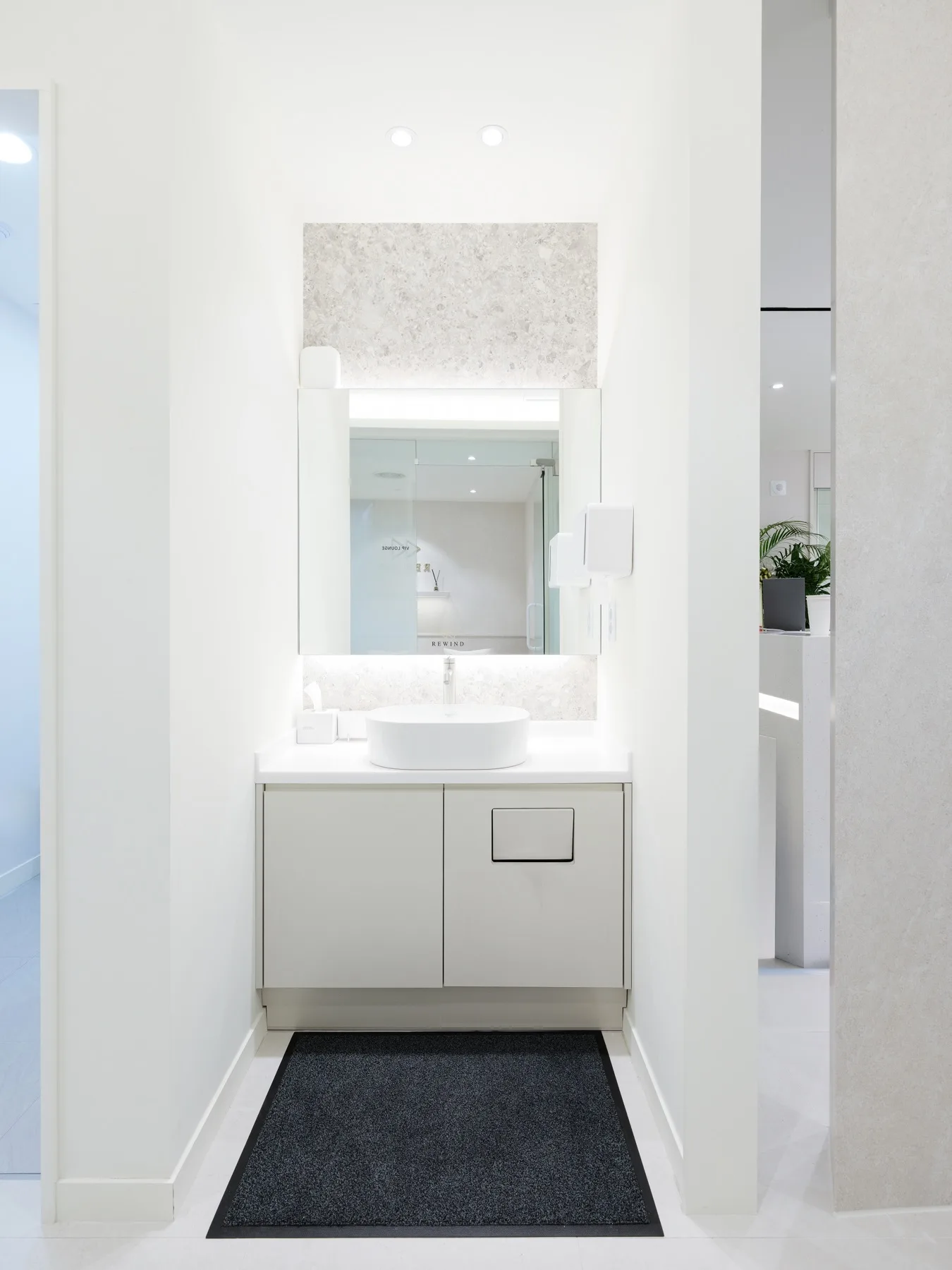
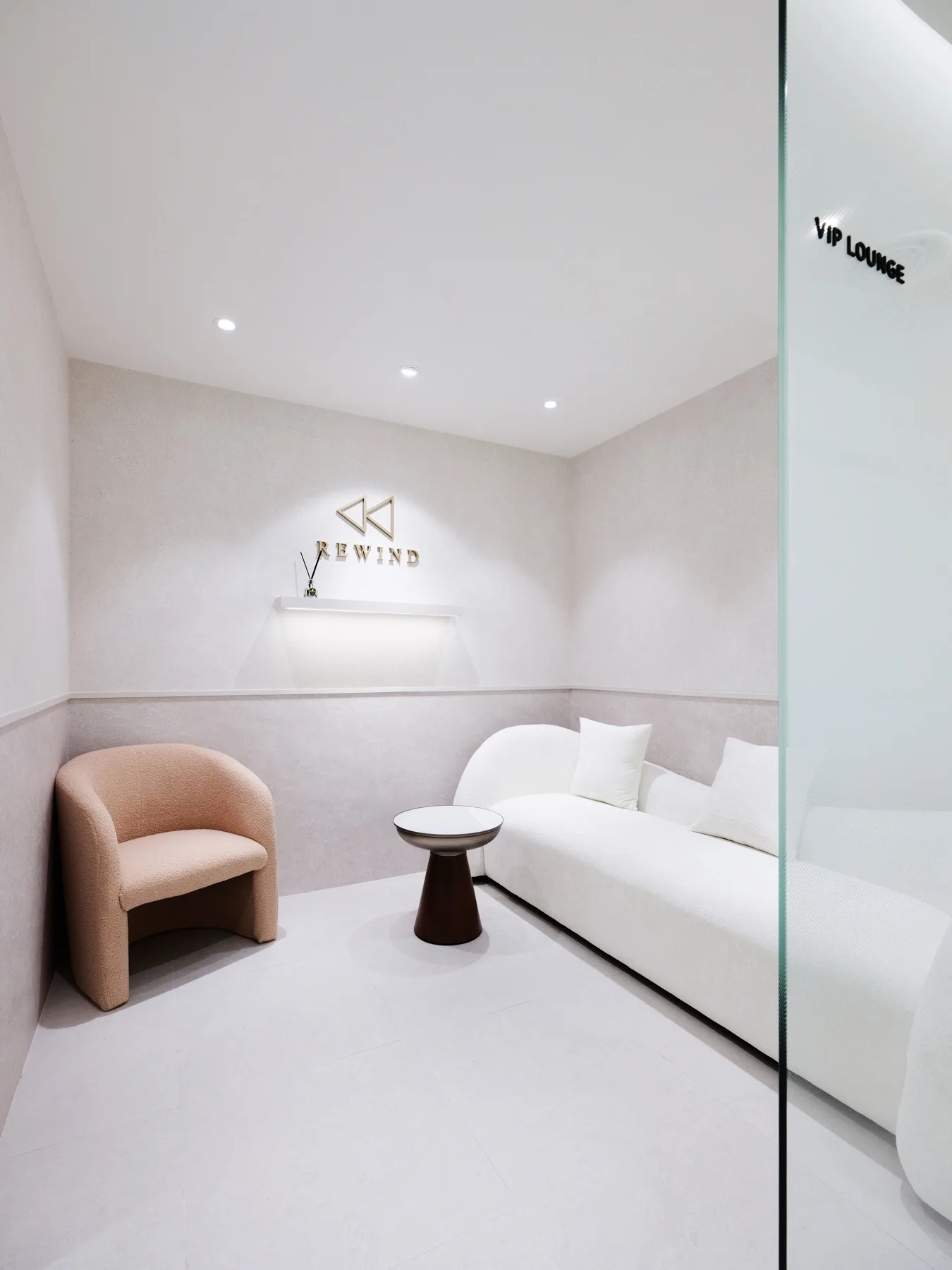
Fig. 04 — A treatment room on the clinic floor

Fig. 05 — Where early swelling is allowed to settle before you go
The face is cleansed and the area is read again against what the mapping showed, because a jaw line does not look the same lying down as it did sitting upright at the desk. The zone is marked, and the deposits are placed across the layer in a close pattern. Rewind's material states that no anaesthesia is used for this treatment and that there are no stitches afterwards. Most patients describe a stinging that arrives with the injection and fades quickly. Appointments run on the fourth and fifth floors of the Richro Building in Gangnam, Seoul, by appointment, Monday, Tuesday, Wednesday and Friday from 10:00 to 19:00 and on Saturday from 10:00 to 16:00.
You will be swollen leaving the room and that swelling is part of the treatment working, so nothing about the result can be judged on the day. Photographs taken at the clinic are repeated at the review under the same lighting, which is the only way a change of this size can be told apart from a change of camera angle.
Case photography
No consented case series for this treatment has been released, and the cards below stay empty until one exists. Jaw line photography is unusually easy to fake without meaning to: a chin lifted two centimetres, a camera moved slightly higher and a different shirt collar will produce a visible improvement on a face that has had nothing done to it.
When pairs are published they will state the number of appointments completed, the interval since the last one, the volume used and the date of each frame, shot at matched distance and matched lighting with the head in a fixed position. Written consent will be on file for every pair. No specific outcome can be promised from another patient's face, and individual results may vary.
Pricing
The first line is the published volume for facial contour work and it is priced per appointment, which matches how the treatment is actually bought. The second line is the device route to the same complaint, listed beside it because patients deciding between a syringe and a handpiece deserve to see both figures at once.
VAT is charged on top of both figures and anaesthesia costs are already counted inside the published rates, which in the case of the injection is a formality, since the clinic's material states that none is used. Larger volumes and combinations with other treatments carry their own lines and are quoted at the consultation once the mapping is done; no total for a plan is issued before then, because the number of appointments is the term that moves. Surgical removal of under-chin fat is priced separately and appears on its own page.
Suitability
This is the decision the treatment lives or dies by, so it is set out as two lists. The left-hand column is where the syringe is the better tool. The right-hand column is where it is turned down, and several of those entries send a patient to double chin liposuction instead.
Recovery
Rewind's own aftercare for this treatment is four instructions long and each one has a reason behind it. The cards follow that instruction sheet; the paragraph beneath them names the risks in full.
The risk list belongs in plain sight. Rewind's page records swelling and a stinging soreness resolving within days. Beyond that, the recognised profile for injectable lipolysis includes bruising, firm nodules under the skin that take weeks to soften, numbness over the treated zone, tenderness on pressure, and asymmetry where one side responds faster than the other. The serious end of the list is rare and is documented: a published systematic review of serious adverse events after deoxycholic acid injection for under-chin and jowl fat describes skin ulceration and tissue injury at injection sites, and weakness of the marginal mandibular nerve producing a temporarily uneven smile. A separate review of phosphatidylcholine and deoxycholate formulations questions the risk profile directly in its title. Those papers are listed below. Any area that hardens and keeps hardening, any skin that discolours or breaks down, any asymmetry of the smile and any fever are reasons to contact the clinic the same day, ahead of the next appointment.
At Rewind, one board-certified plastic surgeon carries every case — from the first consultation to the final follow-up. Because a face is a story, and a story deserves a single author.
Rewind,
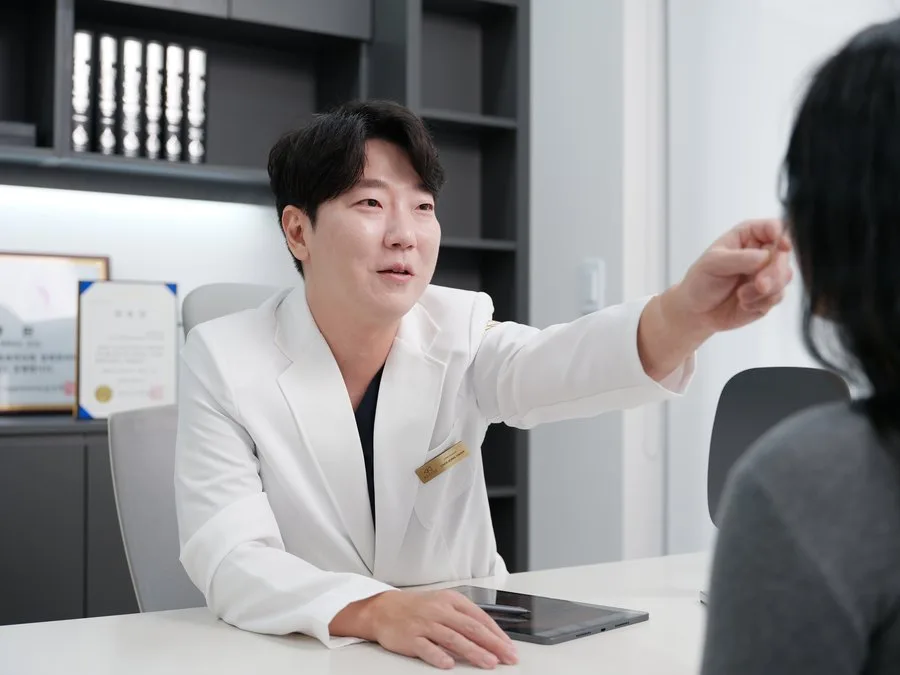
Rewind's Doctor
Dr. Jonghwan Choi Medical Director
One surgeon, from the first
consultation to the last follow-up.
A board-certified plastic surgeon devoted to anti-aging lifting — with the precision and restraint built through years of craniofacial practice.
Google Reviews
"Sample review card — at launch this section pulls the clinic's real Google reviews automatically, shown verbatim with the reviewer's initial and posting date."
"Sample review card — reviews are never written or edited by the clinic; only what patients posted on Google appears here."
"Sample review card — a 'See all reviews on Google' link takes visitors to the clinic's Business Profile."
Questions
Reservation
Tell us what you are considering — we reply within one business day, in your language.
Scientific evidence
These six papers cover the whole arc of this treatment category. Two laboratory studies establish which component of an injectable formulation does the work and how selectively it acts on fatty tissue. Two clinical trials, one European phase III and one multicentre phase 3 programme, measure what a deoxycholic acid injection achieves under the chin against placebo. The final two are the reason the risk paragraph above is written as it is: a systematic review of serious adverse events with management recommendations, and a review asking directly whether phosphatidylcholine and deoxycholate injection is worth the risk it carries. All of them concern deoxycholic acid or phosphatidylcholine preparations and none was carried out at Rewind Plastic Surgery, which is also why this page declines to present them as evidence for a formulation the clinic has not disclosed.