★★★★★
Came to REWIND to get my facial treatment and i'm absolutely obsessed about it💞 the doctor is so kind and is an expert! Everyone must visit!
 YunHee Hong2 weeks ago
Non-Surgical · Hyaluronidase · Existing Filler
Filler placed by a previous provider, in Korea or abroad, and what is needed to reverse it
Gangnam, Seoul | Board-certified plastic surgeon, Dr. Jonghwan Choi
KHIDI-registered for international patients · Apgujeong Rewind
Existing filler
The short answer
Yes, when the filler is hyaluronic acid. Hyaluronidase breaks down hyaluronic acid gel whoever injected it, whenever that was and in whichever country, so the origin of the filler does not decide the answer. The material does. Before anything is injected, Rewind needs whatever helps establish what was placed, where it now sits and whether you have reacted to the enzyme before. If the product turns out not to be hyaluronic acid, the enzyme will have no effect and the plan changes.
Rewind lists filler dissolving as its own treatment, charged per area. How the area is numbed, how long the visit takes and how many passes may be needed are confirmed at the consultation.
Filler you already have often arrives with gaps in its story. The brand name may be lost, the injection may date back years, and several sessions may have added different products to the same area. None of that rules out dissolving. It does mean the first appointment is spent working out what is there before any enzyme is drawn up.
That appointment is practical in aim. It describes the tissue as it is today and what can be done about it. It does not grade the earlier treatment, and nobody will ask you to justify having had it. Filler can change its look over years for many reasons, the ageing of the face around it among them.

What to bring
None of these is compulsory. Each one narrows what the doctor has to infer from touch and appearance alone, and a photograph of a label on your phone is as useful as the label itself.
If the product cannot be identified at all, dissolving can still go ahead when the examination points clearly to hyaluronic acid. When it does not, no enzyme is used, and the appointment remains an assessment of what the material is likely to be.
Assessment
An enzyme that works on one material is only as useful as the identification behind it. These four steps come before the injection, and the last of them comes after it.
Your records and recollection are laid out against a timeline: which areas, which years, and whether anything other than hyaluronic acid was ever mentioned. A product described to you as a collagen booster or a long-lasting filler is a cue to look harder at what the area holds.
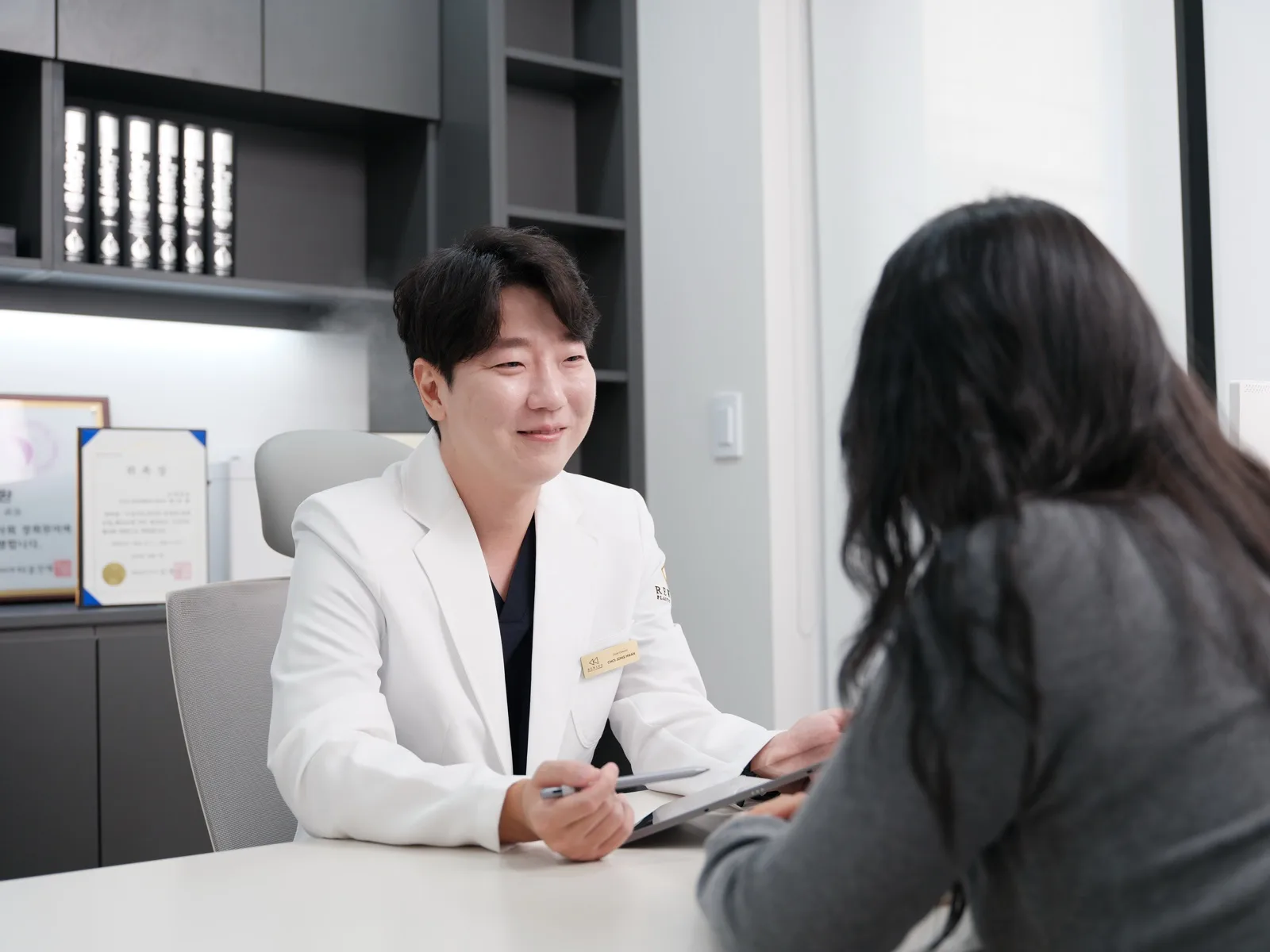
Hyaluronic acid gel, collagen-stimulating products, scar tissue and fat each behave differently under the fingers and tend to sit in different layers. Dr. Jonghwan Choi carries out this examination personally and states which parts he reads as hyaluronic acid and which he does not.
The enzyme is itself a protein, and allergic reactions to it appear in published reviews of its aesthetic use. If you have received it before, the doctor needs to know how that went. A prior reaction, or a marked allergy history, affects whether a first dose is offered at all and how small it would be.
Where hyaluronic acid is identified, the enzyme goes into that deposit in small amounts and the area is reviewed once it settles. A mixed area may clear only partly, and that partial response is itself informative about what remains.
Why here
Dissolving filler you already have is a diagnostic task before it is an injection. These three points are where that difference shows.
Poly-L-lactic acid, polycaprolactone and calcium hydroxylapatite are injected into the same regions as hyaluronic acid and can sit beside it. A 2014 study of a polycaprolactone-based product described new collagen forming in the injected tissue, a response no enzyme reverses. Knowing which material is which keeps you from paying for a treatment that would change nothing.
You are not asked to defend a past decision, and the earlier injector is not discussed. The questions are about the material, its position and your reaction history, because those are the only things that change what the enzyme can do.
Dr. Choi is a board-certified plastic surgeon whose daily work takes place in the facial layers where filler sits. That familiarity helps separate gel from descent or fat, and it tells him when removing gel alone would leave a shape you would not want.

On the day

Fig. 04 · The clinic floor in the Richro Building

Fig. 05 · A quiet room to sit in once the area has been treated
Consultations run on Monday, Tuesday, Wednesday and Friday between 10:00 and 19:00 and on Saturday between 10:00 and 16:00; the clinic is shut on Thursdays and Sundays, and every visit is booked ahead. If you can, send your records ahead through the booking form, then bring the originals or photographs on the day. Before the enzyme is drawn up you may ask to read the label on its packaging.
For a short stay in Seoul, put the consultation near the start. Whether the first dose follows on the same day is decided at the examination, and an early appointment leaves room for the review before you fly. Filler placed abroad in a product never sold in Korea is assessed in exactly the same way: by what the examination and your records show.
Pricing
Existing filler is dissolved at the same per-area rate as any hyaluronic acid. The rate list carries no surcharge line for filler of unknown brand, filler placed abroad or filler placed by a previous provider in Korea.
VAT is added to the listed rate, and the numbing used during the injection is included. How many areas are treated, and how any further pass would be charged, is agreed in writing ahead of the first dose. Material that is not hyaluronic acid is not dissolved and carries no enzyme charge.
Suitability
When the material is not hyaluronic acid, the consultation turns to how that material behaves over time and what can be offered around it. One poly-L-lactic acid product that Rewind itself uses is described on the Olidia page.
Afterwards
Removing gel that has been in place for a long time can reveal changes it was hiding. Expect the area to look different from how you remember it before any filler went in.
Swelling, bruising and tenderness at the injection points are expected. The specific risk of this enzyme is allergy, from localised itching and swelling to rare reactions affecting the whole body. Dissolving can take more volume than hoped, leaving a hollow or unevenness until your tissue recovers. Infection is uncommon. Where several products share an area, only the hyaluronic acid part responds, so the result can be partial. Contact the clinic or emergency care straight away for spreading swelling, hives, difficulty breathing or any change in vision.
At Rewind, one board-certified plastic surgeon carries every case — from the first consultation to the final follow-up. Because a face is a story, and a story deserves a single author.
 Rewind,
Rewind's Doctor
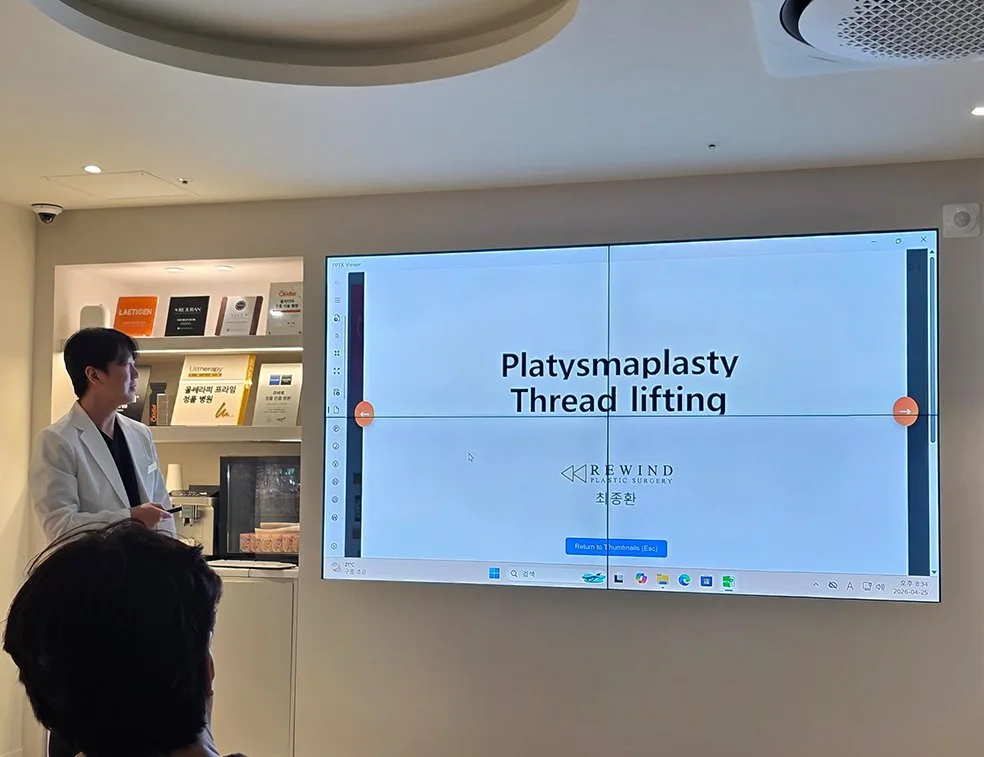
Dr. Jonghwan Choi Medical Director
One surgeon, from the first
consultation to the last follow-up.
A board-certified plastic surgeon devoted to anti-aging lifting — with the precision and restraint built through years of craniofacial practice.
Questions
Google Reviews
Came to REWIND to get my facial treatment and i'm absolutely obsessed about it💞 the doctor is so kind and is an expert! Everyone must visit!
YunHee Hong2 weeks agoThere are just way too many cosmetic clinics in Korea and I'm so happy I found Rewind Clinic in Gangnam. Dr. Choi was so kind and patient while explaining the different face-lifting options, from threads to mini-lifts to deep-plane lifts…
 J. S.5 months ago
I found Rewind clinic through a Korean chat forum and many local clients highly recommended it. The clinic is brand new, featuring large, clean rooms and many private waiting areas so it doesn't give off that "factory" clinic vibe. All the…
 J. Siou5 months ago
Really nice environment. Doctor is easy to communicate and understands my visions. Waited two weeks to make a review and I confirm the results exceeded my expectations and I am super happy with it. Can't wait to come back!! :))
 Kristie Chu5 months ago
I received a thread lift at Rewind Plastic Surgery. The clinic was clean and the atmosphere was comfortable. The consultation was thorough, and I felt confident because they kindly explained everything tailored to my facial condition. They…
Reservation
Tell us what you are considering — we reply as soon as possible, in your language.
For international patients — interpreter-assisted, from your first message to your follow-up.
Scientific evidence
These papers describe the range of filler materials that can sit in the face, including a polycaprolactone-based product and calcium hydroxylapatite, and set out how complications of hyaluronic acid and other fillers are avoided and managed according to expert consensus. None was conducted at Rewind Plastic Surgery or on patients treated here, and none was funded by the clinic. They inform how existing filler is approached; they cannot forecast your own result.