Surgery · Comparison
Take the bulge away, or move it into the groove beneath
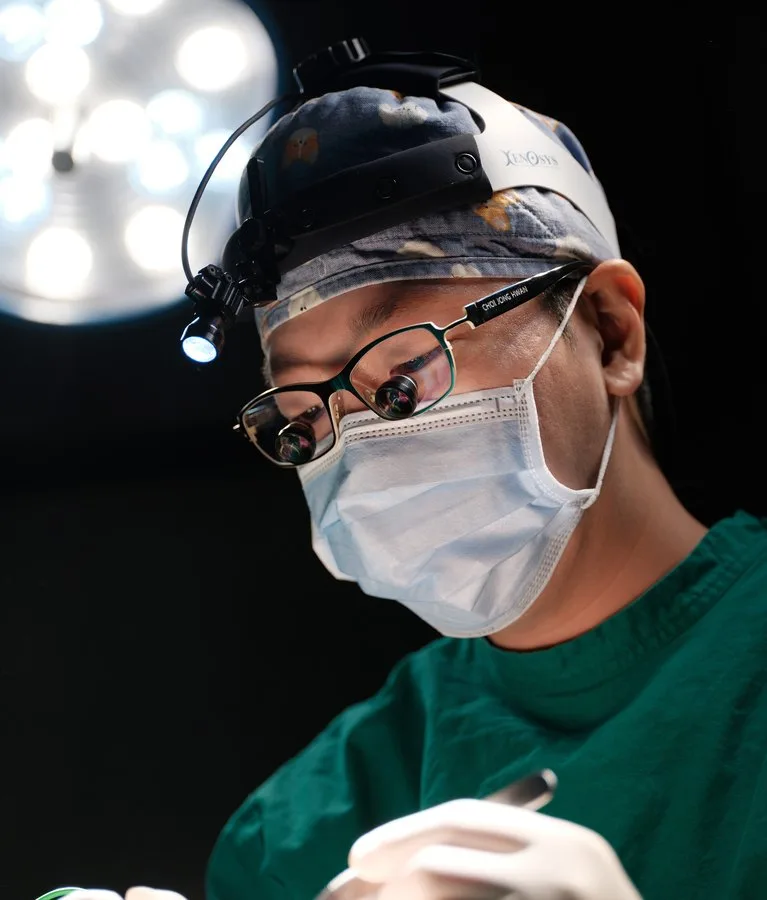
Gangnam, Seoul | Board-certified plastic surgeon, Dr. Jonghwan Choi
Removal and repositioning listed as separate operations · KHIDI-registered for international patients
Two ways to treat eye bags
The short answer
Both begin with the same bulge of orbital fat. Removal takes the protruding fat out, which flattens the bulge and leaves any groove beneath it as it was. Repositioning releases the ligament adhesion at the tear trough and carries that fat down into the hollow, so one piece of tissue treats both the bulge and the groove. Rewind lists each as its own operation: under-eye fat removal only, fat repositioning, and a septal-reinforced version in which the orbital septum is also fixed to the bone. Whether there is a groove to fill is the main question that decides between them.
Facts are taken from Rewind's pages for septal-reinforced fat repositioning and lower blepharoplasty and from its price list. Rewind does not publish a rule for when removal alone is chosen, so that decision is described here as a question for examination.
The comparison is often put online as an old method against a new one. For a single lower lid that framing is too blunt. Removal is the smaller operation with the lower listed price, and for a bulge with nothing beneath it there is little reason to move fat anywhere. Rewind's own material describes the bulge and the groove developing together from the thirties onward, and that overlap is why the choice is rarely obvious from a mirror.
Case photographs
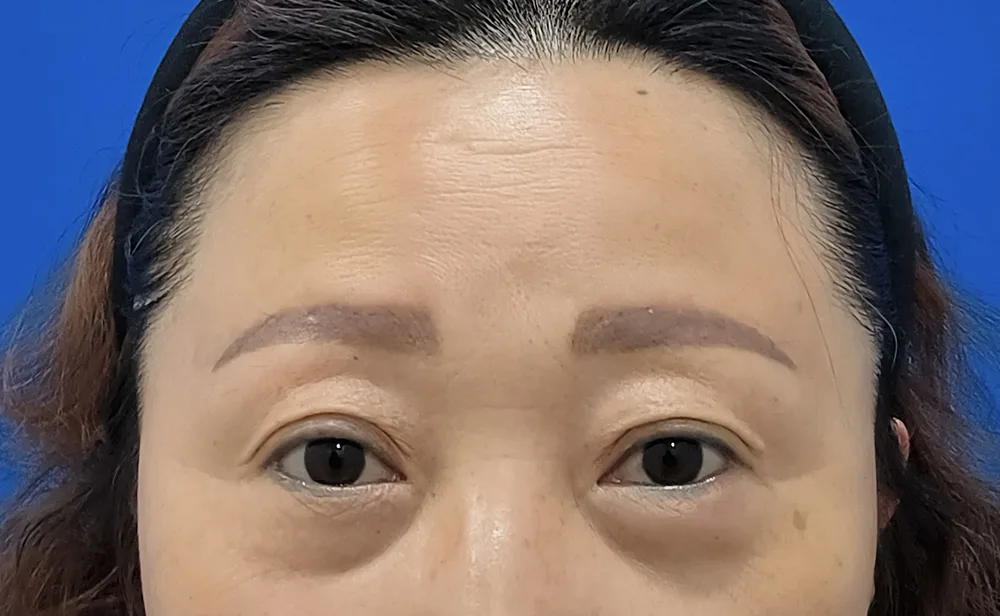
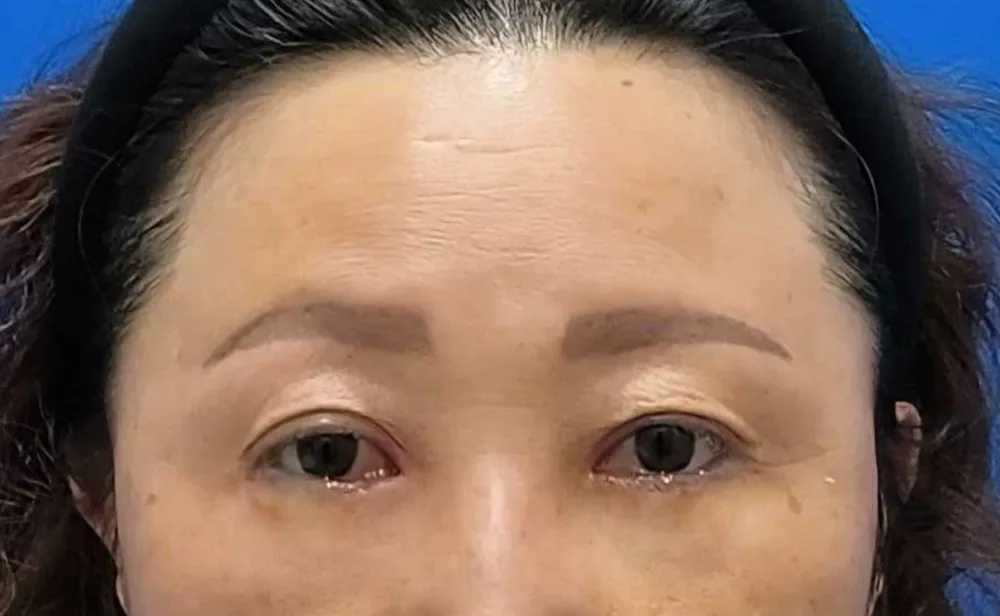
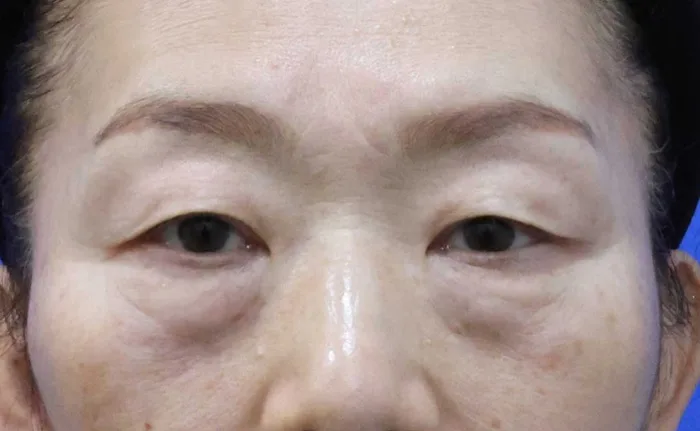
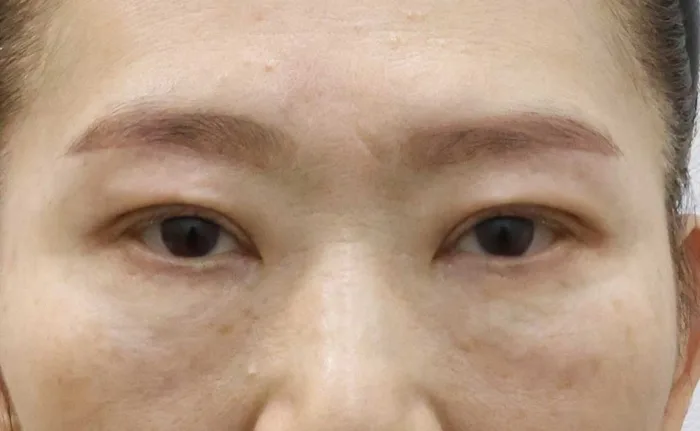
Rewind has not published pairs from removal alone, so both cases here are repositioning, and this page does not use them to show what removal would have done. In the first, fat repositioning was the only operation. In the second, upper blepharoplasty was performed in the same session, so the change around the whole eye belongs to both operations together.
BEFOREAFTER
BEFOREAFTERRewind's own patients, published unretouched, with the full session named in each caption. Individual results may vary. Either operation on the lower eyelid can lead to bruising, prolonged swelling, asymmetry, under- or over-correction and a change in lid position.
What each changes
Rewind's list reads like a ladder, each rung adding a step to the one below it. Seeing the steps side by side is the quickest way to understand the price gaps.
The top rung shows that the two ideas are not rivals inside Rewind's own practice. Its lower blepharoplasty page describes fat being removed or repositioned within the same operation, according to what the lid needs.
The decision
Five questions, asked in this order, narrow the list down to one line. None of them can be answered from a photograph taken at arm's length.
A groove is the reason to move fat. If the lid has a bulge and the cheek meets it smoothly, there is no hollow waiting to receive anything, and removal becomes a reasonable subject for discussion.
The amount of fat sets how much can be moved and how much, if any, can be spared. Taking out more than a lid can afford is how a flat under-eye turns into a sunken one.
Rewind describes the orbital septum being pushed forward by the fat. Where that support is weak, the septal-reinforced version adds the step of fixing it to the bone.
Marked skin laxity or a lid that has descended moves the discussion to lower blepharoplasty, where fat is removed or repositioned and the muscle is re-fixed as well.
Earlier removal may have left little fat to reposition, and earlier filler changes what the groove looks like. Both are recorded before a line on the price list is chosen.

Why here
Moving fat into a groove is one step. Rewind's version of the operation adds a second, aimed at the support that let the fat push forward in the first place.
Rewind's page describes two stages: the fat pushes the orbital septum forward, so the septum is pulled downward and fixed to the bone. The clinic's explanation is that tightening a weakened septum strengthens the structure supporting the fat, letting it settle in a stable position.
Releasing the tear trough ligament and redistributing fat through the conjunctiva has its own technique literature, and a 2020 series reports the outcomes and complications of transconjunctival blepharoplasty with fat repositioning. Both papers are listed at the end of this page.
Because fat removal only is priced separately, a lower lid that needs nothing more than a flatter bulge is not quoted for the larger operation. The board-certified plastic surgeon who examines you explains which rung your lid sits on.
At the clinic

Fig. 04 — The procedure room used for lower-eyelid surgery

Fig. 05 — The lounge on the clinic's upper floor
A consultation at Rewind's Apgujeong clinic, on floors four and five of the Richro Building, starts with the lid itself: the size of the bulge, the depth of the groove and how firmly the ligament holds it, the support in front of the fat and the state of the skin. Bring details of any earlier under-eye filler or surgery, including when it was done.
Board-certified plastic surgeon
Whether the fat is removed or moved, Dr. Jonghwan Choi makes the call and performs the operation; his record includes ten peer-reviewed papers. Rewind's KHIDI registration for international patients is M-2025-01-08-09288.
Pricing
Each step on the ladder carries its own line, so the gap between two figures is the price of the step between them. Removal is the lowest line; repositioning adds the ligament release and the move; the septal-reinforced version adds the fixation of the septum.
Rates as listed, VAT not included, with the anaesthetic fee counted in each figure. The line that applies is agreed after examination.
Suitability
Neither fits on its own where the skin is lax or the lid has descended, which is lower blepharoplasty ground, or where an earlier removal has already left the under-eye hollow. In that last case there may be too little fat to move, and adding volume becomes the question, as covered on the under-eye fat grafting page. Brown pigment is untouched by any of these operations.
Recovery
Rewind publishes one sheet for under-eye surgery and does not issue a separate one for removal alone, so this page makes no claim that either heals faster. The markers are the same.
Risks shared by removal and repositioning include bleeding, infection, prolonged swelling, asymmetry, altered sensation and changes in lower-lid position such as retraction or ectropion. Removal can leave a lid looking hollow if more fat is taken than the lid can spare; repositioning can leave the groove under- or over-filled. Outcomes vary between individuals and cannot be promised.
At Rewind, one board-certified plastic surgeon carries every case — from the first consultation to the final follow-up. Because a face is a story, and a story deserves a single author.
Rewind,
Rewind's Doctor
Dr. Jonghwan Choi Medical Director
One surgeon, from the first
consultation to the last follow-up.
A board-certified plastic surgeon devoted to anti-aging lifting — with the precision and restraint built through years of craniofacial practice.
Google Reviews
"Sample review card — at launch this section pulls the clinic's real Google reviews automatically, shown verbatim with the reviewer's initial and posting date."
"Sample review card — reviews are never written or edited by the clinic; only what patients posted on Google appears here."
"Sample review card — a 'See all reviews on Google' link takes visitors to the clinic's Business Profile."
Questions
Reservation
Tell us what you are considering — we reply within one business day, in your language.
Scientific evidence
Four papers bearing on the choice: a technique paper on extended transconjunctival blepharoplasty with tear trough ligament release and fat redistribution, reported outcomes and complications of transconjunctival fat repositioning, a systematic review of lower blepharoplasty safety, and a nasojugal groove study co-authored by Rewind's medical director.
Each paper reports its own authors' methods and patients. The groove study is reconstructive; none of the four was carried out at Rewind or compares its two listed operations directly, and none forecasts the result for a particular lower eyelid.