Surgery · Case photographs

Midface Lift Before and After

One released case, and a way to read every midface frame you are shown

Apgujeong, Gangnam, Seoul | Board-certified plastic surgeon, Dr. Jonghwan Choi
Unretouched clinic frames, every procedure in the session named · KHIDI-registered for international patients

Midface Lift Results Cheek Lift Photographs Midface Lift Results Cheek Lift Photographs Midface Lift Results Cheek Lift Photographs 
Frames

Midface lift results

What do midface lift results look like in a photograph?

The short answer

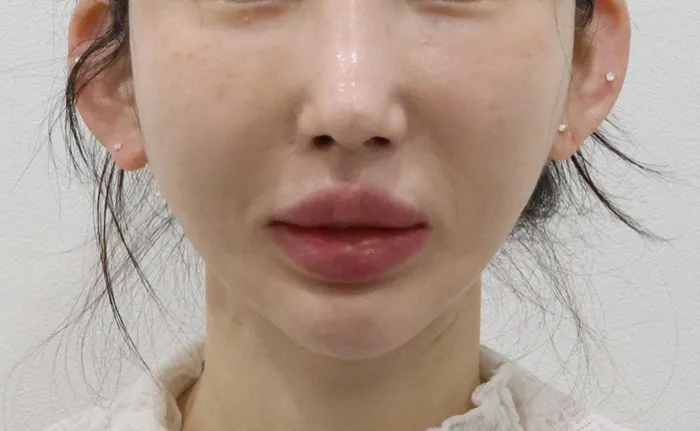
A midface lift result shows up as a change in position more than a change in shape. In a useful pair, the fullest part of the cheek sits closer to the lower eyelid, the upper end of the fold beside the nose looks shallower, and the lid and cheek read as a shorter, smoother slope. Rewind has released one midface case so far. It combined a thread elevation of the midface with under-eye fat repositioning, its frame starts at the edge of the lower lid, and it is published unretouched with both procedures named. No photograph of a transconjunctival midface lift performed on its own has been released yet, and this page says so where that frame would sit.

Case record: one Rewind patient, frames matched as the same person before publication. Procedure list taken from the clinic's case record for that session.

The second question patients ask is when the face in the second frame stops changing. Rewind does not publish a single week at which a midface result becomes final. It publishes the milestones on the way: a three-day dressing where the lower lid is operated, early swelling and bruising that recede over one to two weeks, about a month without firm pulling on the area, and an Endotine device that the body absorbs across roughly nine months in the surgical version. A frame taken inside the first weeks is a photograph of healing as much as of the lift.
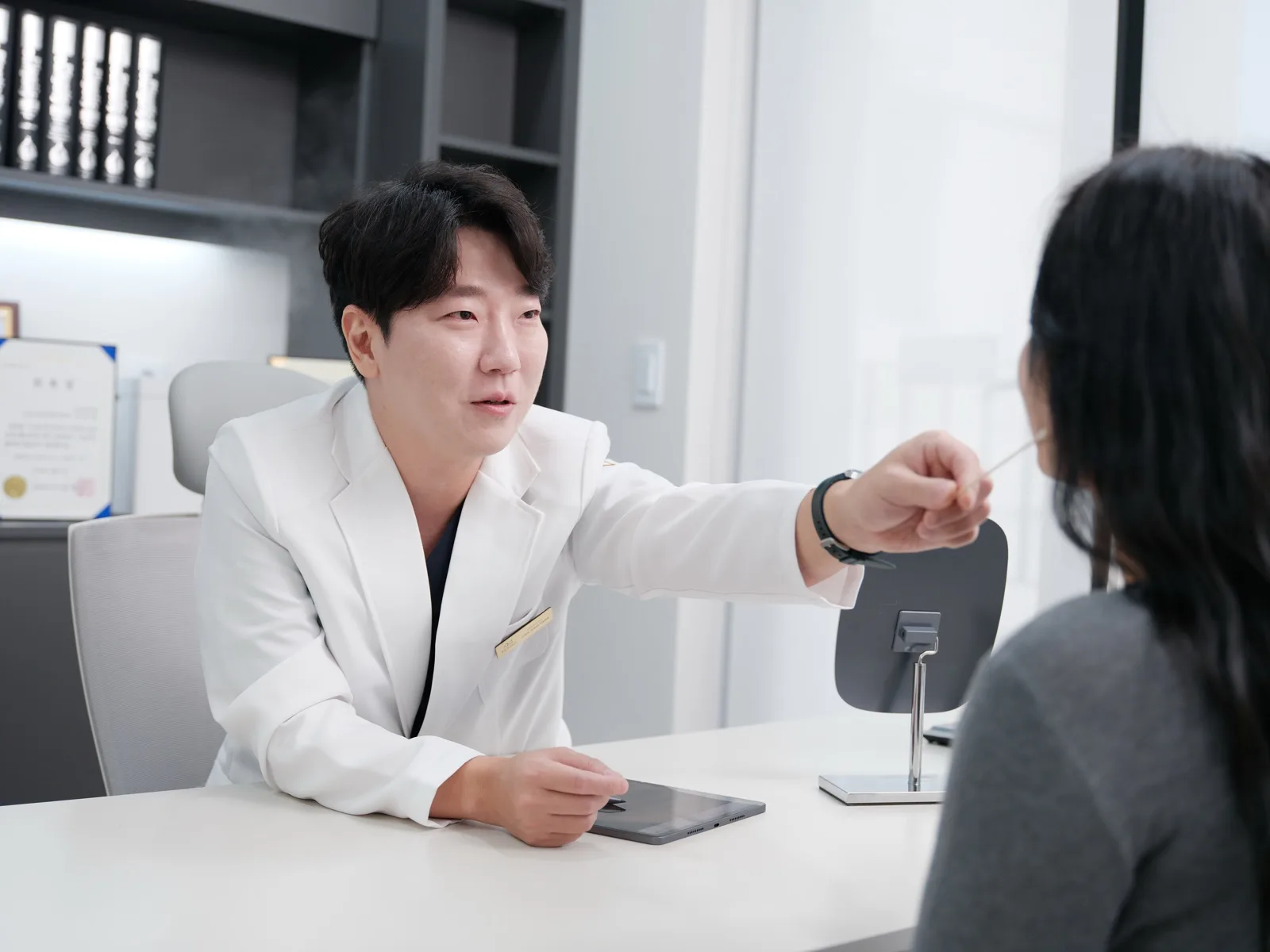
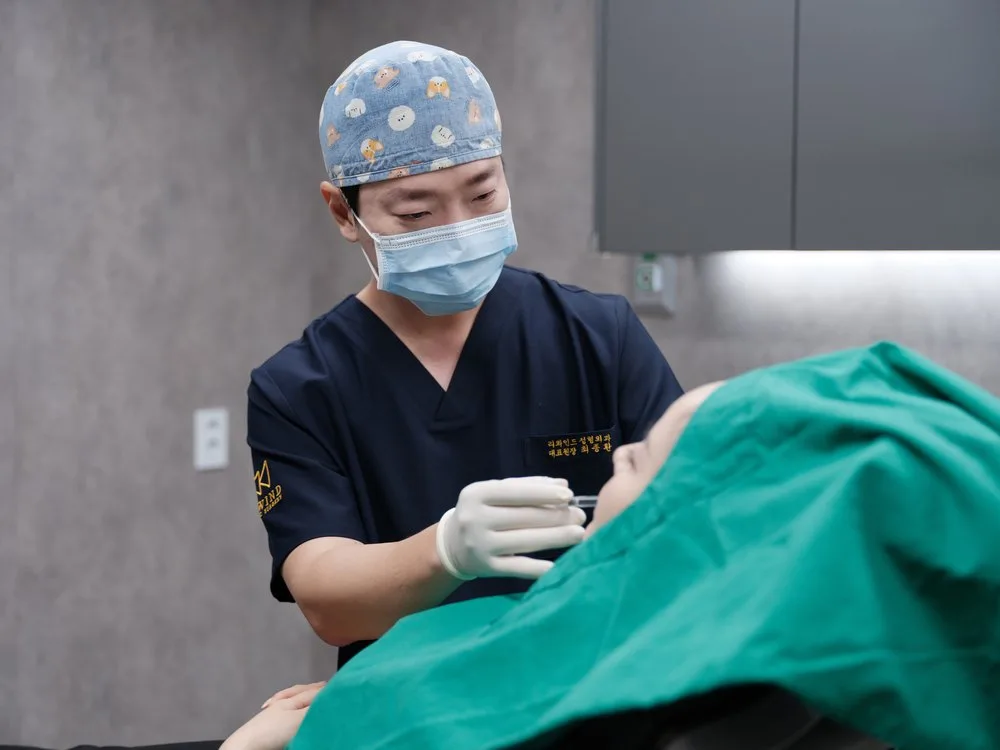
Dr. Jonghwan Choi pointing to the cheek of a patient during a midface examination at Rewind
Fig. 01 · Reading a midface starts at the cheek, with the patient in the chair
Cases

Case photographs

The released midface case, and the midface frames still pending

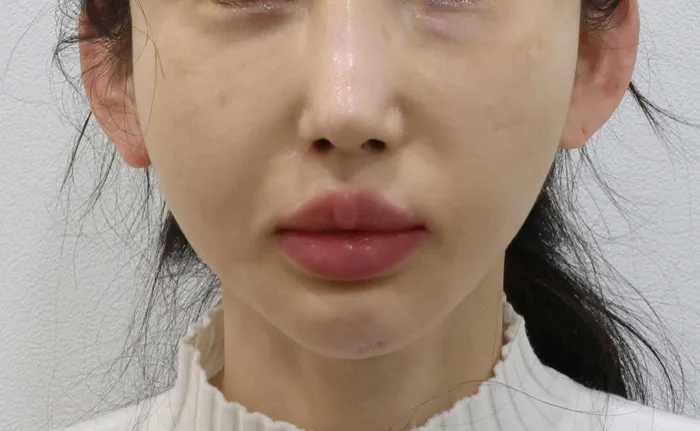
Case 01 is a combination, so it is evidence for the combination. The midface was raised with threads and the under-eye fat was repositioned surgically in the same session; the transconjunctival operation with Endotine fixation was not part of it. The frame runs from the lower lid edge to the neck, which makes the cheek and the fold beside the nose readable and leaves the tear trough mostly outside the picture. The two empty frames below are held for the surgical midface lift, alone and combined, until the clinic releases them.

Rewind patients: midface, cheek and lower lid

Earlier frame: midface raised with threads plus under-eye fat repositioning, lower lid edge to neck Later frame: midface raised with threads plus under-eye fat repositioning, lower lid edge to neck BEFOREAFTER
case 01 · two procedures
Midface elevated with threads, plus under-eye fat repositioning, one session
Individual results may vary. No Endotine fixation was used in this case, and the interval between the two frames is not recorded in the caption. Photographs unretouched.
BEFORE PHOTO
AFTER PHOTO
BEFOREAFTER
not yet released
Transconjunctival midface lift on its own, Endotine fixation
Individual results may vary. No case of this operation alone has been released for publication, so the frame is left empty.
BEFORE PHOTO
AFTER PHOTO
BEFOREAFTER
not yet released
Surgical midface lift with under-eye fat repositioning
Individual results may vary. Frames are kept at the clinic until released for publication.

Case 01 shows Rewind Plastic Surgery's own patient, and both frames are published unretouched. Hair, earrings and clothing differ between the two frames, so compare anatomy against fixed points such as the nostrils and the corners of the mouth. Individual results may vary. Bruising, swelling, asymmetry between the sides, numbness or altered sensation, a change in lower-lid position and scarring can follow midface and lower-lid surgery.

Read

Where to look

Where to look first in a midface lift photograph

Read a midface frame from the fixed points outward: first the features surgery cannot move, then the soft tissue measured against them.

mark 01
The high point of the cheek
Find the fullest part of each cheek and note how far it sits below the lower lid and to the side of the nostril. Midface descent lets that fullness slide down and inward; a lift is meant to carry it back up.
mark 02
The top of the nasolabial fold
Look at the fold where it begins beside the nostril, not at its lower end near the mouth. The upper part is the stretch a midface lift can influence; the lower part belongs to the jowl and lower face.
mark 03
The lid-cheek junction
Where the lower lid meets the cheek, a long visible slope usually means the cheek has dropped away from the rim. Check first whether this junction is inside the frame at all. In case 01 it sits at the very top edge.
mark 04
The frame itself
A chin tipped up or down changes how high the cheek appears, and a smile lifts the cheek on its own. Compare head tilt, expression, hair and shadow before you credit any difference to the operation.

Some of what matters in a midface lift never reaches a photograph. The conjunctival opening sits on the inside of the lid, the Endotine device lies against bone, and durability can only be shown by a third frame taken years later. A pair tells you about position on one day.

Camera

Step and frame

What the camera records from each midface lift step

Rewind publishes the surgical midface lift as three steps, with fixation and absorption around them. Only some of them leave a trace that a front-facing photograph can pick up.

01Design

Design: the direction of lift is set first

A one-to-one design is marked before a small opening is made below the eye. None of it shows in a later frame, yet the direction chosen here decides where the cheek will sit in it.

02Lift

Tissue and fascial layer rise as one block

The midface is drawn upward together with its fascial layer. This is the step a photograph reads most directly, as a change in the height of the cheek's fullness relative to the nose and lid.

03Anchor

Fallen fat is set on the periosteum

Descended fat is fixed to the bone covering and the opening is closed. In a frame this appears as a shorter, smoother lid-cheek slope, where the junction is visible at all.

04Hold

Endotine keeps the position while tissue settles

Five prongs hold the lifted tissue at several points on a bone-seated base. The device is invisible in any photograph and is taken up by the body over about nine months.

05Close

Where the opening sits, and whether it shows

On the conjunctival route the incision is inside the lid and does not appear in a frontal photograph. Where the skin route is used, Rewind states that a line may stay visible under the lashes, depending on how elastic the skin is, and only a close-up of the lash line will show it.

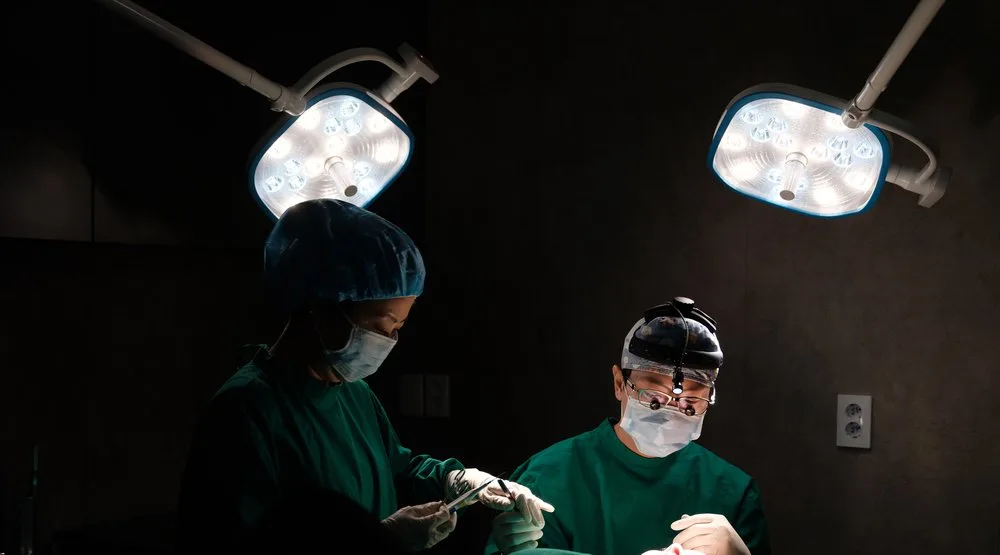
Operating room at Rewind Plastic Surgery, Richro Building, Apgujeong
Fig. 02 · The theatre where the surgical midface lift is performed
Rewind

Why here

Why Rewind's midface lift gallery holds one case

A gallery is only as useful as its captions. Rewind publishes a midface frame when the patient has agreed, the two frames are confirmed as one person, and the caption can list everything done in that session.

01Labels

Case 01 carries its full procedure list

The midface in case 01 was raised with threads and the lower lid had fat repositioning. Printing both keeps the frame from being read as a result of the Endotine operation, which it is not.

02Gaps

Unreleased midface frames stay visibly empty

Frames for the transconjunctival lift are held at the clinic. Filling those slots with an eyelid or facelift case would put a different operation under a midface caption, so the slots stay marked.

03Author

The operating surgeon reads the midface frames with you

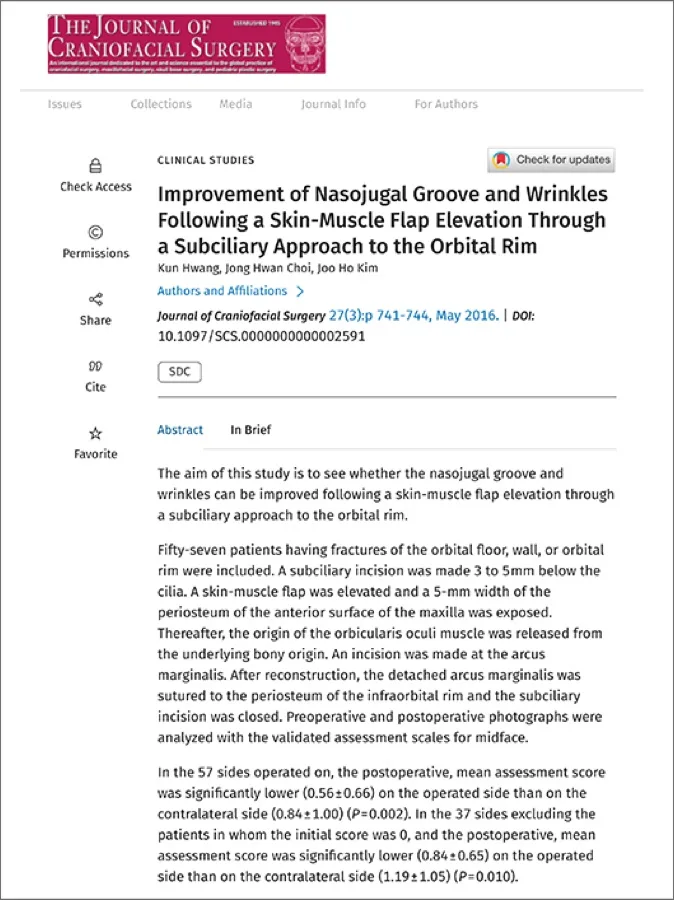
Dr. Jonghwan Choi, a board-certified plastic surgeon, is the only operating surgeon at Rewind. His paper on the nasojugal groove after skin-muscle flap elevation appeared in the Journal of Craniofacial Surgery, and that groove sits at the top edge of every midface frame.

Journal of Craniofacial Surgery paper by Dr. Jonghwan Choi on the nasojugal groove
Fig. 03 · The nasojugal groove paper, Journal of Craniofacial Surgery
Visit

At consultation

Reviewing midface cases with the surgeon in Apgujeong

Procedure room set up for lower-lid and midface surgery at Rewind

Fig. 04 · Set-up before a lower-lid and midface operation

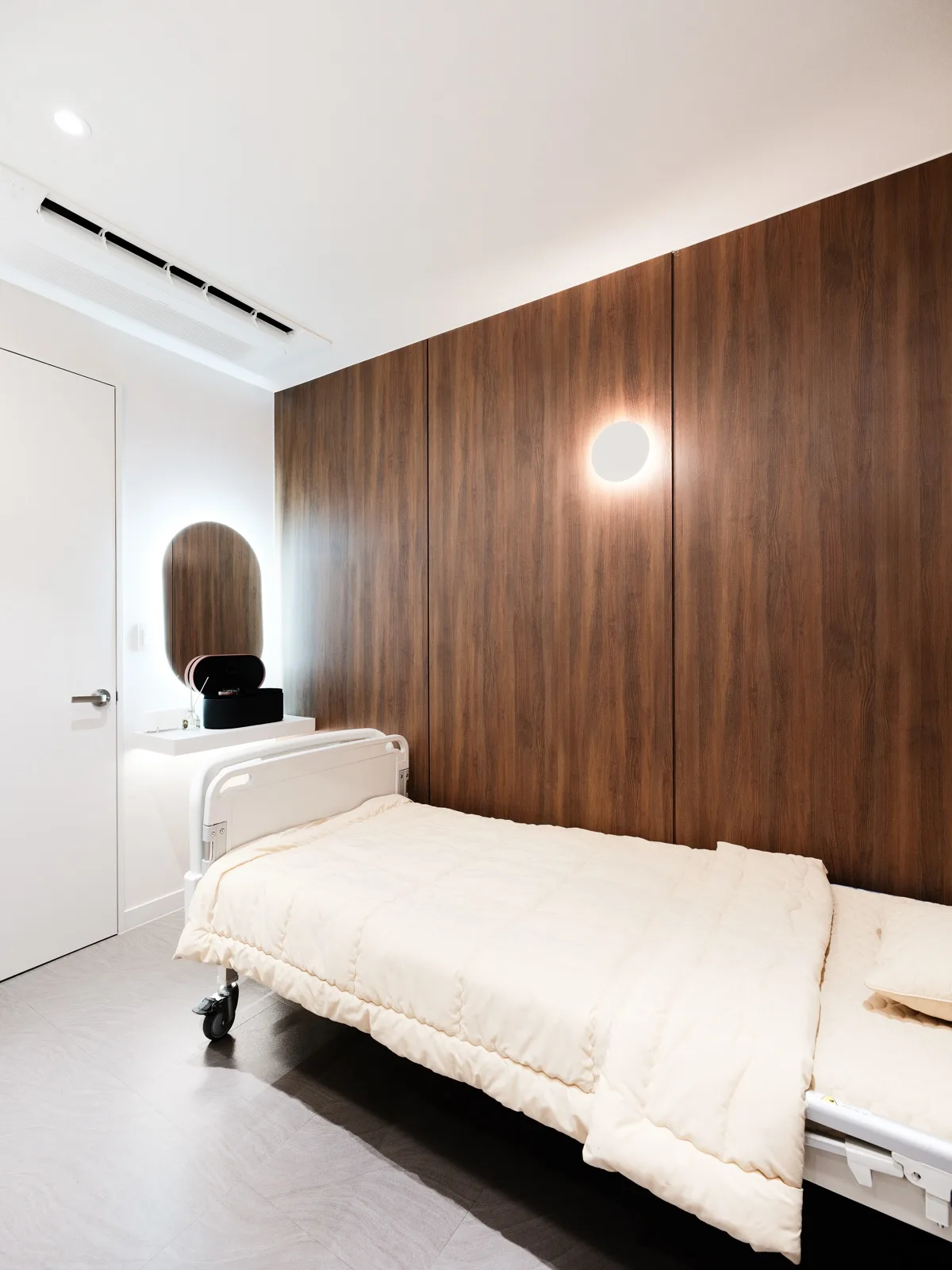
Private recovery room at Rewind Plastic Surgery, Apgujeong

Fig. 05 · The recovery room used after midface surgery

Consultations are held on the fourth and fifth floors of the Richro Building in Apgujeong, Gangnam, Seoul, by appointment on Monday, Tuesday, Wednesday and Friday from 10:00 to 19:00 and on Saturday from 10:00 to 16:00. Bring the midface photographs that made you enquire. The surgeon marks on your own face where the cheek has descended and says which released case, if any, started from a comparable point.

Cheek height read against lid and nostril
Upper fold and lid-cheek junction assessed
Route chosen: conjunctival or through the skin
Under-eye fat repositioning decided case by case
Case captions list every procedure
Frames published unretouched
Operated by Dr. Jonghwan Choi
Follow-up with the same surgeon
Dr. Jonghwan Choi, board-certified plastic surgeon

Board-certified plastic surgeon

Every midface case shown or discussed at Rewind was operated by Dr. Jonghwan Choi, who holds Korean specialist certification in plastic surgery. The clinic is registered with KHIDI to treat international patients, registration M-2025-01-08-09288.

Cost

Pricing

Midface lift pricing for the operations in these frames

Each operation named in a midface caption corresponds to a line on Rewind's list. Matching a case to its line is part of reading the case, and it is also why a combined frame cannot be priced from the midface figure alone.

Transconjunctival midface lift, on its ownThe operation of the first pending frame: Endotine fixation, opening inside the lid
₩4,000,000
Midface lift with under-eye fat repositioningThe surgical combination held for the second pending frame
₩6,000,000
Midface lift added to lower blepharoplastyWhere a lower-lid operation is already planned for the same session
₩7,000,000
Under-eye fat repositioningThe lower-lid procedure performed in case 01
₩1,600,000

Listed prices, VAT excluded, with the anaesthetic fee included. The thread elevation in case 01 belongs to the non-surgical list and is quoted on its own terms. Which midface line applies to you is fixed at the examination, regardless of which frame first drew you to this page.

Fit

Suitability

Whose midface is likely to photograph like case 01, and whose is not

Closer to the released frames

  • Cheek fullness that has slid down and toward the nose
  • A fold beside the nostril that deepens more at its top than at its base
  • A long lid-cheek slope with a groove or shadow at the top
  • An under-eye fat pad that bulges and would be repositioned in the same session
  • Good general health, with no bleeding or healing disorder

Likely to look different in the second frame

  • Laxity that runs past the midface into the jowl and neck, where a full or mini lift is discussed first
  • Lost volume with little descent, which a lift is not designed to replace
  • A wish for a broader cheekbone: the conjunctival route is chosen partly to keep the side of the cheek from widening
  • A lower lid already operated, which is assessed on its own before any plan
  • Pregnancy, breastfeeding, active eye infection, or a medicine that affects clotting, which postpone surgery
After

Recovery

When a midface lift photograph becomes worth comparing

Rewind does not publish a separate aftercare sheet for the midface lift. Its midface page sets the one-month rule, and its sheet for under-eye fat repositioning, the second procedure in case 01, sets the early days. Read together, they explain why an early second frame shows healing as well as the lift.

Days one to three
Dressing under the eye
Where the lower lid is operated, the dressing stays on for three days. A photograph taken in this window records the dressing and the first swelling.
One to two weeks
Swelling and bruising recede
The under-eye sheet records early swelling and bruising decreasing over one to two weeks, with sauna and hard exercise avoided for at least a week and sunscreen from the start.
About one month
No firm pulling on the midface
The midface page asks that the operated area not be pulled hard for roughly a month, and that alcohol, smoking and sauna visits wait for a period.
About nine months
Endotine absorbed
In the surgical version the fixation device is taken up by the body over about nine months. Rewind does not name this, or any other point, as the date a result becomes final.

Rewind puts the expected duration of a midface lift at five years or more, varying by individual, and the face keeps ageing through that time. Risks include bleeding, infection, prolonged swelling, asymmetry, numbness or altered sensation, a lower lid pulled out of position, and scarring. Results vary by individual and cannot be promised; the interval at which your own review photographs will be taken is confirmed at consultation.

Doctor

Professional

At Rewind, one board-certified plastic surgeon carries every case — from the first consultation to the final follow-up. Because a face is a story, and a story deserves a single author.

Dr. Jonghwan Choi, board-certified plastic surgeonRewind,
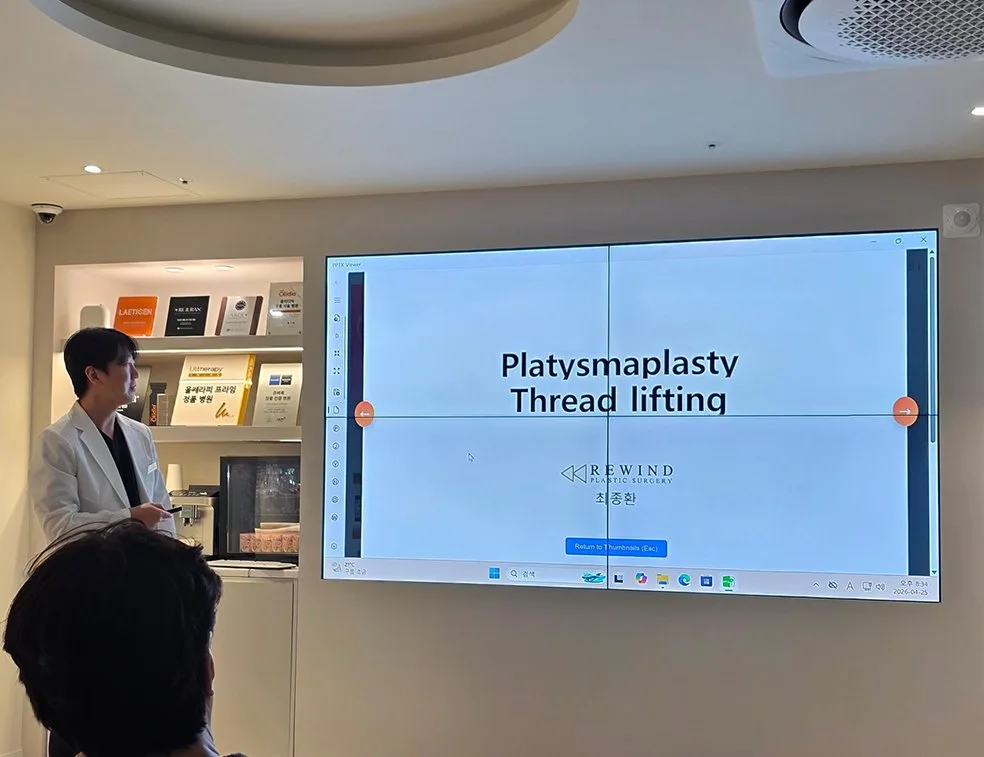
Dr. Jonghwan Choi presenting at an academic session
Fig. 06 — Academic presentation, thread-lifting session

Rewind's Doctor

Dr. Jonghwan Choi Medical Director

One surgeon, from the first
consultation to the last follow-up.

A board-certified plastic surgeon devoted to anti-aging lifting — with the precision and restraint built through years of craniofacial practice.

Board-certified plastic surgeon (Plastic Surgery)
10 peer-reviewed publications
Medical Director, Rewind Plastic Surgery
Korean Society of Plastic & Reconstructive Surgeons
Former chief director, Apgujeong Y&T Plastic Surgery
Korean Society for Aesthetic Plastic Surgery
J Craniofac Surg · JKMS · Arch Craniofac Surg
Korean Cleft Palate-Craniofacial Association
Voices

Google Reviews

What our patients say.

G 5.0 ★★★★★ 12 Google reviews · Rewind Plastic Surgery, Apgujeong — live-synced from Google Business Profile

"Sample review card — at launch this section pulls the clinic's real Google reviews automatically, shown verbatim with the reviewer's initial and posting date."

AReviewer namePOSTED ON GOOGLE

"Sample review card — reviews are never written or edited by the clinic; only what patients posted on Google appears here."

BReviewer namePOSTED ON GOOGLE

"Sample review card — a 'See all reviews on Google' link takes visitors to the clinic's Business Profile."

CReviewer namePOSTED ON GOOGLE
Ask

Questions

Questions about midface lift results and photographs

What do midface lift before and after results look like?
In a readable pair the fullest part of the cheek sits higher and closer to the lower lid, and the fold beside the nostril looks shallower at its top. Rewind's released case combined a thread elevation of the midface with under-eye fat repositioning, so it shows that combination. Individual results vary from face to face.
How long until the final midface lift result settles?
Rewind names no single date. Its published milestones are a three-day dressing where the lower lid is operated, swelling and bruising receding over one to two weeks, about a month without firm pulling, and Endotine absorption across roughly nine months. Photographs taken in the early weeks still include swelling.
Why does the released midface case start at the lower eyelid?
Case 01 was published as a crop from the edge of the lower lid down to the neck. The cheek, the fold beside the nose and the jaw are in view, while the tear trough is only partly visible. Judge that pair by the cheek, and ask about the under-eye at consultation.
Was the midface in case 01 lifted with the Endotine operation?
No. The case record lists a thread elevation of the midface and surgical under-eye fat repositioning in one session. Photographs of the transconjunctival midface lift with Endotine fixation, alone or combined, have not been released for publication, so the matching frames on this page stay empty.
Has anything been edited in the midface photographs?
The frames are published unretouched. They show Rewind's own patient and were matched as one person before release. Hair, earrings and clothing differ between the two, and posture can shift, so measure the cheek against the nostrils and the mouth corners, which a midface operation does not move.
Where would a midface lift scar show in a close-up photograph?
On the conjunctival route the opening is on the inner surface of the lower lid, so a frontal photograph does not show it. Where the skin route is used, Rewind notes that a fine line may stay under the lashes, depending on how elastic the skin is. Case 01 is cropped too tightly at the top to judge the lash line.
How can I tell whether my face would change like case 01?
Compare starting points before outcomes. A case predicts more when the cheek had descended in a similar way and the under-eye fat bulged similarly. Where laxity runs into the jowl and neck, or the concern is lost volume, the second frame will probably look different. The surgeon makes that comparison at examination.
What does the operation shown in a midface case cost?
Price follows the caption. A frame labelled as the surgical midface lift alone corresponds to ₩4,000,000; one labelled with under-eye fat repositioning corresponds to ₩6,000,000. The lower-lid half of case 01 is listed at ₩1,600,000, its thread component is quoted separately, and VAT is added on top.
Booking

Reservation

REWIND,booking

Tell us what you are considering — we reply within one business day, in your language.

Scientific evidence

Research on midface lifting and on reading surgical photographs

The first paper sets out why facial surgery photographs need consistent framing and position before two frames can be compared, and it is the reason this page points to landmarks and not to overall impression. The next two describe the transconjunctival midface lift as a technique. The fourth reports transconjunctival release with a midface lift used to repair a lower lid pulled out of position after earlier surgery, and is cited for the approach only. The fifth concerns nasojugal groove correction during lower-lid surgery and is cited for the anatomy at the top of a midface frame. None of these studies involved Rewind patients, and none can forecast your own result.