Surgery · Eyelid Comparison
Lid height and lid fold, told apart first
Gangnam, Seoul | Board-certified plastic surgeon, Dr. Jonghwan Choi
Two listed operations, compared by what each changes · KHIDI-registered for international patients
The difference
The short answer
Double eyelid surgery changes where the upper lid folds. Ptosis correction changes the height the lid reaches as the eye opens. A crease can be made on a lid that already lifts well, and it leaves a weak lift as it found it; the correction deals with the lift and leaves the fold to the crease. Rewind prices them as two distinct items, the correction appearing only as an addition to a double eyelid operation, so a plan holds either a crease alone or a crease with the correction.
This comparison is built from the clinic's Korean-language crease and upper-lid pages and from its rate list. Rewind publishes no technique for the correction, so it is compared here by purpose and by what the clinic lists.
The second question, whether a droopy eyelid is ptosis or simply excess skin, starts at the lid edge. With the brow relaxed and the eyes looking straight ahead, an edge that sits low over the iris points to a weak lift. An edge at a normal height with skin folding down over it points to excess skin. Plenty of eyes show some of each, and the reading is done in person for that reason.
In English-speaking eyelid practice the question tends to come from someone older who notices heaviness and a narrower upper field of view. In Korean eyelid practice it often comes from someone younger whose eyes look sleepy in photographs. Age shifts the likely answer: loose skin accumulates over the years, while a weak lift can be present from childhood.
Point by point
The two operations are often mentioned together because they are often done in one sitting. Held apart, they answer different questions.
That third operation is upper blepharoplasty, which removes descended skin, fat and slack muscle through the fold line. The crease methods themselves are set out on the double eyelid surgery page.
Telling them apart
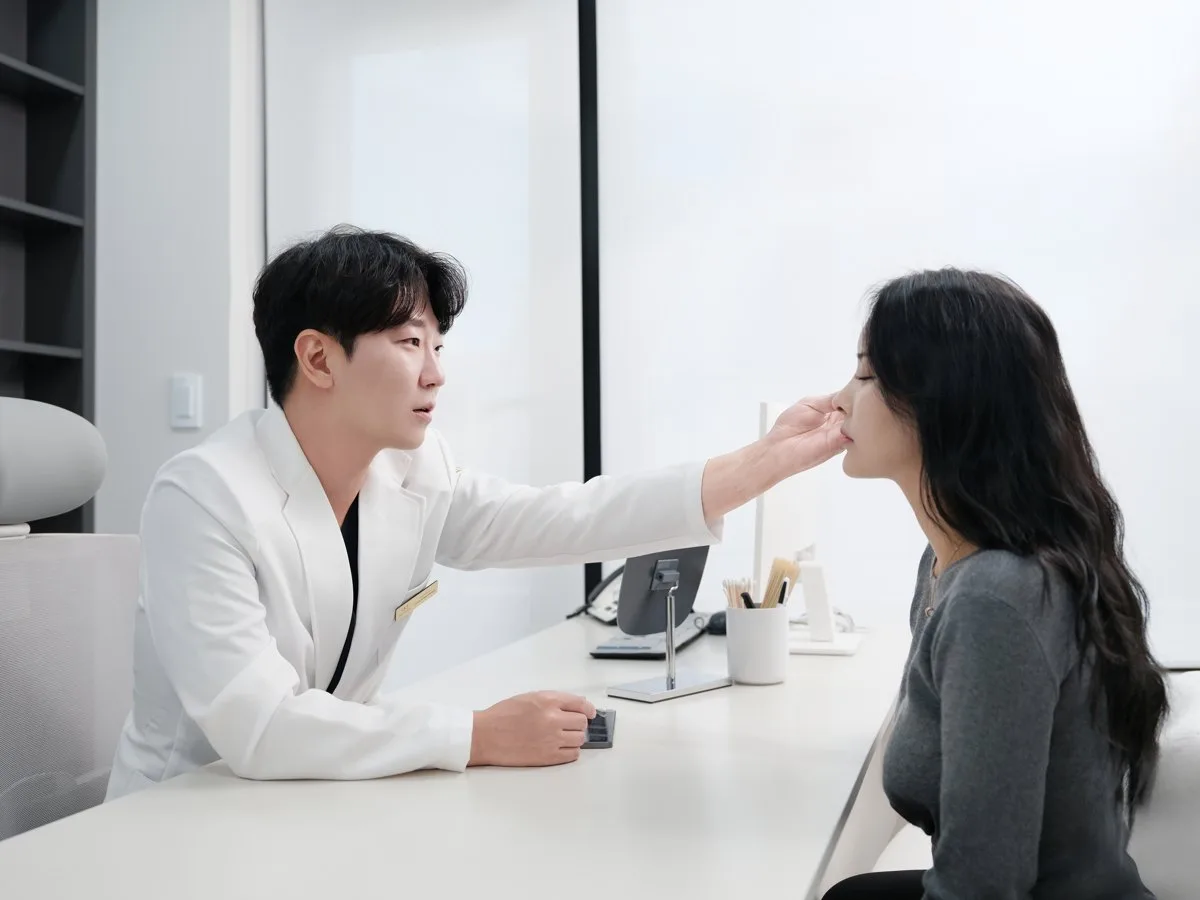
The decision is made by observation in the consultation room, in an order that keeps the three causes of a heavy eye from being confused.
Many people with a weak lift have learned to open their eyes with the brow. The surgeon asks you to let the forehead go slack, because only then does the resting height of the lid margin show.
An edge that covers a good part of the iris points toward the lift. The two eyes are recorded separately, since a difference between them is common and changes the plan.
Loose skin can hide the fold and the lashes while the margin underneath sits at a normal height. When that is the finding, the answer is skin removal, and the conversation turns to upper blepharoplasty.
With the lift and skin questions answered, the crease is designed. More fat and thicker skin lead toward partial or full incision; the buried method, secured through seven small points with double fixation, makes the fold without an incision.
You leave with a crease plan, or a crease plan with the correction added, each item listed with its rate. Where a weak lift and loose skin are both present, the surgeon says which one accounts for most of the heaviness.

Why the distinction matters
A common eyelid disappointment is a clean fold on an eye that still looks tired. It usually means the lift was never assessed.
When the margin sits low, a fold drawn above it has little lid to show beneath it, and there is a temptation to set the line higher to compensate. Rewind's crease page notes that a line set too high, or overcorrection for the skin and fat present, is what produces the heavy, puffy 'sausage' look.
A 2023 paper on Asian upper lids argued that mild lid droop often goes unrecognised in cosmetic eyelid surgery and needs addressing at the same time. Reading the lift at every crease consultation is how Rewind responds to that risk.
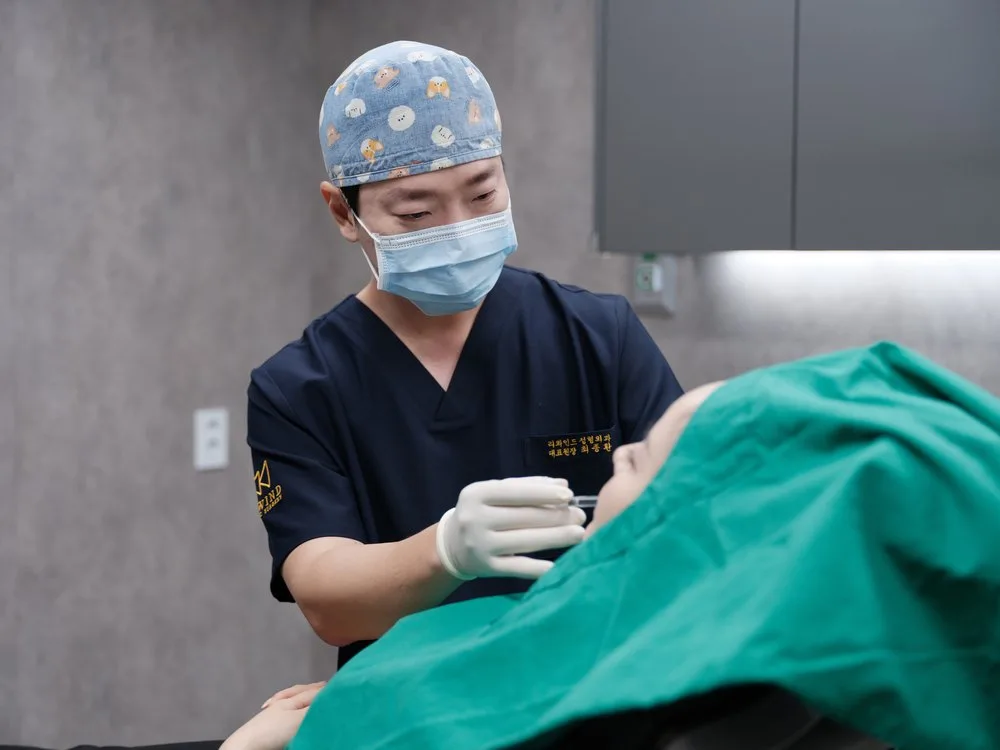
Both operations are carried out by the medical director, so the choice between them does not depend on who would operate. International patients are helped in their own language; Rewind is registered with KHIDI to treat them.
Where both are carried out

Fig. 04 — The table prepared for eyelid surgery

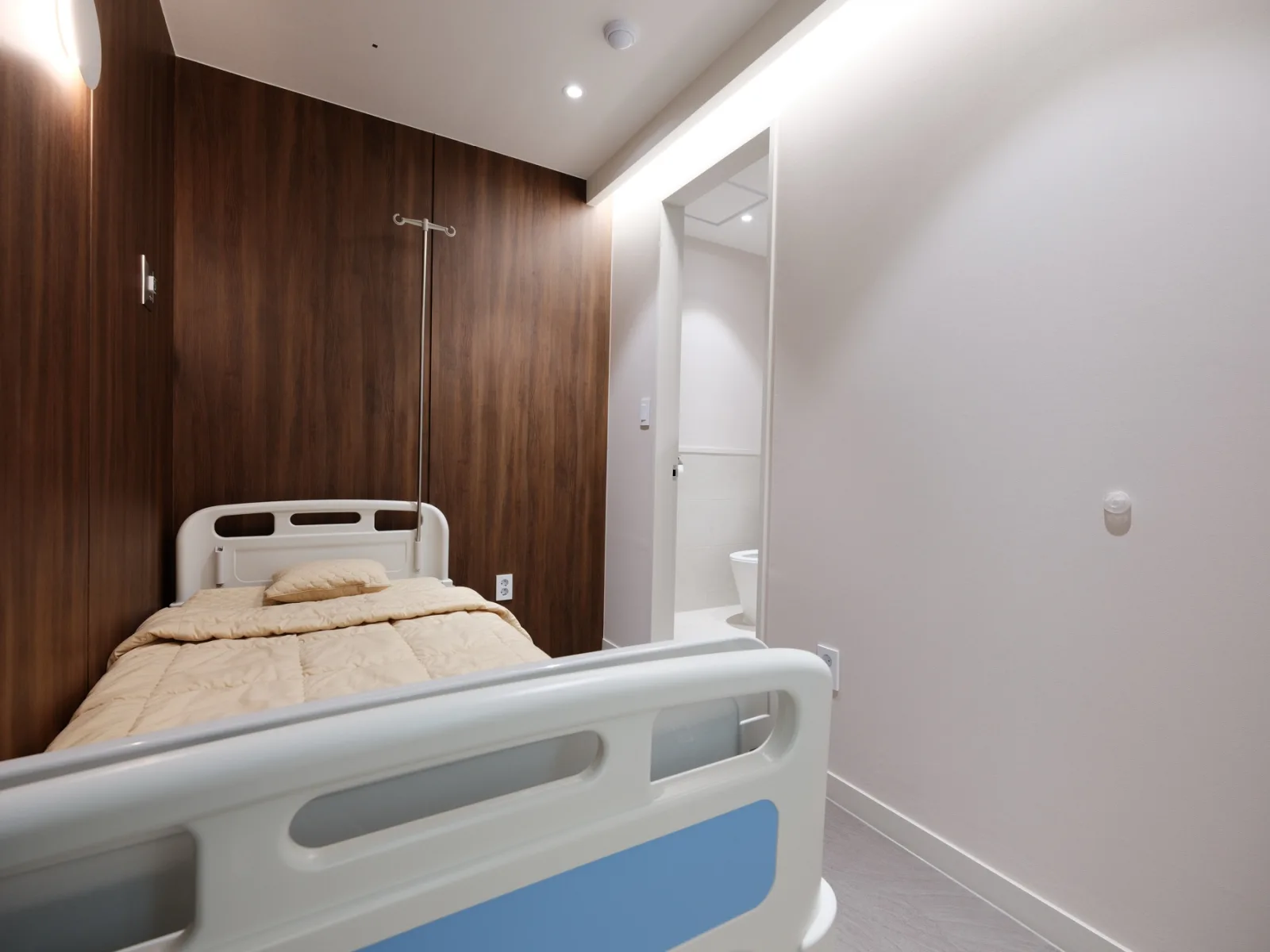
Fig. 05 — A private room for resting after eyelid work
Crease and correction alike are performed in the theatre Rewind runs on floors four and five of the Richro Building, Gangnam, Seoul. Appointments for either are taken Monday to Saturday except Thursday, closing at 19:00 on weekdays and 16:00 on Saturday. The clinic states more about the crease than about the correction, and the list below shows where each detail comes from.
Board-certified plastic surgeon
Certified in Korea in plastic surgery, and a member of the Korean Society of Plastic and Reconstructive Surgeons. The number under which Rewind treats international patients (KHIDI) is M-2025-01-08-09288.
Rates compared
A crease alone costs one line. A crease with the correction costs that line plus the add-on. The comparison is therefore between a crease row on its own and the same row with the add-on beside it, for whichever method your lid needs.
Listed rates, VAT excluded, with the anaesthetic fee included in each. Upper blepharoplasty is shown because it is where the examination turns when the heaviness is skin; it is not added to a ptosis plan by default. Work on a lid that has been operated on before is quoted after examination.
Which one fits
Recovery compared
Rewind publishes aftercare by crease method and no separate sheet for the correction, so the comparison runs between methods, with the correction adding work to whichever method carries it.
Both operations share the risks of eyelid surgery: bleeding, infection, prolonged swelling, asymmetry, altered sensation and scarring along any incision. The correction adds its own, namely a lid that finishes higher or lower than intended and dryness or irritation of the eye surface. A fold requested higher than the lid can carry is declined, whichever operation is planned.
At Rewind, one board-certified plastic surgeon carries every case — from the first consultation to the final follow-up. Because a face is a story, and a story deserves a single author.
Rewind,
Rewind's Doctor
Dr. Jonghwan Choi Medical Director
One surgeon, from the first
consultation to the last follow-up.
A board-certified plastic surgeon devoted to anti-aging lifting — with the precision and restraint built through years of craniofacial practice.
Google Reviews
"Sample review card — at launch this section pulls the clinic's real Google reviews automatically, shown verbatim with the reviewer's initial and posting date."
"Sample review card — reviews are never written or edited by the clinic; only what patients posted on Google appears here."
"Sample review card — a 'See all reviews on Google' link takes visitors to the clinic's Business Profile."
Questions
Reservation
Tell us what you are considering — we reply within one business day, in your language.
Scientific evidence
These four papers bear on the comparison: one argues that mild lid droop is often missed in cosmetic upper-lid surgery in Asian patients, one sets out crease strategies for patients with congenital lid droop, one reviews how outcomes of upper-lid surgery are measured, and one reports a short-incision crease method in Asian lids. They describe published patient series; they do not describe the technique used at Rewind or predict an individual result.