Non-Surgical · Healing and Marks

Does Mole Removal Leave a Scar?

Why most treated points fade, why some leave a dent or a dark mark, and what is decided at examination

Gangnam, Seoul | Board-certified plastic surgeon, Dr. Jonghwan Choi
KHIDI-registered for international patients · Apgujeong Rewind

Mole Removal Scar Mole Removal Scar Mole Removal Scar Mole Removal Scar Mole Removal Scar Mole Removal Scar 
Mark

Mole removal and scarring

Does mole removal leave a scar? What a treated point becomes

The short answer

Every mole removed by laser leaves a mark at first, because the treatment creates a small wound. In most cases that point fades gradually until it is hard to find. Whether a lasting mark remains, such as a small dent, a darker or paler spot, or a raised scar, depends on the depth of the mole, where it sits, how your skin heals and how the point is protected while it heals.

Rewind does not publish a healing timeline or a percentage for how treated points settle, and none is invented here. What your own skin is likely to do is discussed at examination.

Patients usually ask this as a yes-or-no question. A more useful version is: what kind of mark, how likely, and what can be done about it. A laser point is a controlled wound that passes through a crust, then a pink phase, then a long, slow fade, and each stage has its own way of going wrong. Much of the risk is settled in two places: at the examination, where the list and the depth are decided, and at home, where sunlight and picking do their damage.

For some people the right answer is to leave a mole untreated. If you form thick raised scars, or the mole sits where a mark would stand out more than the mole does, leaving it can be the better choice, and at Rewind in Apgujeong, Seoul, the doctor will say so plainly.


Treatment room with a bed at Rewind Plastic Surgery, Gangnam, Seoul
Fig. 01 — A treatment room on the clinic floor
Types

Kinds of mark

Four kinds of mark mole removal can leave

When a treated point does not fade fully, the mark usually falls into one of these groups. Each has a different cause and is handled differently.

group 01
A depressed point
A small dip where tissue was removed deeper than the surrounding skin could fill. More likely after a deep-rooted mole, or when a crust is pulled off early.
group 02
A darker mark
Post-inflammatory pigmentation: healing skin makes extra pigment, most often after sun exposure. It tends to fade slowly with strict sun protection.
group 03
A paler spot
A point lighter than the skin around it, where pigment does not return fully. It shows more on tanned or deeper skin tones.
group 04
A raised scar
Thickened tissue standing above the surface. Less common on the face, more likely on the chest, shoulders and back, and in people who already form thick scars.

A small pink or slightly uneven point in the early phase is part of normal healing and is not yet a scar. Marks are judged once the point has had time to settle.

Cause

Why marks form

What causes a depressed or dark mark after mole removal

Four mechanisms account for most lasting marks. Knowing them makes the aftercare instructions easier to follow.

01Depth

Clearing a deep mole costs surface tissue

A deep-rooted mole has pigment cells well below the surface. Chasing every one risks a dent; stopping sooner protects the surface but may leave cells that regrow. The doctor weighs this lesion by lesion.

02Sunlight

Ultraviolet light on healing skin drives dark marks

New skin at a treated point reacts strongly to ultraviolet light. Sun exposure while the point is still pink is the commonest reason it turns brown and stays that way for a long time.

03Picking

An early-lifted crust reopens the wound

The crust protects the base while it heals. Pulling it away exposes raw tissue, deepens the wound and adds inflammation, which raises the risk of both a dent and a dark mark.

04Skin tendency

Some skin scars thickly wherever it is wounded

A personal or family history of raised or keloid scars changes the calculation, especially below the jaw. Mention it at the consultation, since it can change which moles are treated.

Consultation room at Rewind Plastic Surgery, Apgujeong, Seoul
Fig. 02 — The consultation room, where scarring history is asked about first
Rewind

Prevention first

Why scar risk is weighed at Rewind ahead of any mole removal

A mark is easier to prevent than to correct. Three things happen at the examination with that in mind.

01History

Your scarring history is asked about

Earlier raised scars, slow-healing wounds or marks from previous procedures are part of the conversation. They can move a borderline mole from the treatment list to the leave-alone list.

02Depth

A plastic surgeon sets the depth

Dr. Jonghwan Choi, a board-certified plastic surgeon, decides how deep each point goes. Accepting a possible second pass on a deep mole is sometimes the cost of a flatter surface.

03Selection

Not every mark is worth a wound

Flat pigment that a toning laser suits, or a tiny mole in a conspicuous spot, may be left off the list. You are told which ones, and why.

Dr. Jonghwan Choi talking a patient through a treatment plan at Rewind Plastic Surgery
Fig. 03 — Talking through which lesions to treat, and which to leave
Room

On the day

How Rewind lowers the risk of a mole removal scar on the day

Washroom at Rewind Plastic Surgery, Gangnam, Seoul

Fig. 04 — The washroom, where make-up and sunscreen come off for examination

Patient lounge at Rewind Plastic Surgery, Apgujeong

Fig. 05 — Lounge seating by the windows

The day follows the usual order: clean skin, examination in good light, marking, then treatment. Scar prevention runs through every step. Lesions are chosen with your healing history in mind, depth is judged at each point, and every treated site is dressed before you leave. You go home with Rewind's written laser instructions and the instruction that comes with the dressing.

Scarring history asked about before any lesion is marked
Depth judged separately at each point
Every treated site dressed at the clinic
Sun protection explained as part of the treatment
Treated sites recorded for follow-up
Mon, Tue, Wed, Fri 10:00 to 19:00 · Sat 10:00 to 16:00

If you fly home soon after treatment, expect your follow-up to happen with your own doctor. Take the record of treated sites with you, with a note of which points were deep, so anyone looking at a mark later knows exactly what was done. The full treatment sequence is described in the mole removal guide.

Rates

Pricing

Mole removal pricing when scarring is a concern

A careful approach does not change the rate. The same lines apply whether a lesion is shallow or deep.

One facial mole: small, medium or largeThe same rate for a shallow or a deep-rooted lesion
₩15,000
Whole faceOne rate for the facial lesions agreed at examination
₩200,000
Second pass on a returning moleTerms agreed at your first visit
Quoted at consultation

Listed rates exclude VAT, which is added when you pay; the sheet states the anaesthetic cost is already included. Moles on the neck or body are priced after they have been seen, partly because the scar trade-off there is different.

Fit

Suitability

Lower and higher scar risk: who should think twice about mole removal

Lower risk of a lasting mark

  • Small, long-unchanged moles on the cheeks or jawline
  • Skin with no history of raised or thick scars
  • Patients who can keep treated points out of the sun
  • Anyone who will leave crusts alone until they lift
  • People willing to accept a possible second pass in exchange for a gentler first treatment

Higher risk, or a reason to wait

  • A history of keloid or raised scars, especially if body moles are on the list
  • Recently tanned or sunburned skin
  • A holiday in strong sun planned soon after treatment
  • Deep-rooted moles in conspicuous places such as the tip of the nose or the lip border
  • Any lesion that has changed, bled or itched, which is examined medically and never lasered
After

Aftercare

How to reduce the mark after mole removal

Rewind's standing instructions after laser treatment are the base of scar prevention: some redness right afterwards is normal; avoid sauna, jjimjilbang and exercise that makes you sweat; keep massage and rubbing off the area; wear sunscreen whenever you go out. The points below explain why each one matters for the final mark.

Dressing
Keep it as instructed
The dressing applied at the clinic keeps the point covered while it heals. Follow the instruction that comes with it on how to look after it and when to change it.
Crust
Let it lift by itself
Picking is the most avoidable cause of a deeper mark. If a crust catches or lifts early, cover it and mention it at follow-up.
Sun
Every day, every point
Sunscreen on each treated point whenever you go outside is the main defence against a dark mark, for as long as the point stays pink.
Review
Look at the mark, not the calendar
A point that stays raised, dark or dented is worth showing to the doctor at follow-up, where options for a persistent mark are discussed case by case.

Listed plainly: pigment can darken or lighten at a treated point, a deeper treatment can leave a dip, skin that scars thickly can form a raised mark, infection is uncommon and usually follows a crust pulled off early, and a deep-rooted mole can come back.

Doctor

Professional

At Rewind, one board-certified plastic surgeon carries every case — from the first consultation to the final follow-up. Because a face is a story, and a story deserves a single author.

Dr. Jonghwan Choi, board-certified plastic surgeonRewind,
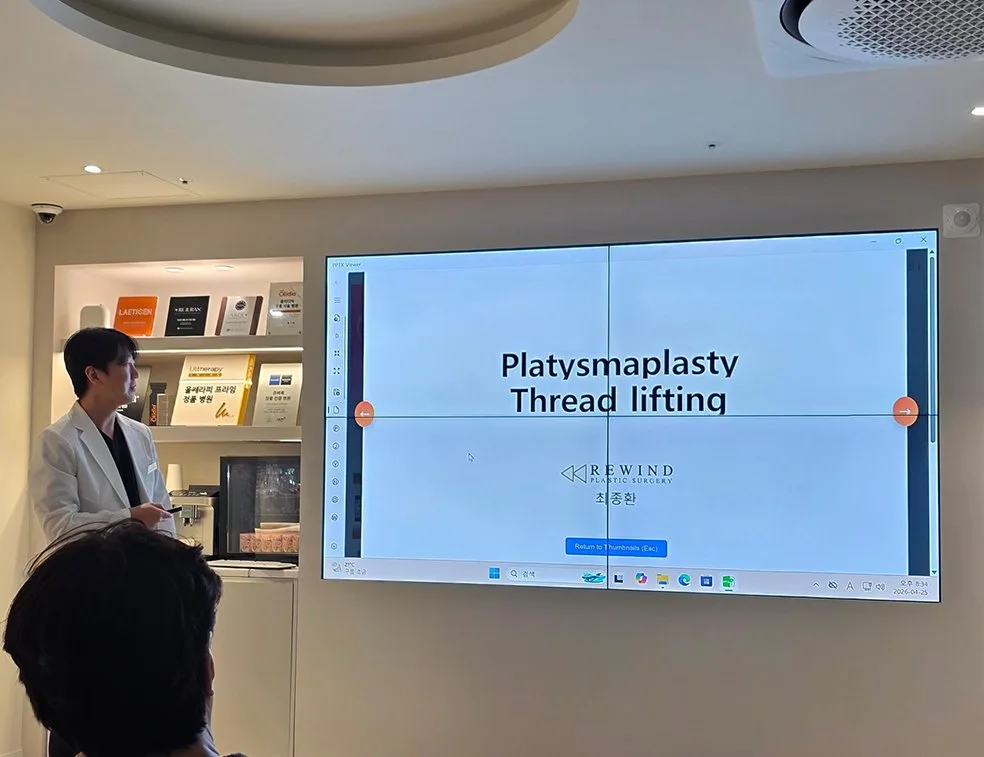
Dr. Jonghwan Choi presenting at an academic session
Fig. 06 — Academic presentation, thread-lifting session

Rewind's Doctor

Dr. Jonghwan Choi Medical Director

One surgeon, from the first
consultation to the last follow-up.

A board-certified plastic surgeon devoted to anti-aging lifting — with the precision and restraint built through years of craniofacial practice.

Board-certified plastic surgeon (Plastic Surgery)
10 peer-reviewed publications
Medical Director, Rewind Plastic Surgery
Korean Society of Plastic & Reconstructive Surgeons
Former chief director, Apgujeong Y&T Plastic Surgery
Korean Society for Aesthetic Plastic Surgery
J Craniofac Surg · JKMS · Arch Craniofac Surg
Korean Cleft Palate-Craniofacial Association
Voices

Google Reviews

What our patients say.

G 5.0 ★★★★★ 12 Google reviews · Rewind Plastic Surgery, Apgujeong — live-synced from Google Business Profile

"Sample review card — at launch this section pulls the clinic's real Google reviews automatically, shown verbatim with the reviewer's initial and posting date."

AReviewer namePOSTED ON GOOGLE

"Sample review card — reviews are never written or edited by the clinic; only what patients posted on Google appears here."

BReviewer namePOSTED ON GOOGLE

"Sample review card — a 'See all reviews on Google' link takes visitors to the clinic's Business Profile."

CReviewer namePOSTED ON GOOGLE
Ask

Questions

Mole removal scars: the questions patients ask most

Does laser mole removal leave a scar?
It leaves a small mark at first, because each treated point is a wound. Most fade gradually until they are hard to see. A lasting dent, dark or pale spot, or raised scar depends on the depth of the mole, its location, your healing tendency and how the point is protected while it heals.
How can I reduce the mark after mole removal?
Leave the crust to lift on its own, follow the dressing instruction given at the clinic, keep sauna, sweaty exercise and rubbing away from the site, and wear sunscreen outdoors every day. Sun exposure while the point is pink is the main avoidable cause of a darker mark.
What causes a depressed mark after removal?
A dent forms when tissue is removed deeper than the surrounding skin can fill, which is more likely with deep-rooted moles or when a crust is pulled off early. The doctor weighs depth at each point, sometimes accepting a possible second pass to protect the surface.
Why did my treated spot turn darker?
Healing skin can produce extra pigment, especially when exposed to ultraviolet light. This darkening tends to fade slowly with strict daily sun protection. If it persists, show it at follow-up so the doctor can see how it is changing and discuss what can be done.
Is a scar more likely on the body than on the face?
Generally, yes. Skin on the chest, shoulders and back heals more slowly and is more prone to raised or spread scars than facial skin. That is why body moles are assessed individually, and why removing a mole nobody sees is weighed carefully.
I get keloid scars. Can I still have moles removed?
Tell the doctor at the consultation. A history of keloid or thick raised scars raises the risk wherever skin is wounded, and it may mean some moles are better left untreated, particularly below the jaw. The decision is made lesion by lesion after examination.
Can a mark left after mole removal be improved later?
Often something can be done, depending on the type of mark. Early laser treatment of healing surgical scars has been studied in split-scar trials, though not on mole removal points. A persistent mark is reviewed in person and the options are discussed then.
Is it worth removing a small mole if I worry about scarring?
Sometimes it is not. If a mole is small, flat and unchanged, and sits where a treated point would be more visible than the mole itself, leaving it may be the wiser choice. The doctor gives you that view plainly at the examination.
Booking

Reservation

REWIND,booking

Tell us about the moles you are considering and any history of raised scars, and we reply within one business day in your language.

Scientific evidence

Research on laser treatment of benign lesions and of healing scars

The first two papers are split-scar trials in which early fractional laser treatment was tested on healing surgical and skin-cancer excision scars; they inform how scar care is thought about and did not study mole removal points. The third reviews carbon dioxide laser treatment of benign skin growths. None involved patients of Rewind Plastic Surgery, and none can predict how a particular point on your skin will settle.