Surgery · Midface Lift Technique

Transconjunctival Midface Lift

The route runs through the inner lining of the lower lid

Apgujeong, Gangnam, Seoul | Board-certified plastic surgeon, Dr. Jonghwan Choi
Incision on the conjunctiva · Endotine fixation

Transconjunctival Transconjunctival Transconjunctival Transconjunctival 
Route

Transconjunctival approach

Can a midface lift be done without an incision on the facial skin?

The direct answer

Yes, when the transconjunctival route is used. At Rewind Plastic Surgery in Apgujeong, Seoul, the apple-cheek midface lift can be reached through the conjunctiva, the moist lining on the inside of the lower eyelid. The incision is made there, so nothing is cut on the skin of the face. That is a statement about where the incision sits. The conjunctiva still heals as a wound, the tissue behind it is moved and fixed, and swelling and bruising follow as they do after any operation. Rewind's own wording is that cutting on the inside of the conjunctiva keeps the scar to a minimum and stops the side of the cheekbone from looking wider.

Source: Rewind's Korean surgical page for the apple-cheek midface lift, which states that the lower eyelid is approached through the conjunctiva or through the skin, and that a skin-route line may show under the lashes to a degree set by how elastic the skin is.

The words people type into a search bar, "no scar", compress three separate questions: where the incision goes, whether that incision can be seen once it has healed, and whether every lower lid can take that route. This page works through the three in order, for the midface lift only, and sets the inside-the-lid route against the temple approach that appears in published surgical work.

The broader operation, with its zones and full recovery notes, is covered on Rewind's main midface lift page. Here the subject is narrower: the route, and what it does and does not change about the healed face.
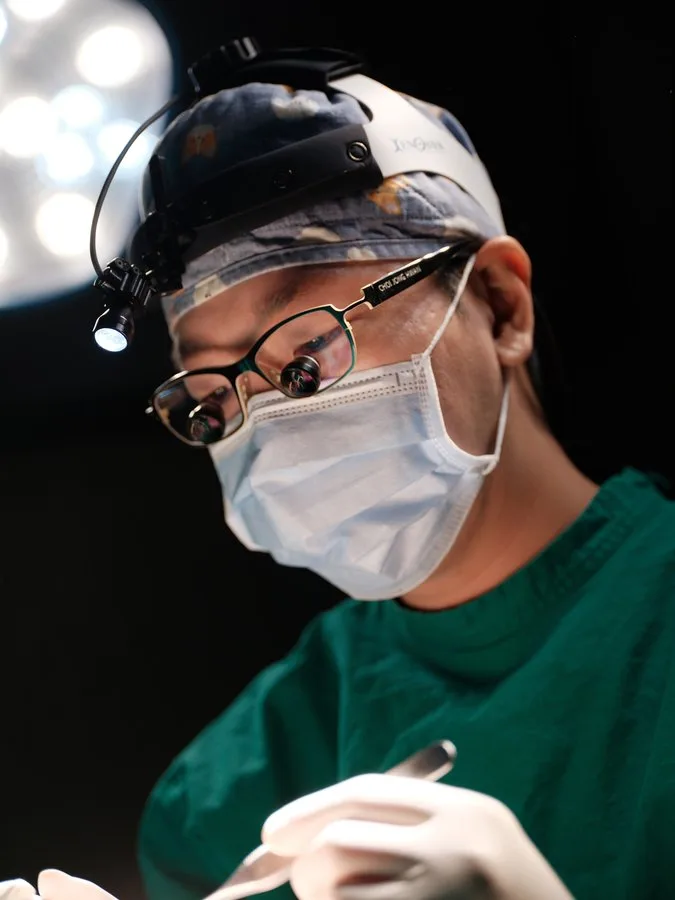
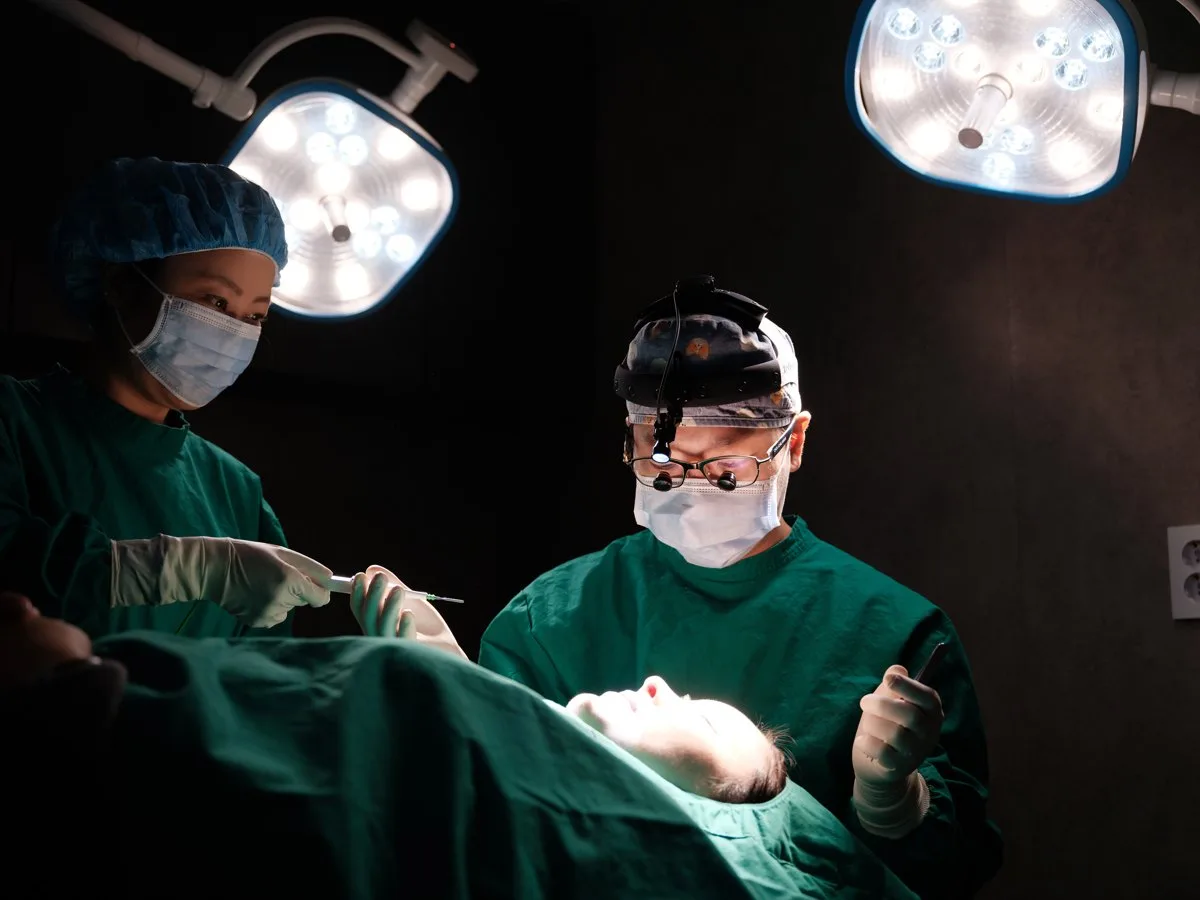
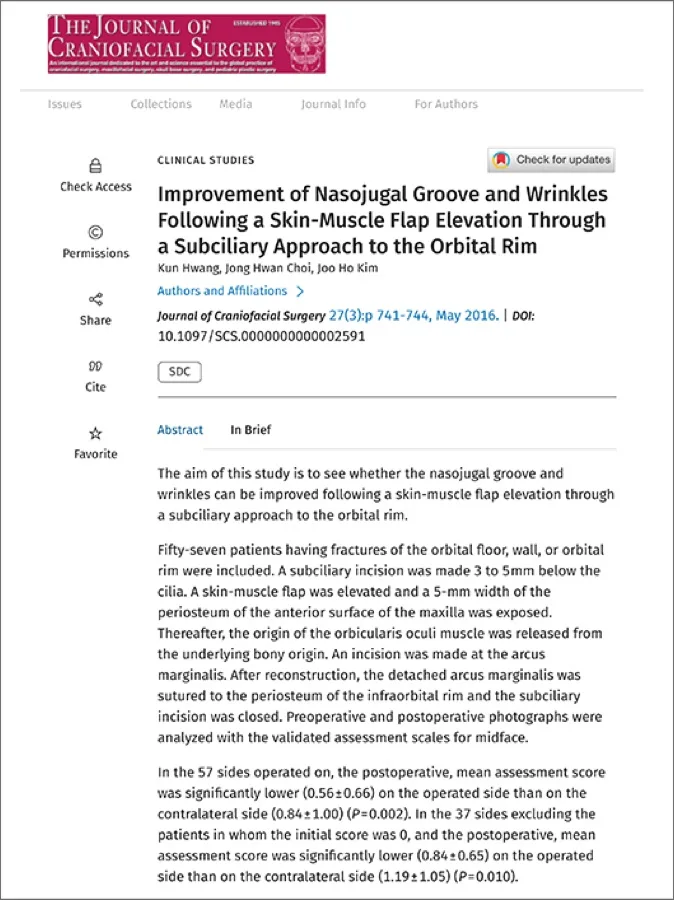
Dr. Jonghwan Choi operating under a headlight with loupes at Rewind Plastic Surgery
Fig. 01 · Theatre work at Rewind, headlight and loupes in place
Cases

Patient photographs

Transconjunctival midface photographs: what has been released so far

Rewind has not yet released a photograph of a transconjunctival midface lift performed on its own, so this page shows none. The single midface case the clinic has released combined a thread-anchored elevation with under-eye fat repositioning. It says nothing about where an incision was placed, which is the whole question here, so it is left off this page.

When you are shown any case to judge a route, ask three things: which route was used, whether the lower lash line is visible in close-up where a skin-route line would sit, and what else was done in the same session. A straight-ahead photograph taken at a distance cannot answer the first two.

Individual results may vary. Operations on the lower lid and midface can be followed by bruising, swelling, uneven healing between the two sides, numbness or altered sensation, a shift in lower-lid position, and scarring. Decide only after an in-person consultation with the surgeon.

Access

Three routes

Where each midface lift incision sits

The midface can be reached from more than one direction. Two routes appear on Rewind's surgical page, both starting below the eye, and only one of them leaves the skin of the face untouched. A third, through the temple, is described in published surgical work and is included here because patients often ask about it.

route 01
Conjunctival, inside the lid
The incision is placed on the inner lining of the lower eyelid. The facial skin is not cut, and the clinic describes this as the route that keeps the scar to a minimum.
route 02
Lid skin, below the lashes
Used when the finding calls for it. Rewind states that a line can stay visible below the lashes, and that how visible depends on the elasticity of the individual's skin.
route 03
Temple, in the literature
Published techniques reach the cheek from an incision in the hair-bearing temple. Rewind does not list a temple-route midface lift on its fee sheet or its surgical page.
shared
Fixation on bone
Whichever opening is used, the lifted midface is held by an Endotine device seated on bone at five points, and the device is absorbed over about nine months.
Inside

Inside the lid

How a transconjunctival midface lift is carried out

Rewind publishes the operation as a design, a small incision below the eye, a lift of the midface with its fascial layer, and fixation of the descended fat to the periosteum. On the conjunctival route each of those steps is done from behind the lower lid.

01Design

The vector is marked ahead of the incision

Surgery begins with a one-to-one design drawn on the face. It records how far the midface block has to travel and toward which point, which is what allows the opening to stay small.

02Open

A small incision on the inner lining of the lid

The small incision below the eye is placed on the conjunctiva. From there the midface is reached from beneath, and the outer skin of the lid and cheek is left uncut.

03Lift

The fascial layer travels with the midface

The tissue between the lower lid and the nasolabial fold is drawn upward as a whole, fascial layer included. Moving the block together is what makes this a lift of descended tissue.

04Fix

Descended fat set on the periosteum, Endotine placed

The fat that has slid down is fixed to the periosteum, the covering of the bone. Endotine then holds the lifted tissue with five prongs on a bone-seated base, and the device's rounded edges are shaped to press on the tissue as little as possible.

05Close

The inner incision is sutured

The opening is closed with care. Because it lies on the inside of the lid, the wound heals on the inner surface; the lid itself still swells and bruises while that happens.

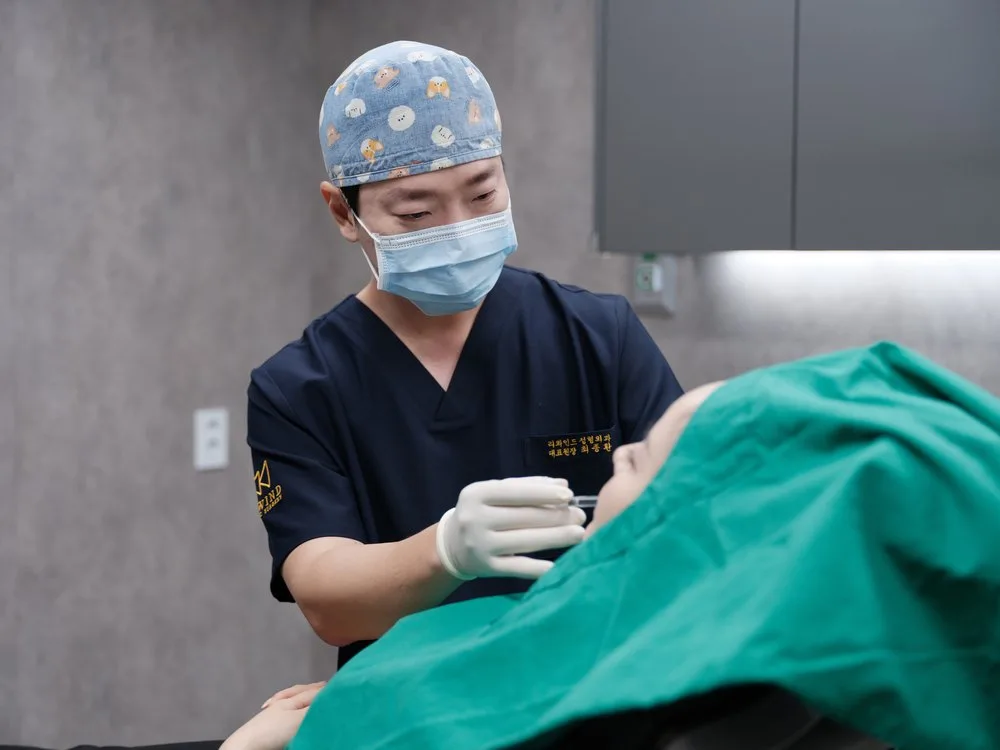
Surgical team at work in the operating room at Rewind Plastic Surgery
Fig. 02 · The operating team in the Apgujeong theatre
Rewind

Why this route

Why Rewind reaches the midface from inside the eyelid

A route is a trade between access and what is left behind. Rewind's page names what the conjunctival route is chosen for, and it also names the case in which the skin route is used.

01Surface

The skin of the face is left uncut

The clinic gives two reasons for incising on the inside of the conjunctiva: the scar is kept to a minimum, and the side of the cheekbone is kept from widening. The second reason matters for faces where a broader outer cheek is exactly what the patient wants to avoid.

02Research

The surgeon has published on the route below the lashes

Dr. Choi is a co-author of a 2016 paper on improvement of the nasojugal groove and wrinkles after skin-muscle flap elevation through a subciliary approach to the orbital rim. A surgeon who has written on the skin route can set out plainly what each route leaves behind.

03Finding

The lid decides, at the examination

Rewind ties the visibility of a skin-route line to skin elasticity. A patient who asks only for the conjunctival route is examined first, and the route is written into the plan once the lid has been assessed.

First page of the 2016 paper co-authored by Dr. Jonghwan Choi on the nasojugal groove
Fig. 03 · Journal of Craniofacial Surgery, 2016: the nasojugal groove and a subciliary approach
Theatre

Theatre and consultation

Who decides whether your midface lift stays inside the lid

Procedure room prepared for lower-lid surgery at Rewind Plastic Surgery

Fig. 04 · The room is prepared before the lid is opened

Dr. Jonghwan Choi discussing the incision route with a patient

Fig. 05 · Route, vector and scope are agreed at the desk

Rewind is on floors four and five of the Richro Building in Apgujeong, Gangnam, and sees patients by appointment only: 10:00 to 19:00 on Mondays, Tuesdays, Wednesdays and Fridays, 10:00 to 16:00 on Saturdays, with no clinic on Thursdays or Sundays. The surgeon who assesses your lower lid is the surgeon who operates on it and reviews it afterwards.

Conjunctival incision, facial skin not cut
Skin route kept for lids that need it
Fascial layer lifted with the midface
Descended fat fixed to the periosteum
Endotine, absorbed over about nine months
Anaesthesia and theatre time set at consultation
Dr. Jonghwan Choi, board-certified plastic surgeon

Board-certified plastic surgeon

Dr. Jonghwan Choi is a Korean-certified specialist in plastic surgery, and every transconjunctival midface lift at the clinic is his own operation. Rewind is a KHIDI-registered institution for international patients, registration M-2025-01-08-09288.

Cost

Pricing

What a transconjunctival midface lift costs at Rewind

The standalone line on Rewind's fee sheet is written for the conjunctival route. When the examination also finds a bulging under-eye pad, a combined line takes its place.

Transconjunctival midface lift, standaloneApple-cheek lifting through the inner lid, with Endotine fixation
₩4,000,000
Midface lift with under-eye fat repositioningThe same lift, with the bulging under-eye fat moved into the tear trough in one operation
₩6,000,000

Listed figures before VAT, each already carrying the anaesthetic fee. Should your lid need the skin route, you are told in writing at consultation whether that alters the figure.

Fit

Suitability

When the inside-the-lid route suits a midface lift, and when it does not

The conjunctival route is usually discussed for

  • A deep tear trough, or dark circles that follow the contour of the under-eye
  • Under-eye fat that bulges forward
  • Sagging that runs from beneath the eye down into the cheek
  • A lower eyelid that rolled outward after a past lower-lid operation, where the midface has to be brought back up behind it
  • Patients who want no cut on the facial skin and accept that swelling and bruising still follow

A different route or plan is discussed when

  • The lid skin itself needs work, so a line below the lashes becomes part of the plan
  • The descent carries on into the jaw and neck, which moves the conversation to a full facelift
  • The cheek looks hollow from lost volume with little tissue that has actually fallen
  • A bleeding or clotting disorder, blood-thinning medication, or smoking that cannot stop during healing
  • Pregnancy, breastfeeding or an active infection around the eye
After

Healing inside the lid

Aftercare for a transconjunctival midface lift

Rewind's midface lift page gives two instructions, and both apply whichever route is used. The clinic does not publish a day count for suture removal, swelling or return to work for this operation, so those dates are set by the surgeon after the lid has been seen.

From the first day
Hands off the lid
The operated area is not pressed, rubbed or tugged while the inner incision heals.
About one month
No firm pulling
For roughly a month the operated area is not pulled firmly in any direction.
A period after surgery
Alcohol, smoking, sauna
All three interfere with recovery and are avoided for a period; the length is given to you at discharge.
Follow-up
The lid is checked
The same surgeon reviews lid position and the incision, and your flight date is confirmed after that review.

Any operation on the lower eyelid and midface carries risk, including bleeding, infection, prolonged swelling, bruising, asymmetry, altered sensation, a change in lower-lid position and scarring. The conjunctival route keeps the incision off the facial skin; it does not remove these risks. The clinic records the lift holding for upward of five years, varying from person to person.

Doctor

Professional

At Rewind, one board-certified plastic surgeon carries every case — from the first consultation to the final follow-up. Because a face is a story, and a story deserves a single author.

Dr. Jonghwan Choi, board-certified plastic surgeonRewind,
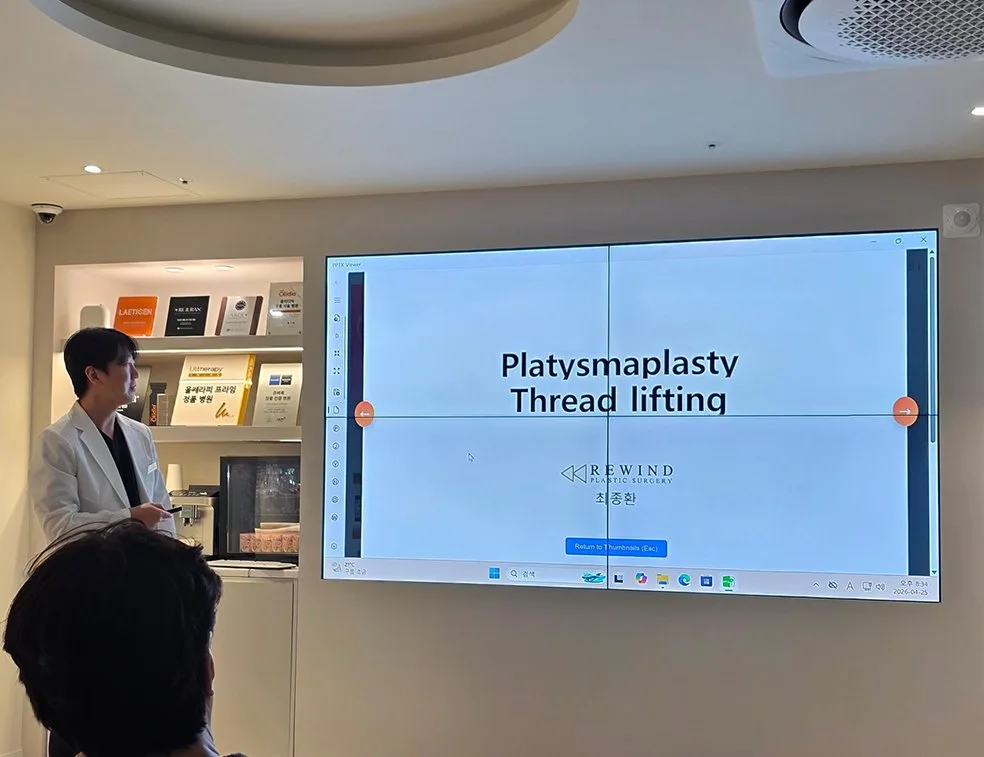
Dr. Jonghwan Choi presenting at an academic session
Fig. 06 — Academic presentation, thread-lifting session

Rewind's Doctor

Dr. Jonghwan Choi Medical Director

One surgeon, from the first
consultation to the last follow-up.

A board-certified plastic surgeon devoted to anti-aging lifting — with the precision and restraint built through years of craniofacial practice.

Board-certified plastic surgeon (Plastic Surgery)
10 peer-reviewed publications
Medical Director, Rewind Plastic Surgery
Korean Society of Plastic & Reconstructive Surgeons
Former chief director, Apgujeong Y&T Plastic Surgery
Korean Society for Aesthetic Plastic Surgery
J Craniofac Surg · JKMS · Arch Craniofac Surg
Korean Cleft Palate-Craniofacial Association
Voices

Google Reviews

What our patients say.

G 5.0 ★★★★★ 12 Google reviews · Rewind Plastic Surgery, Apgujeong — live-synced from Google Business Profile

"Sample review card — at launch this section pulls the clinic's real Google reviews automatically, shown verbatim with the reviewer's initial and posting date."

AReviewer namePOSTED ON GOOGLE

"Sample review card — reviews are never written or edited by the clinic; only what patients posted on Google appears here."

BReviewer namePOSTED ON GOOGLE

"Sample review card — a 'See all reviews on Google' link takes visitors to the clinic's Business Profile."

CReviewer namePOSTED ON GOOGLE
Ask

Questions

Transconjunctival midface lift: eight questions about the route

Can a midface lift be done without any external scar?
When the transconjunctival route is used, the incision sits on the inner lining of the lower lid and nothing is cut on the facial skin. Rewind describes this as keeping the scar to a minimum. The wound still has to heal, swelling and bruising follow, and the examination decides whether your lid suits this route.
How does the inside-the-eyelid approach differ from a temporal midface lift?
A temporal midface lift, as described in published surgical work, reaches the cheek from an incision in the hair-bearing temple. Rewind's two published routes both start below the eye, through the conjunctiva or the lid skin, and the lifted tissue is held by Endotine seated on bone. The clinic does not list a temple-route midface lift.
Why would an incision below the lashes ever be chosen?
Rewind ties the route to the individual lid and names skin elasticity as the factor that decides how visible a skin-route line becomes. Where the examination points to the skin route, the surgeon tells you before any date is set, so the possibility of a line below the lashes is accepted in advance.
What does the conjunctival route have to do with a wider-looking cheekbone?
Rewind states that incising on the inside of the conjunctiva, besides keeping the scar to a minimum, prevents the side of the cheekbone from widening. That aim matters most where the width of the outer cheek is already a concern, and it is discussed at the examination.
What holds the midface up after a transconjunctival lift?
The descended fat is fixed to the periosteum, and an Endotine device, which Rewind describes as approved in Korea by the Ministry of Food and Drug Safety and in the United States by the FDA, holds the lifted tissue at five points on a bone-seated base. It is absorbed by the body over roughly nine months.
How much does a transconjunctival midface lift cost?
The standalone listing is ₩4,000,000; the anaesthetic fee sits inside that figure and VAT is added on top. If under-eye fat repositioning is added in the same operation, the combined listing of ₩6,000,000 applies in its place.
When will the inside of my lid have healed?
Rewind does not publish a day count for this operation. Its instructions ask that the operated area not be pulled firmly for about a month, and that alcohol, smoking and sauna be avoided for a period. Suture, swelling and flight dates are confirmed by the surgeon once the lid has been examined.
Who performs the transconjunctival midface lift at Rewind?
Dr. Jonghwan Choi, a board-certified plastic surgeon and the clinic's medical director, examines, operates and reviews every case. He co-authored a 2016 paper on the nasojugal groove after skin-muscle flap elevation through a subciliary approach, the route below the lashes that this page compares.
Booking

Reservation

REWIND,booking

Tell us what you are considering — we reply within one business day, in your language.

Scientific evidence

Published research on the transconjunctival midface route

The first two papers describe transconjunctival midface lifting as a surgical approach. The third concerns transconjunctival release combined with a midface lift to repair a lower lid turned outward after blepharoplasty, and is cited for the approach, not for cosmetic outcomes. The fourth is an anatomical description of the ligaments that hold the cheek tissue in place. All four report on patients treated by their own authors, and none can forecast how a particular face will heal.