
★★★★★
Came to REWIND to get my facial treatment and i'm absolutely obsessed about it💞 the doctor is so kind and is an expert! Everyone must visit!
 YunHee Hong2 weeks ago
Non-Surgical · Picosecond Laser
A shorter pulse, and what the trials say it changes
Gangnam, Seoul | Board-certified plastic surgeon, Dr. Jonghwan Choi
KHIDI-registered for international patients · Apgujeong Rewind
Picosecond laser
The short answer
A picosecond laser is used for tattoo removal because its pulse is short enough to break ink particles apart mainly through pressure, with less heat reaching the surrounding skin than the older nanosecond, Q-switched devices deliver. In a randomised split-tattoo trial on black and blue tattoos, halves treated with a 755-nm picosecond laser reached higher clearance scores than halves treated with a nanosecond laser after the same five sessions. Rewind in Gangnam, Seoul uses the Pico K, which the clinic lists at 300 picoseconds and 2.9 W.
Trial results describe groups of patients treated on research devices. They are not a forecast for your tattoo, and they say nothing about the Pico K beyond the figures the clinic itself publishes.
Picosecond lasers came to tattoo work as successors to Q-switched systems, which had been the standard tool for years and still clear many tattoos. The difference between them is time. A Q-switched pulse is measured in nanoseconds, billionths of a second. A picosecond pulse is measured in trillionths, and it ends before much of its energy can spread outward as heat, so a larger share goes into fracturing the particle it hits.
Pulse length does not make a laser choose one colour over another. Wavelength decides which ink absorbs the energy, and pulse length decides what happens to the particle once it has. Rewind's Korean device note gives pulse and power figures for the Pico K but does not list its wavelengths, so which colours are in your tattoo, and how the device will be set for them, is worked out at the examination.

Picosecond against nanosecond
The published comparisons point to a handful of specific differences. It helps just as much to know which parts of tattoo removal a change of device leaves untouched.
The trial enrolled 30 people with professional, amateur and cosmetic tattoos in black or blue, treated three months apart and followed for six months. Coloured tattoos were not part of it, and complete clearance was recorded on 10 percent of picosecond-treated sites.
Mechanism
The sequence below follows a single pass of the Pico K, from the pulse itself to the weeks afterwards when the fading actually happens.
Energy is delivered to the ink particle faster than it can diffuse into the tissue that holds it. The particle is stressed mechanically and breaks apart, while less of the energy leaks sideways as heat into the surrounding skin.
Breaking ink into smaller pieces is the reason picosecond devices are expected to clear pigment efficiently. Immune cells take up the fragments and drain them through the lymphatic system over the weeks after the visit.
In a 2022 split study of 19 black tattoos, halves given a fractional 1064-nm picosecond pass on top of a standard pass reached more than 50 percent clearance in 84.6 percent of tattoos after three sessions, against 69.2 percent with the standard pass alone, with fewer blisters and texture changes. Rewind lists a pico fraxel treatment for skin texture; whether a fractional pass has a place in your tattoo plan is decided by the doctor.
Picosecond or not, removal is a course. Photographs are compared at every visit, and the settings and spacing are adjusted to how the ink and the skin responded last time. The number of visits for your tattoo is confirmed at consultation.
Judgement
A faster pulse is an advantage with a known cost attached. The way the Pico K is used on tattoos at Rewind reflects both halves of the published record.
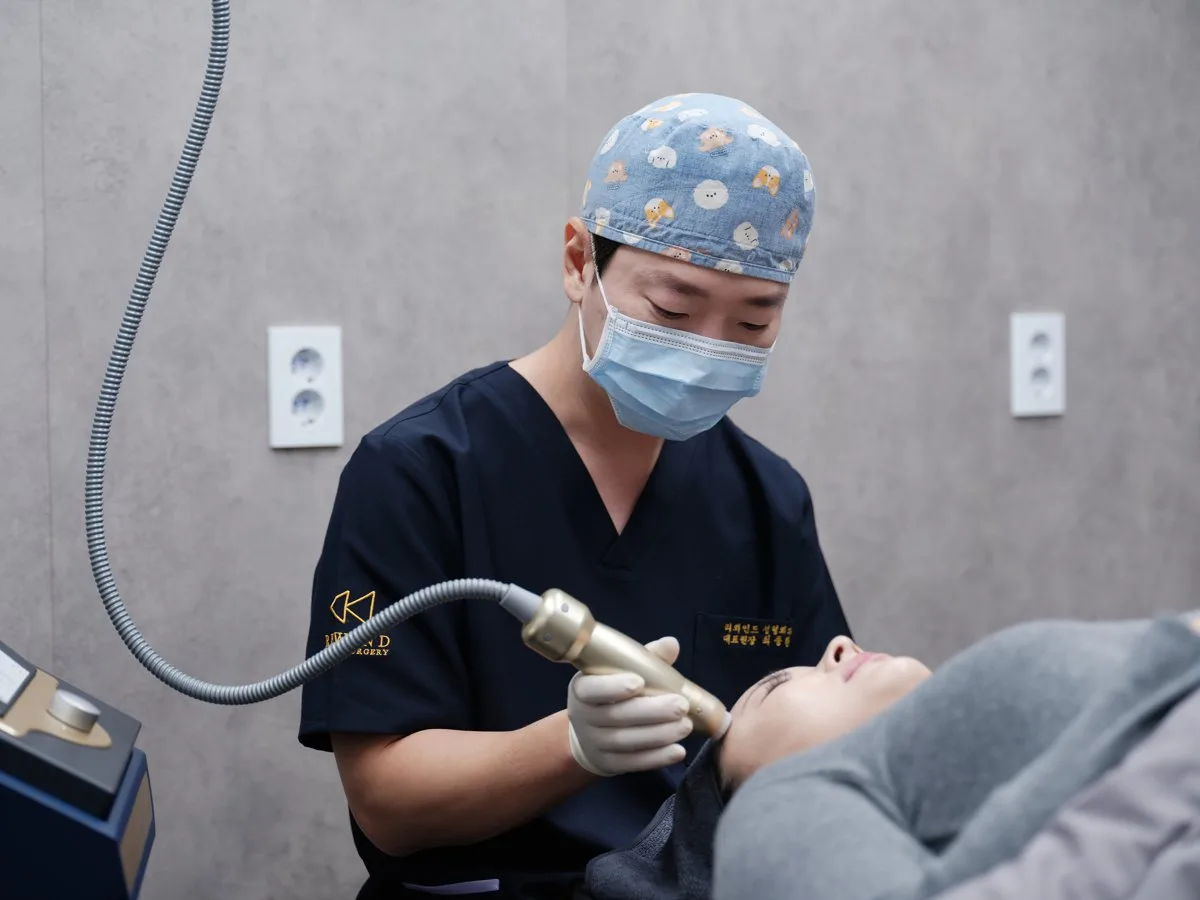
The Pico K is the laser Rewind lists for tattoo removal, and the same unit is used at other settings for pigment, acne scarring and pores. For ink, the doctor chooses energy that fractures particles while leaving the skin around them as intact as possible.
Picosecond halves in the 755-nm trial developed hyperpigmentation more often than nanosecond halves, and the authors suggested that refining pulse parameters may reduce it. At Rewind that finding shapes how carefully darker skin types and sun-exposed sites are approached.
Dr. Jonghwan Choi reviews scar history, skin type and any earlier treatment of the tattoo before choosing settings. Where the skin makes a laser course a poor prospect, you hear that before the first pass.

On the day

Fig. 04 — The device room where tattoo passes are carried out

Fig. 05 — Lounge seating, Richro Building
On the day, the tattoo is photographed and compared with the previous visit, the skin is cleansed, and protective eyewear goes on before the laser is switched on. The Pico K is passed over the ink at the settings chosen for that visit. A white frosting usually appears where the pulses land and fades, followed by redness and some swelling. Visits are booked Monday to Wednesday or Friday between 10:00 and 19:00, or on a Saturday between 10:00 and 16:00.
The clinic's Korean material names no anaesthetic type and gives no appointment length for ink work, so neither is invented here. Both are explained in person at the first visit. The clinic is closed on Thursday and Sunday.
Pricing
Picosecond work on tattoos is priced by the area of ink, and the same Pico K is used whichever band applies. The three size bands come from the clinic's rate matrix; the last line is the pico tattoo removal rate on the main price sheet, and the one that applies is settled when the tattoo is measured.
Rates exclude VAT, which is added at payment, and include anaesthesia cost according to the clinic's price sheet. A tattoo larger than the biggest band is measured and quoted at consultation.
This month at Rewind — offers published by the clinic, updated monthly.
Suitability
Recovery
Pico passes still leave the skin with work to do. The clinic's laser aftercare is brief, and the part that matters most for a picosecond device is sun protection, because darkening was the reaction the trial found more often.
Risks after a picosecond pass include blistering, crusting, swelling and pinpoint bleeding, and in the longer term lightening or darkening of the treated skin and textural or raised scarring. In the 755-nm trial, darkening of the surrounding skin was the one reaction more common with the picosecond laser. Incomplete clearance remains possible on any device.
At Rewind, one board-certified plastic surgeon carries every case — from the first consultation to the final follow-up. Because a face is a story, and a story deserves a single author.
 Rewind,
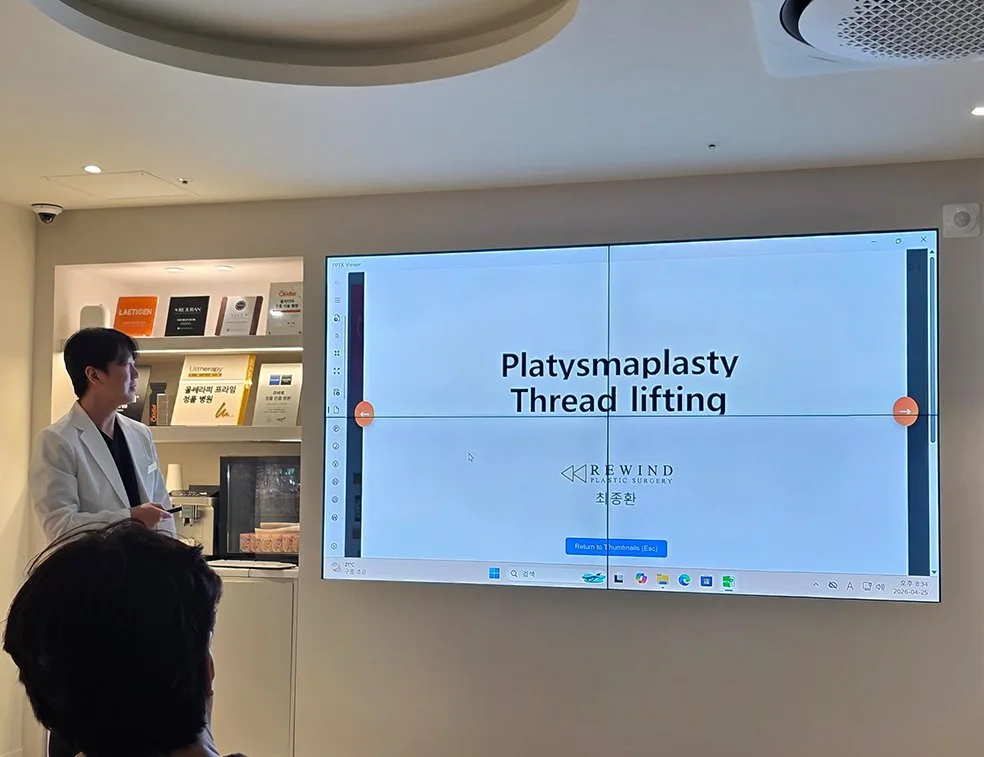
Rewind's Doctor
Dr. Jonghwan Choi Medical Director
One surgeon, from the first
consultation to the last follow-up.
A board-certified plastic surgeon devoted to anti-aging lifting — with the precision and restraint built through years of craniofacial practice.
Questions
Google Reviews
Came to REWIND to get my facial treatment and i'm absolutely obsessed about it💞 the doctor is so kind and is an expert! Everyone must visit!
YunHee Hong2 weeks agoThere are just way too many cosmetic clinics in Korea and I'm so happy I found Rewind Clinic in Gangnam. Dr. Choi was so kind and patient while explaining the different face-lifting options, from threads to mini-lifts to deep-plane lifts…
 J. S.5 months ago
I found Rewind clinic through a Korean chat forum and many local clients highly recommended it. The clinic is brand new, featuring large, clean rooms and many private waiting areas so it doesn't give off that "factory" clinic vibe. All the…
 J. Siou5 months ago
Really nice environment. Doctor is easy to communicate and understands my visions. Waited two weeks to make a review and I confirm the results exceeded my expectations and I am super happy with it. Can't wait to come back!! :))
 Kristie Chu5 months ago
I received a thread lift at Rewind Plastic Surgery. The clinic was clean and the atmosphere was comfortable. The consultation was thorough, and I felt confident because they kindly explained everything tailored to my facial condition. They…
Reservation
Tell us what you are considering — we reply as soon as possible, in your language.
For international patients — interpreter-assisted, from your first message to your follow-up.
Scientific evidence
The comparison figures on this page come from the randomised 755-nm split-tattoo trial and the 2022 fractional picosecond study. The 2024 series shows what a Q-switched laser achieved in routine use, and the 2020 review sets out how wavelength, fluence and pulse are chosen. None of this work was done at Rewind Plastic Surgery, and none of it predicts the result on your own tattoo.